
On this page16
Cargo reaching Antigua and Barbuda, Dominica, Grenada, St Kitts and Nevis, St Lucia or St Vincent and the Grenadines is cleared by each island's own Customs department on ASYCUDA World. Duty is assessed on the CIF value under the CARICOM Common External Tariff, and a service charge plus VAT or sales tax follow on top.
That makes six customs administrations running one shared logic, and our container shipping to the Caribbean service moves cargo to all of them. The guide starts with what the six have in common, then takes each island in turn: authority, system, taxes and the quirks that matter when a container lands.
What the OECS Islands Have in Common
All six islands are CARICOM members and apply the CARICOM Common External Tariff, a schedule with duty-free lines and lines as high as 40%, built on the Harmonized System. Each government keeps its own national suspensions, exemptions and surcharges, so one HS code can produce a different total bill in Castries than in St. John's.
The sequence is the same everywhere: a licensed broker or registered declarant lodges a Single Administrative Document (SAD) in ASYCUDA World, the system assesses duty and taxes, the importer pays, and Customs releases the cargo. Dutiable value is CIF in all six. Currency is the Eastern Caribbean dollar (EC$), which the Eastern Caribbean Central Bank pegs at EC$2.70 to US$1.00, a rate in effect since July 1976.
Our Caribbean import duties and taxes hub compares these islands with the other CARICOM markets.
Eastern Caribbean (OECS) Customs at a Glance
| Territory | Customs authority | Electronic system | Consumption tax on imports | Other levies confirmed |
|---|---|---|---|---|
| Antigua and Barbuda | Customs and Excise Division | ASYCUDA World | ABST (Antigua and Barbuda Sales Tax), rate set by the Inland Revenue Department | Revenue Recovery Charge, Environmental Protection Levy, customs surcharge (statutes confirmed, rates to be checked per HS line) |
| Dominica | Customs and Excise Division | ASYCUDA World | VAT 15% | Customs service charge 4% of CIF, environmental levy, excise tax |
| Grenada | Customs and Excise Division | ASYCUDA World (since 2012) | VAT, collected by Customs at import | Customs service charge under Cap. 75D |
| St Kitts and Nevis | Customs and Excise Department | ASYCUDA World | VAT 17% (standard rate restored July 1, 2025) | Other duty and charges published on the Department's site |
| St Lucia | Customs and Excise Department | ASYCUDA World | VAT 12.5% | Service charge 6% (the essentials waiver ended May 31, 2026), Health and Citizen Security Levy 2.5% |
| St Vincent and the Grenadines | Customs and Excise Department | ASYCUDA World 4.4.0 | VAT and service charge shown in the Department's duty calculator | Confirm in the calculator |
Duty valuation basis is CIF on all six. The importer is the taxpayer; the broker files.
How Does Customs Clearance Work in the OECS?
Each island runs the same eight steps; the island sections below give the local differences.
- Register the importer and the user. The importer registers with Customs and each declarant or broker requests an ASYCUDA World login.
- Classify the goods. The broker assigns the HS code, which sets the duty rate and flags permits.
- Receive the manifest. The carrier or consolidator files the manifest electronically before arrival, so the cargo exists in the system.
- Lodge the SAD. The declarant enters value, origin, HS code and attaches the invoice, packing list and transport document.
- Selectivity. ASYCUDA routes the declaration to a lane: release after payment, document check or physical examination.
- Pay. Duty, service charge and VAT are paid at the Customs cashier, at a bank, or online where the island has enabled ePayment.
- Exit the port. Customs releases the declaration and the port authority issues the gate pass once port charges are cleared.
- Deliver. The truck leaves with the release and the importer keeps the assessment for tax records.
Documents Required for OECS Customs
Every island wants the same core file, and one missing item stops the declaration:
- Commercial invoice with seller, buyer, Incoterm, currency and unit values.
- Packing list that matches the invoice line by line.
- Ocean bill of lading or air waybill.
- Single Administrative Document (SAD) lodged in ASYCUDA World.
- Certificate of origin when claiming CARICOM preference.
- Agent or broker authorization, where a third party signs for the importer.
- Permits for regulated goods (see the permits section).
Antigua and Barbuda Customs and Import Duties
In Antigua and Barbuda the Customs and Excise Division clears cargo on ASYCUDA World, with separate environments for regular declarations (ASYCUDA Live) and declarations over 100 lines (ASYCUDA Live+, which needs 64-bit Java and 8 GB of memory), according to the Antigua and Barbuda Customs website. The same site hosts the online payment portal, the broker documentation, the ASYCUDA registration form and the Duty Waiver Form.
The legal base is the Customs (Control and Management) Act 2013, the Customs Duties Act 1993 and their amendments, plus the Customs Surcharge Act, the Revenue Recovery Charge Act 2010 and the Environmental Protection Levy Act 2002. The last three are why an Antiguan assessment carries more lines than duty and sales tax.
Customs collects the Antigua and Barbuda Sales Tax (ABST) on taxable imports, payable to the Comptroller of Customs. The Inland Revenue Department publishes no current rate that we could cite, so take the ABST figure from the broker's assessment before you price a landed cost. For port, island and transit context, see our Antigua and Barbuda shipping guide.
Dominica Customs and Import Duties
Dominica is also on ASYCUDA World. Duty follows the CARICOM tariff on CIF value, and the Invest Dominica Authority lists five import charges: import duty, customs service charge, environmental surcharge, excise tax and VAT.
The customs service charge is 4% of CIF value and VAT is 15%, per Invest Dominica. The Inland Revenue Division confirms the 15% VAT is paid by the importer. Vehicles show the full stack: duty of 40% of CIF, excise of 25% or 28% depending on age, and a sliding environmental levy.
Timing is where Dominica bites. An import declaration is due 7 days after landing for air freight and 14 days for sea freight, and goods sit at the port for 7 days without rental charges. A Comptroller's directive, as reported to the WTO, requires anyone who does business with the Customs and Excise Division to be a qualified customs broker or tariff clerk. Island and port details are in our Dominica shipping guide.
Grenada Customs and Import Duties
Grenada went live on ASYCUDA World on April 16, 2012, with the declaration, accounting and selectivity modules, and the government's business portal states that all imported goods must be declared there. A representative can sign the SAD for the importer using the Division's agent and broker authorization form, and an occasional importer registers for ASYCUDA before the first entry.
The service charge comes from the Customs (Service Charge) Act, Chapter 75D, so get the current rate for your HS line from the broker before you quote a landed cost. Import VAT is payable to the Comptroller of Customs at the time of import, according to the Inland Revenue Division, which means Customs collects it together with duty. Port and island details are in our Grenada shipping guide.
St Kitts and Nevis Customs and Import Duties
St Kitts and Nevis clears cargo on ASYCUDA World too, and new users fill in the registration form the Customs and Excise Department publishes. The governing statute is the Customs Act 2014. The Department posts its National Tariff and, for each product, a page of other duty and charges.
The Inland Revenue Department returned the standard VAT rate to 17% on July 1, 2025, after a temporary 13% rate expired. Cargo for the Federation lands at Basseterre on St Kitts or Charlestown on Nevis, and each port adds its own authority tariff to the Customs charges. Our St Kitts and Nevis shipping guide covers the routing.
St Lucia Customs and Import Duties
In St Lucia, entries are processed on ASYCUDA World, and registered importers file an Importer/Exporter Registration Form with two business emails for assessment notices and e-receipts. Payment can be made online by Visa or Mastercard through the ASYCUDA World portal, according to the Customs and Excise Department.
St Lucia stacks three charges: a 6% service charge, standard VAT at 12.5%, and a 2.5% Health and Citizen Security Levy on imported goods that are not zero-rated or exempt. A temporary waiver of the 6% service charge on price-controlled essentials such as packaged rice, flour, milk, cooking oil, potatoes, baby food and canned items ran from June 1, 2025 to May 31, 2026 under Statutory Instrument 82 of 2025. It has lapsed, so budget the full 6% on those lines unless your broker shows a new order.
The tariff moved to HS 2022 on November 1, 2025, under Customs Notice No. 16 of 2025. For Castries and Vieux Fort, see our St Lucia shipping guide.
St Vincent and the Grenadines Customs and Import Duties
The Customs and Excise Department of St Vincent and the Grenadines runs ASYCUDA World 4.4.0, and commercial entries and entries for home use are processed on a paperless basis. The department publishes a Customs Brokers Directory, a Registration of Importers page, a prepayment account facility and two duty calculators, one for general goods and one for vehicles.
Enter an HS code and the calculators return duty, service charge and VAT in EC$ and US$, the quickest way to cost a line before the order is placed. The department also publishes tariff notices on sensitive lines; a notice on pasta, for example, applies the CET rate to CARICOM-origin imports and a higher rate to third-country imports under heading 19.02. Rates and permits change by notice, so check the current list before shipping.
How to Calculate Import Duty and Taxes in the OECS
The cascade runs in one order: CIF value, then duty, then the island's service charge, then VAT or ABST on the combined base. Whether the tax base includes the service charge differs by island, and the broker's assessment is the final word.
Illustrative example, Dominica rates: a container of hardware with a CIF value of EC$10,000 and a 20% duty rate.
- CIF value: EC$10,000
- Duty at 20%: EC$2,000
- Customs service charge at 4% of CIF: EC$400
- VAT base (CIF + duty + service charge, assumed for this example): EC$12,400
- VAT at 15%: EC$1,860
- Total taxes and duty: EC$4,260
The same cargo into St Lucia would add the 2.5% levy and swap the rates for 6% and 12.5%. The structure holds; only the inputs change.
Exemptions and Concessions in the OECS
Concessions exist on every island and nearly all are filed before the cargo lands. Dominica exempts manufacturers from duty and VAT on production machinery and packaging materials, and renewable energy items are duty-free, with applications routed through the Invest Dominica Authority and the Ministry of Finance. Antigua and Barbuda uses a Duty Waiver Form lodged with Customs. St Lucia's essentials relief, which lapsed on May 31, 2026, is a reminder that time-limited measures come and go by statutory instrument.
Import Permits and Licensing in the OECS
Customs releases only what the technical agencies have cleared. Plant and animal products need the Ministry of Agriculture's import permit on every island, and the plant quarantine unit inspects at the port. Restricted goods fall under each island's External Trade or Import Prohibition orders, and Antigua and Barbuda publishes a list of goods requiring an import license. Medicines, food and chemicals route through the health ministry's authority. Ask for the permit before the booking, because Customs will not release a declaration with the permit missing.
Common Customs Delays in the OECS and How to Avoid Them
- Wrong HS code. A line classified under the wrong heading changes duty and can trigger a post-clearance audit.
- Declaration deadlines. Dominica's 7-day air and 14-day sea limits start at landing, and late declarations accrue storage.
- Value mismatch. An invoice below market value invites a valuation query; keep supplier invoices and payment proof.
- Missing permits. Agricultural and health permits are checked before release.
- Unregistered declarant. A login that is not yet approved holds the entry until the broker is activated.
- Generic quotes. A quote built on one island's rates and applied to another understates the bill.
Clearing Cargo to the Eastern Caribbean With Interworld Freight
Interworld Freight has operated from Miami since 1992. Our Miami hub handles warehousing, ocean FCL and LCL, air freight, and customs coordination with licensed brokers at destination, so your documents are checked against the island's requirements before the cargo sails. Request a quote and you hear back within one business day.
Frequently Asked Questions
What system do OECS islands use for customs clearance?
All six islands in this guide clear cargo on ASYCUDA World, the UN-developed customs system. A licensed broker or registered declarant lodges the SAD, and the system assesses duty and taxes.
Is duty calculated on FOB or CIF in the Eastern Caribbean?
CIF. Duty is assessed on cost, insurance and freight, so the freight bill raises the taxable value.
What is the VAT rate in each OECS island?
Dominica charges 15%, St Kitts and Nevis 17% and St Lucia 12.5%. Antigua and Barbuda collects ABST, and Grenada and St Vincent and the Grenadines publish their rates through the tax authority and the duty calculator, so confirm the rate for your HS code.
Do I need a customs broker in the OECS?
Plan on one. Dominica requires anyone dealing with its Customs and Excise Division to be a qualified customs broker or tariff clerk, and Invest Dominica advises using a broker for same-day clearing. On the other islands the broker files the SAD in ASYCUDA World.
What is the customs service charge?
It is a charge on CIF value on top of duty. Dominica sets it at 4% and St Lucia at 6%. It is separate from VAT.
Can one shipment serve two islands?
No. Each island has its own entry, duty bill and permits, so a split shipment needs two declarations.
How long does OECS customs clearance take?
Clearance depends on the selectivity lane and on documents being complete. A declaration routed to the green lane releases after payment; a document check or examination adds time.
Where can I check the current CARICOM rate for my product?
Use the HS code in the CARICOM Common External Tariff, then apply the island's national measures. The broker confirms the final rate in the ASYCUDA assessment.
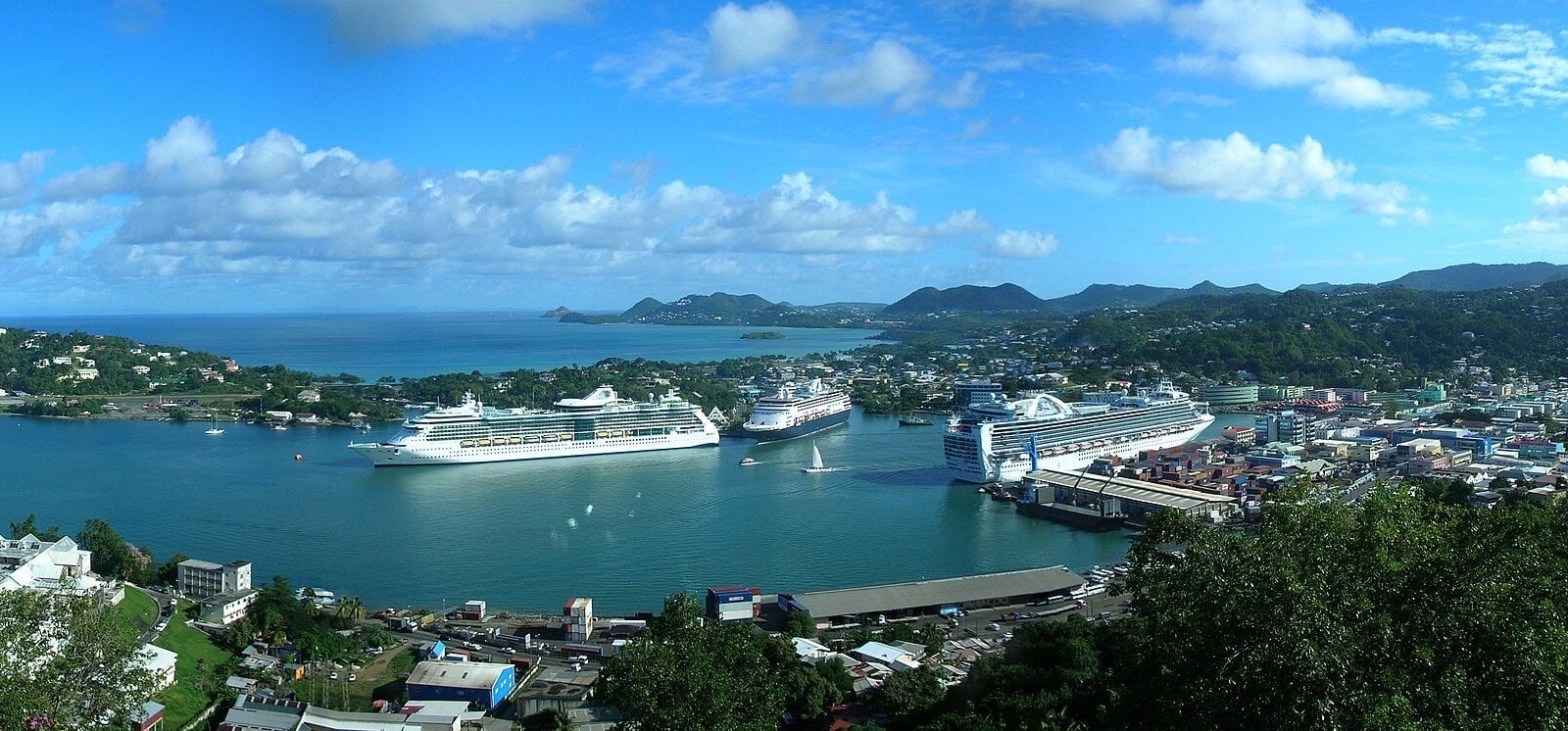
Photo: Port Castries, Saint Lucia. UpstateNYer, CC BY-SA 3.0, via Wikimedia Commons.
Ready to ship your freight?
