
On this page13
You ship to St Lucia by ocean LCL or FCL into Port Castries or Port Vieux Fort, or by air into Hewanorra (UVF): LCL from Miami takes about 5 days, and cargo clears Customs and Excise on ASYCUDA World with CARICOM CET duty, a 6% service charge and 12.5% VAT. St Lucia is one of the few small Caribbean islands with two working commercial seaports, and the choice between them matters. Port Castries in the north sits next to the capital, the main warehouses and the Rodney Bay and Gros Islet resort corridor. Port Vieux Fort in the south sits beside Hewanorra International Airport and the Vieux Fort industrial area, and handles transshipment and banana exports. Both are run by the Saint Lucia Air and Sea Ports Authority (SLASPA), which also manages the island's two airports. A resort in Soufrière or Laborie sits closer to Vieux Fort; a supermarket chain in Castries will not want its containers trucked the length of the island. On top of duty, the service charge and VAT (one of the lower standard rates in the OECS), St Lucia adds a 2.5% Health and Citizen Security Levy.
St Lucia Shipping at a Glance: Transit Times and Options
LCL from Miami reaches Port Castries in about 5 days, air freight to Hewanorra takes 1 to 3 days, and Asian cargo needs 35 to 50 days through a transshipment hub.
| Route & mode | Indicative cost | Transit | Best for |
|---|---|---|---|
| Miami to Castries, ocean LCL | About $900 for 5 CBM / 1,500 kg (IWF published LCL rate, September 2026; excludes destination duties, taxes and local charges) | About 5 days (CFS Miami to port) | Retail, hotel and contractor supplies under 15 CBM |
| Miami to Castries or Vieux Fort, ocean FCL 20ft / 40ft | On request | 5 to 10 days, depending on direct or relay sailing | Food, beverages, building materials, FF&E |
| Miami to Hewanorra (UVF), air freight | On request | 1 to 3 days, depending on flight connections | Spare parts, pharmaceuticals, urgent hotel supplies |
| China / Asia to St Lucia, ocean (via transshipment) | On request | 35 to 50 days, depending on the feeder connection | Furniture, fixtures, tiles, consumer goods |
| Europe (UK / Netherlands) to St Lucia, ocean | On request | 12 to 18 days on the direct UK and Netherlands service | UK and EU goods, vehicles, machinery |
Rates move with fuel, season and space. Use the table to plan and request a firm quote.
How to Ship to St Lucia: Step by Step
Shipping to St Lucia takes eight steps, from HS 2022 classification to collection from SLASPA.
- Classify and check permits. Classify the goods under HS 2022 (in force since November 1, 2025) and check the External Trade (Restricted Imports) Order and Ministry of Agriculture permit rules.
- Register the importer. File the Importer/Exporter Registration Form with Customs, including two official business email addresses for assessment notices and e-receipts.
- Choose the mode, port and Incoterm. LCL from Miami fits loads under 15 CBM, FCL fits full loads, and air to Hewanorra fits urgent cargo; pick Castries or Vieux Fort by where the consignee sits.
- Book from Miami or origin. Deliver to the Miami CFS for the weekly consolidation to Castries, or book FCL space on a direct or relay sailing.
- Prepare documents and US export data. Issue the commercial invoice, packing list and bill of lading, and file the Electronic Export Information in AES when any Schedule B line exceeds $2,500 or the goods need an export license.
- Manifest and degroupage. The carrier files the manifest and the consolidator files the degroupage data that splits the LCL container into house bills.
- Lodge the SAD and pay. A broker lodges the Single Administrative Document in ASYCUDA World, and duty, the 6% service charge, the 2.5% levy and 12.5% VAT are paid, online by Visa or Mastercard through the ASYCUDA World payment portal if preferred.
- Release and collect. After the selectivity lane clears, the cargo is collected from SLASPA once port charges are paid.
For most St Lucian importers, step 4 starts at a Miami warehouse.
Shipping From the USA to St Lucia
The fastest and cheapest regular route from the USA to St Lucia is LCL consolidation from Miami into Port Castries. Suppliers deliver to the Miami CFS, freight is received and documented, and the container sails to Castries directly or via a relay port. On the IWF consolidation service, a 5 CBM / 1,500 kg shipment moves FCA Miami CFS to Port Castries in about 5 days, at about $900 (IWF published LCL rate, September 2026; excludes destination duties, taxes and local charges).
For most St Lucian importers, LCL is the right starting point. Hotel groups, restaurants, hardware stores and distributors buy from several US vendors at once, and consolidating them in Miami produces one house bill and one customs entry in Castries. When the flow is steady and passes 15 CBM per shipment, move to container shipping to St Lucia and decide whether the box should discharge in Castries or Vieux Fort based on where the consignee sits.
Air cargo goes into Hewanorra International Airport (UVF) near Vieux Fort, the island's long-runway international gateway; George F. L. Charles Airport (SLU) in Castries handles regional flights. Use air freight to the Caribbean for spare parts, medical supplies and goods tied to a hotel opening date. If the final destination is in the north, include the road transfer from Vieux Fort in the timeline. Between June and November, the Atlantic hurricane season can shift sailings by a few days, so keep a buffer on time-critical project cargo. Asian and European cargo adds longer legs to that calendar.
Shipping From China, Asia and Europe to St Lucia
Asian cargo reaches St Lucia only through a transshipment hub, while Europe has a direct fortnightly liner service.
Shipping From China and Asia to St Lucia
Cargo from Asia reaches St Lucia by transshipment, not by a direct service. Containers from Chinese ports transship at a regional hub (Kingston, Cartagena, the Panama Canal ports, Caucedo) and continue by feeder vessel to Castries or Vieux Fort. Port to port transit runs 35 to 50 days, depending on the feeder connection. Our guide to Caribbean transshipment hubs explains how hub choice affects reliability, and the dedicated post on shipping from China to Saint Lucia covers the Asia lane in detail.
Resort FF&E is a common Asian flow into St Lucia: case goods, lighting, tiles and bathroom fittings bought from Chinese and Southeast Asian factories. Full container loads move direct via a hub. Smaller or mixed orders work better routed to Miami first, where they can be held, checked and combined with US-sourced mattresses, electronics and kitchen equipment into one consolidated shipment.
Shipping From Europe to St Lucia
St Lucia has a direct European service via Geest Line, which sails fortnightly from Vlissingen (Netherlands) and Portsmouth (UK) to the Eastern Caribbean, with St Lucia among its ports of call. The carrier quotes about 9 days from Portsmouth to Barbados plus about 3 days to the other islands, so plan on 12 to 18 days port to port. The same vessels serve the neighbouring islands, which makes shipping to Barbados and shipping to St Vincent and the Grenadines useful comparisons for buyers supplying more than one island. St Lucia's historic UK trade links make this lane relevant for food brands, vehicles and machinery, and the service carries reefer and breakbulk as well as dry containers. European cargo also moves on the large carriers' networks via a Caribbean hub. Every origin then discharges at one of two SLASPA ports.
Which Ports and Airports Handle Cargo in St Lucia?
St Lucia has two cargo seaports (Castries and Vieux Fort) and two airports (Hewanorra and George F. L. Charles), all run by SLASPA. According to SLASPA, Port Castries handles local market cargo, while banana exports and transshipment were moved to Port Vieux Fort to cut congestion in the capital.
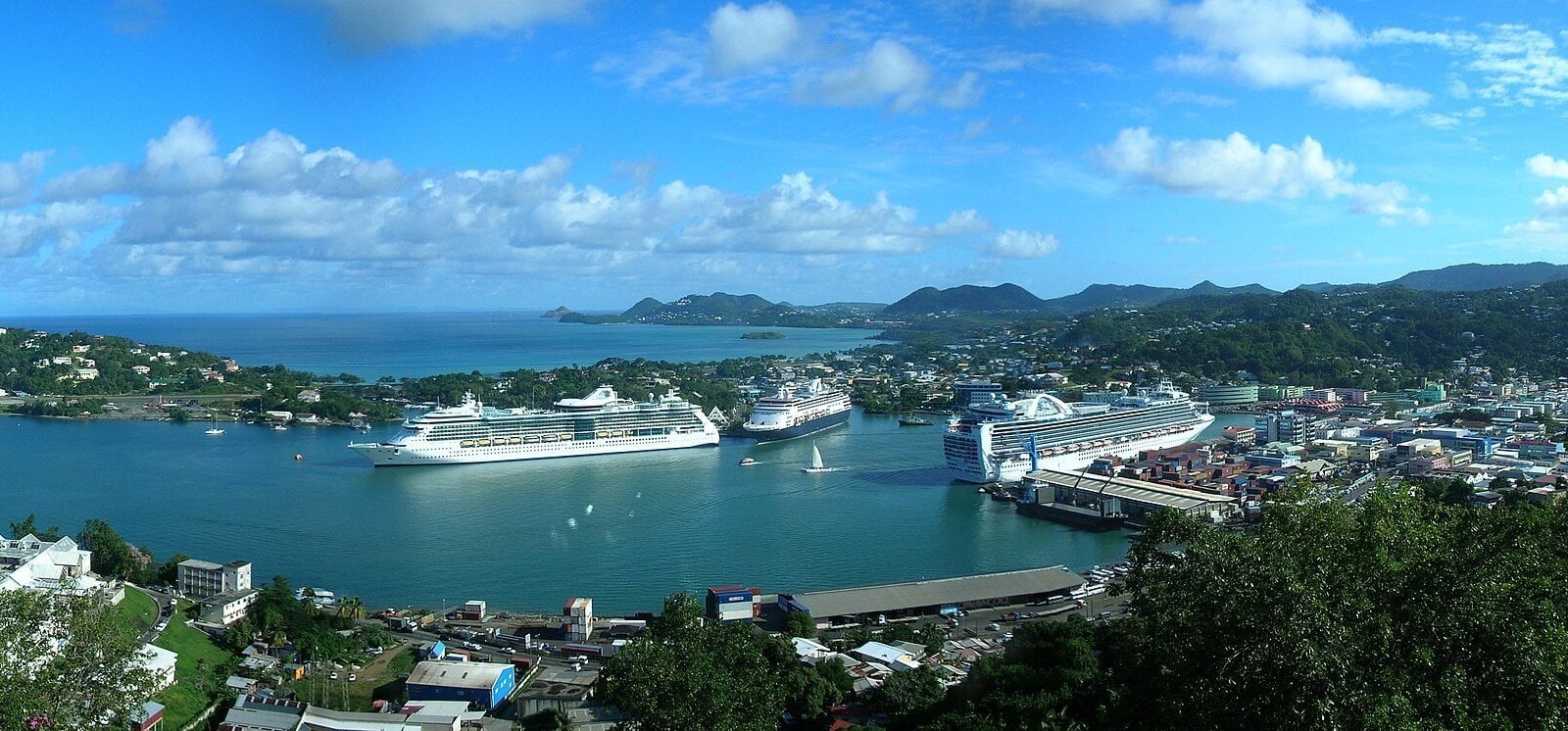
- Port Castries, Castries: the main port for consumer imports (food, clothing, household goods, vehicles) and a major cruise port. Operations have shifted from breakbulk to containers, with a shore crane, top handlers and a redesigned container park. UN/LOCODE LCCAS.
- Port Vieux Fort, Vieux Fort: in the south, minutes from Hewanorra and the Vieux Fort industrial area; handles transshipment, banana exports and cargo bound for the south of the island. UN/LOCODE LCVIF.
- Hewanorra International Airport (UVF), Vieux Fort: the international air cargo gateway.
- George F. L. Charles Airport (SLU), Castries: regional flights and smaller air cargo.
- Smaller points of entry: Soufrière, Marigot and Rodney Bay Marina, mainly for yachts and small craft.
Whichever port the cargo uses, release follows the same ASYCUDA World entry.
How Does Customs Clearance Work in St Lucia?
Imports into St Lucia clear through the Saint Lucia Customs and Excise Department, under the Ministry of Finance, on ASYCUDA World. Under the Customs and Excise Department's importation procedures, all imported goods (with limited exemptions) must be declared by the importer or an authorized agent, and only trained, authorized users can access the broker module that lodges declarations. Commercial cargo is declared on the Single Administrative Document (SAD); the Simplified Declaration is reserved for non-commercial shipments, which since November 17, 2025 must carry a consignee code based on the National Insurance number, passport or driver's license.
- Manifest and degroupage: the carrier files the manifest; the consolidator files the degroupage data that splits an LCL container into house bills.
- Declaration: the SAD is lodged in ASYCUDA World by a customs broker or authorized agent, with goods classified under HS 2022.
- Assessment and payment: duties and taxes are calculated on the customs value (cost, insurance and freight to St Lucia). Since July 14, 2025, SAD charges can be paid online through the ASYCUDA World payment portal by Visa or Mastercard, up to XCD 270,000 per transaction.
- Selectivity: the system routes each entry to a lane. Red means documentary check plus physical examination, yellow means documentary check, green means immediate exit note, and blue means immediate release subject to post-clearance audit.
- Release: once released, the cargo is collected from SLASPA after port charges are paid.
Two recent changes affect every importer. St Lucia moved its tariff to HS 2022 on November 1, 2025, according to Customs Notice No. 16 of 2025, so codes copied from older invoices fail validation wherever HS 2022 changed them. In January 2026, Customs also asked importers to file an Importer/Exporter Registration Form with two official business email addresses for assessment notices and e-receipts. The government has also tendered the design of a National Electronic Single Window that will link Customs with the other border agencies. Have the invoice, bill of lading and any permits ready before the vessel arrives to avoid storage charges; the assessment then fixes the tax layers below.
What Are the Import Duties and Taxes in St Lucia?
Landed cost on a non-CARICOM shipment to St Lucia is built from import duty plus three percentage charges on CIF value and VAT. St Lucia is a CARICOM and OECS member, and the layers are:
- Import duty (CARICOM Common External Tariff): rates by HS code, applied to the CIF customs value. CARICOM-origin goods with a certificate of origin enter duty free.
- Customs Service Charge at 6%: the Customs Service Charge Act sets it at 6% of the CIF value of all goods imported, including many duty-free goods. Under Statutory Instrument No. 82 of 2025, the government suspended the 6% service charge on price-controlled essentials (rice, flour, milk, cooking oil, canned items) from June 1, 2025; confirm whether the suspension is still in force for your HS codes.
- Health and Citizen Security Levy (HCSL) at 2.5%: in force on imported goods since August 2, 2023 and applied by Customs at entry, according to the Government of Saint Lucia. Food items, select medicines, VAT-exempt and zero-rated goods do not attract it.
- Excise duty: on alcohol, tobacco, fuel and vehicles.
- Environmental protection levy: charged on specified imported goods under the Environmental Protection Levy Act (Chapter 15.20).
- VAT at 12.5%: the standard rate since February 1, 2017, when the Government of Saint Lucia cut it from 15%. Customs collects it at import on top of duty and the other charges; selected essentials and building materials have carried temporary zero-rating, so check the current list.
Duty exemptions for hotel projects and approved investments are granted by Cabinet Conclusion or statute, and those entries are reviewed by the Customs Concessions Officer before release, so the approval must be in place before the goods arrive. The CET duty layer is shared with OECS neighbours such as Dominica (see our guide to shipping to Dominica), while Martinique, St Lucia's northern neighbour, sits inside the EU customs territory, a different regime covered in our guide to shipping to Martinique. For a regional comparison, see Caribbean import duties and taxes, and for the cost drivers behind consolidated freight itself, see what drives LCL shipping costs.
What Documents Are Required to Ship to St Lucia?
A St Lucia entry needs a commercial invoice, packing list, transport document and the SAD lodged in ASYCUDA World, plus origin, permit and concession papers where they apply.
- Commercial invoice with HS code, values, currency and Incoterm
- Packing list
- Bill of lading or air waybill; house bill for LCL
- Customs Form 61 or 62, as listed by the Customs and Excise Department
- Certificate of origin, only when claiming CARICOM or another trade preference
- Import licence or permit where required
- Phytosanitary or veterinary certificate and import permit for plants, produce, meat and animal products
- Concession approval for duty-exempt hotel or investment imports
- Importer/Exporter Registration on file and broker authorization for the ASYCUDA World entry
The permit lines apply to a defined list of restricted goods.
Restricted Goods and Import Permits in St Lucia
Restricted goods in St Lucia need a permit or licence from a named authority before shipment, and prohibited goods are seized on arrival. The main categories for commercial shippers:
- Licensed goods: the External Trade (Restricted Imports) Order lists products that need an import licence before shipment; check each HS code against the current list.
- Agricultural and food products: plants, fresh produce, meat and dairy need permits from the Ministry of Agriculture and health certificates from the exporting country; live animals and animal products need a veterinary import permit.
- Firearms, ammunition, explosives and handcuffs: written permission of the Commissioner of Police.
- Radio and television transmitting equipment, including walkie-talkies: licence from the Minister of Communications.
- Chain saws: licence from the Ministry of Agriculture.
- Left-hand-drive vehicles: special permit issued by Cabinet. All vehicles are registered in ASYCUDA World on import, and duty and excise depend on the vehicle, so run the customs duty calculator before buying.
- CITES species and products: valid CITES permits from the exporting and importing authorities.
- Prohibited outright: counterfeit currency, food unfit for human consumption, narcotics, obscene material, flick knives and similar weapons, and goods banned by any other law.
- Hazardous materials: declare under IMDG or IATA rules and confirm the LCL service accepts them.
- Wood packaging: ISPM 15 treated and marked pallets and crates.
LCL, FCL or Air Freight to St Lucia: Which to Choose?
Choose LCL for St Lucia below 15 CBM, FCL above it, and air only when time is worth more than the freight premium.
- Under 15 CBM: LCL from Miami to Castries, about 5 days.
- 15 to 28 CBM, or heavy cargo: compare LCL with a 20ft container; pick the port closest to the consignee.
- Above 28 CBM: a 40ft container, standard for hotel FF&E packages.
- Air: urgent parts and medical supplies into Hewanorra.
Port choice is an extra lever here: a container for a south-coast resort discharged in Vieux Fort saves a cross-island haul, while Castries suits Gros Islet, Rodney Bay and the capital.
Key Industries Shipping Freight to St Lucia
Tourism dominates St Lucia's import profile. All-inclusive resorts, boutique hotels at Soufrière and the Pitons, and the Rodney Bay corridor import furniture, fixtures and equipment on renovation cycles, plus a constant stream of food, beverages, linens, amenities and kitchen equipment. Retail, construction and the cruise sector at Port Castries add volume, and the Vieux Fort industrial area brings in materials for light manufacturing and distribution.
Exports include bananas and other agricultural products, beverages and light manufactured goods sold mainly to CARICOM and UK markets. Because hotel projects drive the most complex shipments on this lane (many vendors, tight opening dates, concession paperwork), our next guide covers shipping resort FF&E and hospitality supplies to St Lucia.
Choosing a Freight Forwarder for St Lucia
The right forwarder for St Lucia controls the Miami consolidation and hands the broker a clean file for ASYCUDA World. On this island it also has to manage two decisions beyond price: which port, and how to combine many vendors into one entry. Interworld Freight was founded in Miami in 1992 and runs ocean FCL and LCL, air freight, warehousing and customs coordination, with coverage on every major trade lane into the Caribbean. Our Miami warehouse receives and holds vendor deliveries until an order is complete, so a resort package ships as one consolidation with HS 2022 codes and documents ready for the St Lucian broker's entry. Request a quote and we answer within one business day.
Frequently Asked Questions
How long does shipping to St Lucia take from Miami?
LCL cargo moves from the Miami CFS to Port Castries in about 5 days on the IWF consolidation service. Air freight to Hewanorra takes 1 to 3 days, plus customs clearance.
What is the cheapest way to ship freight to St Lucia?
LCL consolidation from Miami is the cheapest option for anything below 15 CBM. IWF's published LCL rate for 5 CBM / 1,500 kg from Miami to Castries is about $900 (September 2026), excluding duty, taxes and local port and broker charges in St Lucia.
Should I ship to Castries or Vieux Fort?
Choose the port closest to the consignee. Castries serves the capital, Gros Islet and Rodney Bay; Vieux Fort serves the south and the industrial area, and sits next to Hewanorra airport.
What taxes apply to imports into St Lucia?
Imports pay CARICOM tariff duty, a 6% Customs Service Charge, a 2.5% Health and Citizen Security Levy, excise on specific goods and VAT at 12.5%. Duty and the percentage charges are calculated on the CIF value.
What items are exempt from customs duty in St Lucia?
Goods of CARICOM origin with a valid certificate of origin enter free of import duty, and some basic inputs carry a zero tariff rate. Hotel and investment imports are exempt only when a Cabinet Conclusion or other statutory concession is approved before arrival, and the service charge and VAT still apply unless the concession covers them.
How long does customs clearance take in St Lucia?
Clearance time in St Lucia depends on the selectivity lane. Green and blue lane entries are released as soon as charges are paid, while yellow and red lane entries wait for document checks or a physical examination, so a complete file lodged before arrival is the fastest route.
What goods are restricted or prohibited in St Lucia?
Firearms, explosives, transmitters, chain saws, left-hand-drive vehicles, CITES species and licensed goods need a permit before shipment. Counterfeit currency, narcotics, food unfit for consumption and obscene material are prohibited outright.
Do I need a customs broker in St Lucia?
No, but only trained, authorized users can lodge declarations in ASYCUDA World, so commercial shipments are filed by a licensed broker. Most importers use one.
Photo: Port Castries, Saint Lucia. UpstateNYer, CC BY-SA 3.0, via Wikimedia Commons.
Ready to ship your freight?
