
On this page13
You ship to Antigua and Barbuda by ocean LCL or FCL into St John's or by air into V. C. Bird International (ANU): LCL from Miami takes about 4 days, and cargo clears Customs on ASYCUDA World with CARICOM CET duty, a 10% Revenue Recovery Charge and 17% ABST. Antigua and Barbuda is the commercial center of the Leeward Islands and a different shipping proposition from its southern neighbors. Its main port, the Deep Water Harbour in St John's, was rebuilt as a modern container terminal in a US$90 million redevelopment that opened in December 2022. Cargo for Barbuda clears in Antigua and moves on by inter-island vessel or air. The demand mix is also distinct: alongside resorts and retail, Antigua runs one of the Caribbean's busiest yachting industries, centered on English Harbour, Falmouth Harbour and Jolly Harbour, which generates constant urgent shipments of marine parts. The fiscal structure is its own as well: Antigua charges no VAT, but the Antigua and Barbuda Sales Tax (ABST) at 17% since January 2024 and the Revenue Recovery Charge (RRC) on CIF value, and any commercial shipment over six tariff lines or EC$5,000 in value must be cleared by a licensed broker.
Antigua and Barbuda Shipping at a Glance: Transit Times and Options
LCL from Miami reaches St John's in about 4 days, air freight to V. C. Bird International takes 1 to 2 days, and Asian cargo needs 35 to 50 days through a transshipment hub.
| Route & mode | Indicative cost | Transit | Best for |
|---|---|---|---|
| Miami to St John's, ocean LCL | About $1,035 for 5 CBM / 1,500 kg (IWF published LCL rate, September 2026; excludes destination duties, taxes and local charges) | About 4 days (CFS Miami to port) | Retail, resort and marine supplies under 15 CBM |
| Miami to St John's, ocean FCL 20ft / 40ft | On request | 4 to 10 days, depending on direct or relay sailing | Food, beverages, building materials, FF&E |
| Miami to V. C. Bird International (ANU), air freight | On request | 1 to 2 days, depending on flight connections | Yacht parts, pharmaceuticals, urgent cargo |
| China / Asia to St John's, ocean (via transshipment) | On request | 35 to 50 days, depending on the feeder connection | Furniture, fixtures, consumer goods |
| Europe (UK / Netherlands) to St John's, ocean | On request | 12 to 16 days on the direct UK and Netherlands service | UK and EU goods, marine equipment, vehicles |
Rates move with fuel, season and space. Use the table for planning and request a firm quote.
How to Ship to Antigua and Barbuda: Step by Step
Shipping to Antigua and Barbuda takes eight steps, from HS classification to release at the Deep Water Harbour in St John's.
- Classify and check restrictions. Find the HS code in the online tariff on the ASYCUDA World portal and check the goods against Plant Protection Unit rules, pesticide approvals and the camouflage clothing ban.
- Choose the mode and Incoterm. LCL from Miami fits loads under 15 CBM, FCL fits full resort and retail loads, and air to ANU fits yacht parts and deadline cargo.
- Book from Miami or origin. Deliver to the Miami CFS for the weekly consolidation to St John's, or book FCL space on a direct or relay sailing.
- Prepare the documents. Issue the commercial invoice with HS codes and Incoterm, the packing list and the bill of lading or air waybill; yacht spares carry the vessel name and "ships spares in transit" marking.
- File the US export data. File the Electronic Export Information in AES when any Schedule B line exceeds $2,500 or the goods need an export license.
- Lodge the SAD through a broker. A licensed broker files the Single Administrative Document in ASYCUDA World; a broker is mandatory above six lines or EC$5,000 in value.
- Pay duty, RRC and ABST. ASYCUDA computes CET duty, the 10% Revenue Recovery Charge, levies and 17% ABST, and charges are paid online or at Customs.
- Release and deliver. After agency checks and payment, the cargo is released from the port; Barbuda cargo moves on by inter-island vessel or small aircraft.
The weekly Miami consolidation in step 3 carries most of Antigua's US freight.
Shipping From the USA to Antigua and Barbuda
Miami is Antigua's main US gateway. Vendors deliver to the Miami CFS, freight is received, measured and documented, and it sails to St John's directly or via a relay port. On the IWF consolidation service, a 5 CBM / 1,500 kg shipment moves FCA Miami CFS to Antigua in about 4 days, at about $1,035 (IWF published LCL rate, September 2026; excludes destination duties, taxes and local charges).
Most Antiguan importers ship below container volume and combine orders from several US suppliers, which is exactly what ocean consolidation to the Caribbean is built for: one booking, one house bill and one customs entry in St John's. Resorts, supermarkets and contractors with steady volumes move to 20ft or 40ft containers once shipments pass 15 CBM, or earlier for dense goods such as beverages, tiles and cement products. Our page on freight forwarding from Miami to the Caribbean explains how the Miami consolidation cycle works.
Air freight lands at V. C. Bird International Airport (ANU), which has good passenger and cargo connections to Miami and other US gateways. Air freight to the Caribbean is the standard mode for yacht parts, electronics and anything tied to a charter departure or a regatta date. Asian and European freight follows longer routings into the same port.
Shipping From China, Asia and Europe to Antigua and Barbuda
Asian cargo reaches Antigua only through a transshipment hub, while Europe has a direct fortnightly liner service to St John's.
Shipping From China and Asia to Antigua
There is no direct Asia to Antigua container service. Containers from Chinese and Southeast Asian ports transship at a hub such as Kingston, Cartagena, the Panama Canal ports, Caucedo or the Bahamas, then continue on a feeder service to St John's. Port to port transit runs 35 to 50 days, depending on the feeder connection. Our dedicated post on shipping from China to Antigua and Barbuda covers sourcing, container choice and timelines on that lane, and our guide to Caribbean transshipment hubs explains how the connection is built.
For mixed orders, routing Asian cargo into Miami first is faster: goods are checked, consolidated with US purchases and shipped on the short Miami to St John's leg, producing one entry in Antigua instead of two.
Shipping From Europe to Antigua
Europe has a direct link: Geest Line runs a fortnightly service to St John's from Portsmouth (UK) and Vlissingen (Netherlands), and quotes about 12 days from Portsmouth to Antigua. Plan on 12 to 16 days port to port depending on the origin port and rotation. European cargo also routes through the French Caribbean on the larger carriers' networks. Antigua's UK links and its yachting trade make this lane relevant for food brands, marine equipment and vehicles. All of these services discharge at one rebuilt harbour in St John's.
Which Ports and Airports Handle Cargo in Antigua and Barbuda?
Antigua and Barbuda handles commercial cargo at one seaport, St John's Deep Water Harbour, and one international cargo airport, V. C. Bird International (ANU), with yacht harbours and Barbuda fed from Antigua.
- St John's Deep Water Harbour, St John's: the main commercial port, redeveloped into a modern container facility that opened in December 2022, with a cruise berth, cargo and logistics areas and on-site offices for Customs and Excise, the Plant Protection Unit and Immigration, according to CARICOM Today. Operated by the Antigua and Barbuda Port Authority. UN/LOCODE AGSJO.
- English Harbour and Falmouth Harbour: neighboring south coast harbors, home to the main superyacht marinas and Nelson's Dockyard.
- Jolly Harbour and North Sound: marinas and boatyards serving the charter and cruising fleets.
- V. C. Bird International Airport (ANU), near St John's: the international air cargo gateway.
- Barbuda (Codrington): supplied from Antigua by inter-island vessel and small aircraft after clearance.
Antigua sits at the center of the Leeward Islands, but each neighbour is a separate customs territory with its own entry: importers supplying several islands compare this lane with shipping to St Kitts and Nevis and shipping to Anguilla and St Maarten. In Antigua itself, release from the harbour depends on the customs entry.
How Does Customs Clearance Work in Antigua and Barbuda?
Commercial imports into Antigua and Barbuda clear through the Customs and Excise Division in St John's on ASYCUDA World, using electronic Single Administrative Document (SAD) declarations, and a licensed broker is mandatory once a shipment has more than six lines or a value of EC$5,000 or more, per the division's commercial importation rules. Brokers and declarants register on the ASYCUDA World portal, which also hosts the online tariff (HS code search), document tracking and online payment. Small non-commercial shipments can be cleared by the importer with a simplified declaration.
- Manifest: the carrier transmits the manifest; the consolidator's house bills split an LCL container by consignee.
- Declaration: a licensed customs broker lodges the SAD in ASYCUDA World with the invoice, bill of lading and permits. The importer remains responsible for accuracy.
- Assessment: classification by HS code under the CARICOM tariff and valuation on a CIF basis; ASYCUDA computes duty, RRC, levy and ABST.
- Agency checks: the Plant Protection Unit inspects plants, produce and wood products; other agencies review controlled goods.
- Payment and release: charges are paid and the cargo is released from the port.
The on-port Customs and Plant Protection offices at the Deep Water Harbour shorten the inspection loop compared with the old setup. The assessment in step 3 is where the tax layers below are fixed.
What Are the Import Duties and Taxes in Antigua and Barbuda?
Imports into Antigua and Barbuda pay CARICOM Common External Tariff duty, a 10% Revenue Recovery Charge and 17% ABST, with an environmental levy and excise on specific goods. The country is a CARICOM and OECS member with its own consumption tax structure:
- Import duty (CARICOM Common External Tariff): set by HS code on CIF value. CARICOM-origin goods with a certificate of origin enter duty free.
- Revenue Recovery Charge (RRC) at 10%: a flat charge on the CIF value of imported goods under the Revenue Recovery Charge Act, subject to listed exemptions. It plays the role a Customs Service Charge plays in other OECS states, and a Ministry of Health fiscal policy report shows how it stacks with import duty and ABST on a typical consumer import.
- ABST at 17%: the Antigua and Barbuda Sales Tax, administered by the Inland Revenue Department, was raised from 15% to 17% on January 1, 2024. On imports it is collected by Customs on the CIF value plus duty and other charges. Hotel accommodation carries a reduced rate domestically. The government has used short ABST relief windows (17% cut to 7% over the December 20 to 22, 2024 weekend, and a similar temporary cut approved for 2026); these are brief retail measures, so price imports at the standard rate.
- Environmental levy: on specific goods, with fixed amounts for vehicles.
- Excise and specific taxes: on alcohol, tobacco and fuel.
Because ABST and RRC both apply, Antigua's border charges on a standard dutiable item add up faster than a headline duty rate suggests. The CET duty layer itself is common to the OECS, so the same HS code carries the same base duty when shipping to Dominica, where a service charge and VAT replace the RRC and ABST. For a side-by-side view of the region, see Caribbean import duties and taxes. Hotel developments and other approved investments can obtain concessions, which must be approved before arrival. Some sector waivers exist by Cabinet decision: safety equipment for registered small craft, for example, is exempt from customs duty, RRC and ABST under a Department of Marine Services notice.
What Documents Are Required to Ship to Antigua and Barbuda?
An Antigua and Barbuda entry needs a commercial invoice, packing list and transport document, plus origin, permit, yacht-in-transit and concession papers where they apply.
- Commercial invoice with HS code, values, currency and Incoterm
- Packing list with weights and dimensions
- Bill of lading or air waybill; house bill for LCL
- Certificate of origin for CARICOM preference
- Import licence or permit where required
- Phytosanitary or veterinary certificate for plants, produce and animal products
- For yacht spares in transit: the yacht's name, documentation and its agent's details on the invoice and packages
- Concession approval where an exemption is claimed
- Broker authorization and the importer's details for the ASYCUDA World declaration
The permit and yacht lines apply to a defined set of goods.
Restricted Goods and Import Permits in Antigua and Barbuda
Antigua and Barbuda bans camouflage clothing outright and requires prior approvals for pesticides, chemicals, agricultural products and hazardous cargo, with a waiver route for yacht spares in transit.
- Camouflage clothing: importation is prohibited under a Customs notice, including camouflage-pattern goods shipped as general merchandise.
- Pesticides and chemicals: subject to specific import requirements and approvals before shipment.
- Agricultural products: plants, produce, meat and dairy need permits and health certificates and are inspected by the Plant Protection Unit.
- Yacht spares in transit: goods consigned to a qualifying yacht in transit can have ABST and import duty waived under Customs criteria. Mark packages and invoices "ships spares in transit" with the vessel name, and work through a yacht agent.
- Motor vehicles: duty, RRC, ABST and an environmental levy; refrigerant-containing equipment can involve environmental approvals.
- Hazardous cargo: paints, resins, batteries and compressed gases (common in marine supply) must be declared under IMDG or IATA rules.
LCL, FCL or Air Freight to Antigua and Barbuda: Which to Choose?
Choose LCL from Miami for Antigua below 15 CBM, a container above that, and air for yacht parts and deadline cargo.
- Under 15 CBM: LCL from Miami, about 4 days to St John's.
- 15 to 28 CBM, or dense cargo: compare LCL with a 20ft container.
- Above 28 CBM: a 40ft container, standard for resort FF&E and large retail orders.
- Air: yacht parts and anything tied to a charter or regatta date; the cost of a yacht sitting idle outweighs the air premium.
For Barbuda, build in the onward leg from Antigua; full containers are stripped in St John's.
Key Industries Shipping Freight to Antigua and Barbuda
Tourism is the largest driver of imports into Antigua and Barbuda. Resorts and villas need furniture, fixtures and equipment on renovation cycles, plus food, beverages, linens and amenities year round, and construction for hotel and residential projects keeps building materials moving. Retail and wholesale distribution, much of it sourced from US suppliers through Miami, makes up the other large flow.
Yachting is Antigua's specialist sector. English Harbour, home to Nelson's Dockyard, and Falmouth Harbour host superyachts, the Antigua Charter Yacht Show and Antigua Sailing Week, while Jolly Harbour and North Sound serve cruising and charter fleets. That creates steady demand for engines and parts, rigging, sails, electronics, paints and provisions, much of it urgent and eligible for yacht-in-transit treatment. Our next guide covers shipping marine and yacht supplies to Antigua's marinas.
Choosing a Freight Forwarder for Antigua and Barbuda
Antigua rewards a forwarder that can run two speeds at once: routine weekly consolidation for resorts and retailers, and fast, correctly marked shipments for yachts on tight schedules. Interworld Freight was founded in Miami in 1992 and runs ocean FCL and LCL, air freight, Miami warehousing and customs coordination, with coverage on every major trade lane into the Caribbean. We consolidate vendor deliveries in Miami, prepare a complete packing list and invoice set for the ASYCUDA World entry, and coordinate with the consignee's broker or yacht agent on arrival. Request a quote and we answer within one business day.
Frequently Asked Questions
How long does shipping to Antigua take from Miami?
LCL cargo moves from the Miami CFS to St John's in about 4 days on the IWF consolidation service. Air freight to V. C. Bird International takes 1 to 2 days, plus customs clearance.
How much does it cost to ship to Antigua?
IWF's published LCL rate for 5 CBM / 1,500 kg from Miami to Antigua is about $1,035 (September 2026). It excludes duty, ABST, the Revenue Recovery Charge and local port and broker charges; FCL and air are quoted per shipment.
What are the import duty rates in Antigua?
Antigua's import duty rates follow the CARICOM Common External Tariff by HS code, from zero on many raw materials and basic inputs to higher rates on finished consumer goods. On top of duty, most imports pay the 10% Revenue Recovery Charge on CIF value and 17% ABST on the duty-inclusive value, plus excise or environmental levy on specific goods.
What is ABST and how much is it?
ABST is the Antigua and Barbuda Sales Tax, the country's consumption tax in place of VAT. The standard rate has been 17% since January 1, 2024, and on imports it is charged on the CIF value plus duty and other charges.
What items are exempt from import duty in Antigua?
Goods of CARICOM origin with a valid certificate of origin enter free of import duty, although RRC and ABST can still apply. Approved investment projects, small craft safety equipment and spares consigned to qualifying yachts in transit can receive waivers, but each needs prior approval or must meet Customs criteria.
Do I need a customs broker in Antigua?
Yes for most commercial cargo. Customs requires a licensed broker once a shipment has more than six lines or a value of EC$5,000 or more, and the broker lodges the declaration in ASYCUDA World.
How do I ship cargo to Barbuda?
Cargo clears customs in Antigua and then moves to Barbuda by inter-island vessel or small aircraft. Plan the onward leg and its cost in advance.
Can I ship from China to Antigua?
Yes. Asian cargo transships at a regional hub and takes 35 to 50 days to St John's. Smaller orders can move LCL or via Miami, consolidated with US goods.
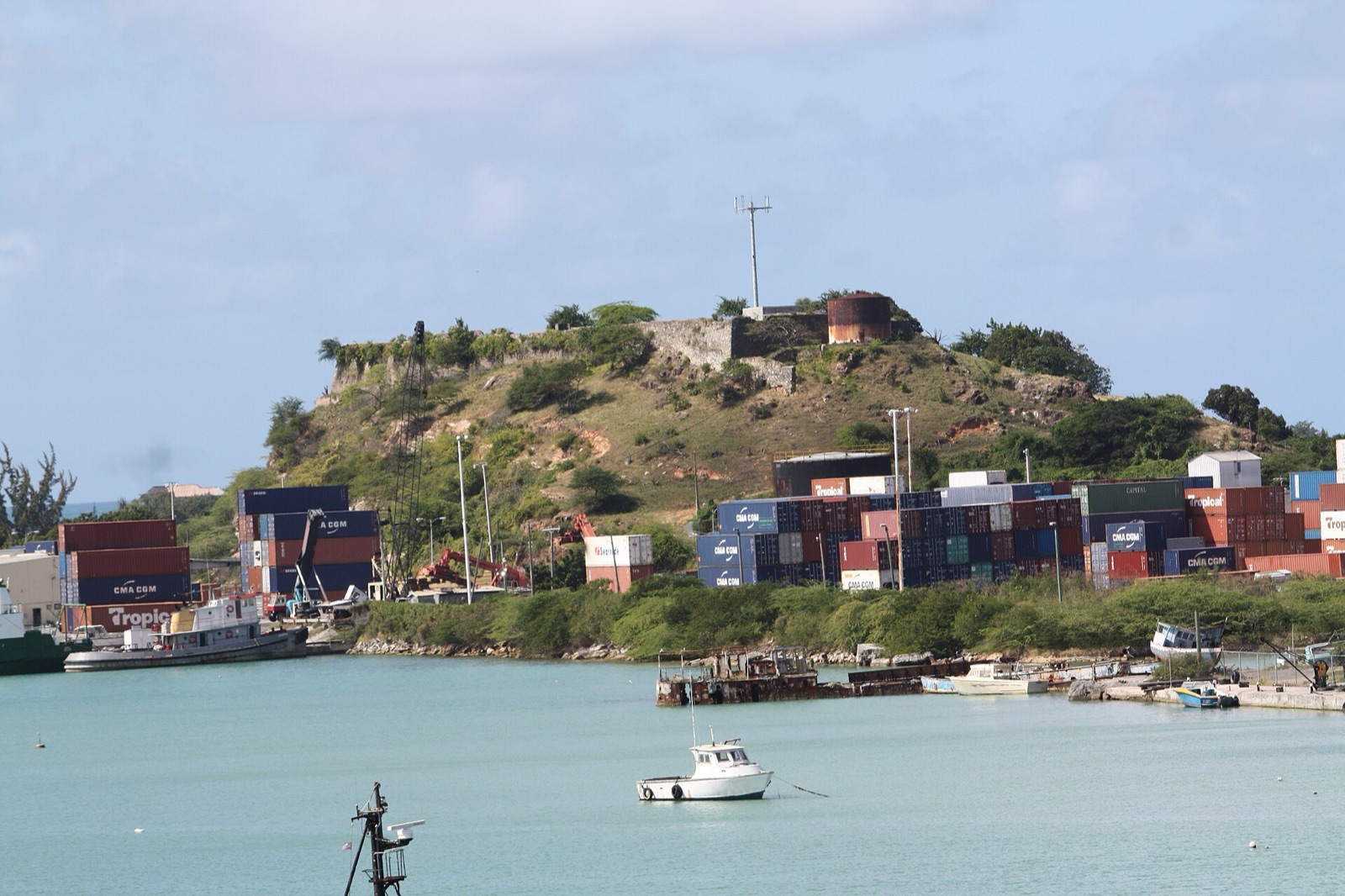
Photo: Deep Water Harbour container yard, St. John's, Antigua. Anneli Salo, CC BY-SA 3.0, via Wikimedia Commons.
Ready to ship your freight?
