
On this page13
You ship to Grenada by ocean LCL or FCL into the Port of St George's or by air into Maurice Bishop International (GND): LCL from Miami takes about 7 days, and cargo clears Customs and Excise on ASYCUDA World with CARICOM CET duty, a 6% service charge and 15% VAT. St George's, run by the Grenada Ports Authority, receives effectively all containerized, LCL and breakbulk cargo for a three-island state (Grenada, Carriacou and Petite Martinique), and cargo for the two smaller islands clears there and moves on by inter-island vessel. Demand rests on two anchors most Caribbean markets do not share in the same proportion: a hotel and villa sector concentrated on the south coast at Grand Anse and Point Salines, and St George's University, whose True Blue campus pulls in a steady flow of furniture, equipment, lab supplies and student provisions. Those consignees buy below container volume, which makes Miami consolidation the default mode.
Grenada Shipping at a Glance: Transit Times and Options
LCL from Miami reaches St George's in about 7 days, air freight to Maurice Bishop International takes 1 to 3 days, and Asian cargo needs 35 to 50 days through a transshipment hub.
| Route & mode | Indicative cost | Transit | Best for |
|---|---|---|---|
| Miami to St George's, ocean LCL | About $1,095 for 5 CBM / 1,500 kg (IWF published LCL rate, September 2026; excludes destination duties, taxes and local charges) | About 7 days (CFS Miami to port) | Retail, hotel and university supplies under 15 CBM |
| Miami to St George's, ocean FCL 20ft / 40ft | On request | 6 to 12 days, depending on direct or relay sailing | Full loads of food, building materials, FF&E |
| Miami to Maurice Bishop International (GND), air freight | On request | 1 to 3 days, depending on flight connections | Lab and medical supplies, spare parts, urgent cargo |
| China / Asia to St George's, ocean (via transshipment) | On request | 35 to 50 days, depending on the feeder connection | Furniture, fixtures, hardware, consumer goods |
| Europe (UK / Netherlands) to St George's, ocean | On request | 10 to 16 days on the direct UK and Netherlands service | UK and EU goods, vehicles, machinery |
Rates move with fuel, season and space. Treat the table as a planning tool and request a firm quote.
How to Ship to Grenada: Step by Step
Shipping to Grenada takes eight steps, from HS classification to release at St George's.
- Classify and check licences. Find the HS code with the Customs and Excise classification tool and check the Ministry of Trade licensing list and Ministry of Agriculture permit rules.
- Register the importer. Commercial importers need an Inland Revenue Taxpayer Identification Number and an ASYCUDA World registration before the first entry.
- Choose the mode and Incoterm. LCL from Miami fits loads under 15 CBM, FCL fits full loads, and air to GND fits deadline cargo; Grenada values imports on CIF whatever Incoterm the seller used.
- Book from Miami or origin. Deliver to the Miami CFS for the weekly consolidation to St George's, or book FCL space on a direct or relay sailing.
- Prepare documents and US export data. Issue the commercial invoice, packing list and bill of lading, and file the Electronic Export Information in AES when any Schedule B line exceeds $2,500 or the goods need an export license.
- Declare in ASYCUDA World. The importer or a licensed broker files the CARICOM Single Administrative Document within 48 hours of arrival (pre-arrival filing is encouraged), with any licence, certificate of origin or concession letter.
- Pay duty and taxes. Duty, the 6% Customs Service Charge, excise and 15% VAT are paid against the assessment notice at a designated customs office.
- Release and deliver. Cargo is released after port charges are settled; freight for Carriacou or Petite Martinique moves on by inter-island vessel to Hillsborough or Tyrrel Bay.
Most of those bookings start in Miami.
Shipping From the USA to Grenada
US cargo for Grenada is consolidated in Miami and sails to St George's in about a week. Vendors deliver to the Miami CFS, where freight is received, measured and documented, then loaded to sail to St George's directly or via a relay port. On the IWF consolidation service, a 5 CBM / 1,500 kg shipment moves FCA Miami CFS to St George's in about 7 days, at about $1,095 (IWF published LCL rate, September 2026; excludes destination duties, taxes and local charges).
Most Grenadian importers ship below container volume: a hotel ordering replacement linens and kitchen equipment, a supermarket topping up dry goods, a contractor bringing in fixtures. Consolidating those purchases into one Miami booking produces one bill of lading and one customs entry in St George's, which keeps broker fees and port charges under control. Container shipping to the Caribbean covers the move to full 20ft and 40ft containers once a regular flow passes 15 CBM, or when the cargo is heavy enough (tiles, cement products, beverages) to justify a dedicated box.
Air freight lands at Maurice Bishop International Airport (GND) at Point Salines, a few minutes from the True Blue and Grand Anse areas. Book air freight to the Caribbean for laboratory and medical supplies, equipment parts and anything with a hard deadline such as a hotel reopening date or the start of a university semester. Shipments must still be quoted on Incoterms that match who pays freight and insurance, because Grenada values imports on a CIF basis whatever term the seller used.
Asian and European orders follow longer routings.
Shipping From China, Asia and Europe to Grenada
Asian cargo reaches Grenada only through transshipment, while Europe has a direct fortnightly liner service to St George's.
Shipping From China and Asia to Grenada
Asian cargo reaches St George's in 35 to 50 days port to port, depending on the hub connection. Containers from Chinese ports transship at a hub such as Kingston, Cartagena, the Panama Canal ports or Caucedo, then continue on a feeder vessel through the Eastern Caribbean. Our dedicated post on shipping from China to Grenada covers that lane in depth, including sourcing patterns and container choices.
For importers that do not fill a container, LCL shipping from China to Grenada is the practical tool: pay by the cubic meter and let the forwarder handle the hub connection. An alternative that works well for hotels and the university is to route Asian purchases into Miami and merge them with US-origin goods, so a full room package (case goods from Asia, mattresses and electronics from the US) arrives in one consolidated shipment and one entry. Check mattresses, aluminium windows and doors, paint and galvanized roofing sheets against Grenada's import licensing list before ordering them from any origin.
Shipping From Europe to Grenada
Europe has a direct link to Grenada through Geest Line, which runs a fortnightly direct service from Portsmouth (UK) and Vlissingen (Netherlands) to St George's and quotes about 10 days from Europe. Plan on 10 to 16 days port to port once loading cut-offs and port time are included. From the UK the service handles dry, reefer, LCL chilled and breakbulk including out-of-gauge cargo; from Vlissingen it runs a full container service and vehicle exports. That suits UK food brands and right-hand-drive vehicles. The same European service makes shipping to Barbados a useful comparison for buyers supplying both islands. Larger carriers also connect European cargo through Caribbean transshipment hubs.
Every lane discharges at the same Grenadian gateways.
Which Ports and Airports Handle Cargo in Grenada?
Grenada has one commercial cargo port, St George's, plus smaller Ports Authority facilities and two airports.
- Port of St George's, St George's (the Carenage): the main commercial gateway, operated by the Grenada Ports Authority, handling containerized, LCL, breakbulk and cruise traffic with reach stackers and top lifters for container moves. UN/LOCODE GDSTG.
- Other Grenada Ports Authority facilities: Grenville on the east coast, Prickly Bay, St David's and Le Phare Bleu on the south coast (largely marine and yacht traffic), Tyrrel Bay and Hillsborough on Carriacou.
- Hillsborough, Carriacou: the main port of entry for Carriacou, receiving cargo by inter-island vessel after clearance in St George's. Inter-island passenger and light cargo service is run by a domestic ferry operator, and cabotage by foreign carriers is not permitted.
- Maurice Bishop International Airport (GND), Point Salines: the international air cargo gateway.
- Lauriston Airport (CRU), Carriacou: domestic and regional flights; small air cargo.
Carriacou and Petite Martinique sit at the southern end of the Grenadines chain; the northern islands belong to a separate customs territory, covered in our guide to shipping to St Vincent and the Grenadines. Cargo arriving at any Grenadian gateway is released only after the ASYCUDA World entry clears.
How Does Customs Clearance Work in Grenada?
Imports into Grenada clear through the Grenada Customs and Excise Division of the Ministry of Finance, headquartered at Burns Point on the Carenage, under the Customs Act No. 9 of 2015 and the Customs Regulations SRO 13 of 2018. Declarations are filed on ASYCUDA World, fully operational since 2017, and the Division publishes its administrative tariff, valuation rules and an HS classification tool through its business resources page. Several border agencies are connected to ASYCUDA World, but Grenada does not yet operate a full customs single window.
- Registration: commercial importers register with the Inland Revenue Division for a Taxpayer Identification Number (and a VAT number where applicable) and register on ASYCUDA World before trading.
- Manifest and arrival: the carrier transmits the manifest; for LCL, the consolidator's house bills identify each consignee.
- Declaration: the importer or a licensed customs broker files the CARICOM Single Administrative Document in ASYCUDA World within 48 hours of arrival, with the commercial invoice, bill of lading or air waybill and any licence, certificate of origin or concession letter. Pre-arrival declarations are encouraged. Using a broker is voluntary, and broker licences go only to Grenadian or CARICOM citizens.
- Valuation and risk: goods are classified under the CARICOM tariff and valued on CIF transaction value under the WTO Valuation Agreement; ASYCUDA routes each entry to a red (inspection), yellow (documents), green (immediate release) or blue (post-clearance audit) channel.
- Payment and release: duty, service charge, excise and VAT are paid against the assessment notice at a designated customs office, then cargo is released and collected after port charges are settled.
Customs processes a clean declaration in about one business day, according to the authorities' reporting to the WTO. Perishables can be released before a full declaration against a security deposit, with the entry completed within seven days. Under-declaration carries heavy penalties and seizure risk, so invoices must show real transaction values, because every tax layer is calculated from them.
What Are the Import Duties and Taxes in Grenada?
Grenada taxes imports in layers on CIF value: CARICOM CET duty, then a 6% Customs Service Charge, then excise where applicable, then 15% VAT on the cumulative total.
- Import duty (CARICOM Common External Tariff): set by HS code, from zero on many basic goods and inputs to higher rates on finished consumer and luxury goods. CARICOM-origin goods with a certificate of origin enter duty free. For a group of products that local and OECS producers supply, Grenada replaced import licensing with temporarily higher tariffs (suspension of CET treatment) that run until July 2029.
- Customs Service Charge (CSC): 6% of CIF value on almost all imports, including goods of CARICOM origin, since 21 February 2014 (up from 5%), as recorded in the WTO Trade Policy Review of Grenada. Manufacturers pay a reduced 3% on imported raw materials under the Customs (Service Charge) (Amendment) Act 2016.
- Excise tax: on alcoholic beverages and tobacco, plus a 5% excise on luxury goods, motor oils, tyres, vehicle batteries and vehicle parts. Petroleum products pay a per-gallon Petrol Tax instead of VAT.
- VAT at 15%: charged at import on CIF value plus duty, CSC and other taxes. Hotel accommodation and tourism services carry a 10% rate, and listed basic items are zero-rated or exempt.
- Environmental levy: 1% of CIF on white goods, 2% to 30% of CIF on vehicles depending on age (and on older trucks by tonnage), a per-unit levy on tyres, and a levy on beverage containers.
Duty concessions for hotels, the university and approved investments are granted through specific incentive instruments, not automatically; the concession letter must be in place before the cargo arrives. After Hurricane Beryl struck Carriacou and Petite Martinique on 1 July 2024, the Ministry of Finance opened time-limited duty-free windows for relief goods, so check with your broker whether any reconstruction concession currently applies. The CET layer is common to CARICOM, so the same HS code carries the same base duty when shipping to Trinidad and Tobago, while the national charges on top differ; for a regional comparison of how these layers stack, see Caribbean import duties and taxes.
What Documents Are Required to Ship to Grenada?
A Grenada import entry needs the CARICOM Single Administrative Document, a commercial invoice and the transport document, plus permits where the product requires them.
- CARICOM Single Administrative Document lodged in ASYCUDA World
- Commercial invoice with HS code, unit values, currency and Incoterm (see our commercial invoice requirements)
- Packing list with pieces, weights and dimensions
- Bill of lading or air waybill; house bill for LCL
- Certificate of origin when claiming CARICOM preference
- Import licence for goods on the restricted list
- Phytosanitary or veterinary certificate for plants, produce and animal products
- Concession letter where a duty or VAT exemption is claimed
- Importer's TIN and VAT number, and broker authorization where a broker files
The licence and permit lines apply to a defined list of goods, set out next.
Restricted Goods and Import Permits in Grenada
Most goods enter Grenada freely, but a defined list needs an import licence or prior permit, and some items are banned outright.
- Import licensing: administered by the Licensing Division of the Ministry of Trade under the Supplies Control Act, Cap 314. The list covers whole chicken, eggs, processed pork, bulk milk powder, sugar, bulk rice, ground spices, jams, high-proof spirits, cigarettes, paint, varnishes, toilet and tissue paper, corrugated galvanized sheets, aluminium windows and doors, wooden doors and mattresses. Licences are not required for goods from other OECS members.
- Prior permits under the Customs Act: arms, ammunition, explosives, mace and pepper spray need the Commissioner of Police; spirits and wine and large tobacco consignments need the Comptroller of Customs.
- Prohibited items: expanded polystyrene food containers and plastic shopping bags have been banned since September 2018, which matters for food service and retail packaging.
- Agricultural products: plants, fresh produce, meat and dairy need permits and health certificates and are inspected by the Ministry of Agriculture's plant quarantine and veterinary services; the Grenada Bureau of Standards also checks regulated products at the border.
- Refrigerants: ozone-depleting substances are under an annual import quota, and the licence must be applied for at least a week before arrival.
- Motor vehicles: attract duty, CSC, VAT and an age-based environmental levy; older units have required additional permits, so confirm the current rules before buying.
- Hazardous cargo: declared under IMDG or IATA rules; confirm acceptance before booking LCL.
- Wood packaging: use ISPM 15 treated and marked pallets and crates.
LCL, FCL or Air Freight to Grenada: Which to Choose?
Below 15 CBM, LCL from Miami is the default for Grenada; above 28 CBM, a 40ft container wins on cost per cubic meter.
- Under 15 CBM: LCL from Miami, about 7 days to St George's.
- 15 to 28 CBM, or dense cargo: compare LCL with a 20ft container.
- Above 28 CBM: a 40ft container, especially for FF&E and full hotel room packages.
- Air: lab supplies, spare parts and goods tied to a fixed date such as a semester start or reopening.
For Carriacou, most cargo is stripped in St George's and reloaded on an inter-island vessel, so the FCL saving shrinks for that final destination. Pack for the extra handling.
Key Industries Shipping Freight to Grenada
Hospitality and education drive most of Grenada's non-food imports. Resorts and villas at Grand Anse, Point Salines and along the south coast refresh furniture, fixtures and equipment on renovation cycles, and run steady replenishment of linens, amenities, kitchen equipment and food and beverage stock. St George's University adds a large, regular demand of its own: campus furniture, lab and medical teaching equipment, IT hardware and provisions for an international student population. Construction materials and food follow, with reconstruction on Carriacou and Petite Martinique after Hurricane Beryl adding demand for roofing, building supplies and equipment.
Exports are smaller but distinctive. Nutmeg, mace and cocoa are Grenada's signature agricultural exports, along with fish and fresh produce shipped to regional and US markets. Because the hotel sector and the university are the two most demanding consignees on this lane, our next guide covers supplying Grenada's hospitality sector and St George's University.
Choosing a Freight Forwarder for Grenada
The right forwarder for Grenada holds, consolidates and documents cargo in Miami. A hotel package or a university order comes from up to a dozen vendors with different ready dates; a Miami warehouse that receives, checks and holds the pieces until the full order is complete saves a second entry and a second set of port charges in St George's. Interworld Freight was founded in Miami in 1992 and runs ocean FCL and LCL, air freight, Miami warehousing and customs coordination, with coverage on every major trade lane into the Caribbean. We prepare documents so the Grenadian broker can file a clean ASYCUDA World entry and coordinate onward moves to Carriacou. Review our Miami to Caribbean freight forwarding service and request a quote: we answer within one business day.
Frequently Asked Questions
How long does shipping to Grenada take from Miami?
LCL cargo moves from the Miami CFS to St George's in about 7 days on the IWF consolidation service. Air freight to Maurice Bishop International takes 1 to 3 days, plus customs clearance.
How much does it cost to ship to Grenada?
IWF's published LCL rate for 5 CBM / 1,500 kg from Miami to St George's is about $1,095 (September 2026). That excludes duty, VAT, the Customs Service Charge and local port and broker charges. Full containers and air freight are quoted per shipment.
What taxes apply to imports into Grenada?
Imports pay CARICOM Common External Tariff duty, a 6% Customs Service Charge on CIF value, excise on specific goods and 15% VAT. VAT is charged on the CIF value plus duty, service charge and other taxes, so classification errors compound.
What is the Customs Service Charge in Grenada?
It is a 6% charge on the CIF value of almost all imports, including goods of CARICOM origin. Manufacturers importing raw materials pay a reduced 3% rate.
How long does customs clearance take in Grenada?
Customs processes a complete ASYCUDA World declaration in about one business day. Entries routed to inspection, missing permits or a late declaration add time, and port storage charges start after free time.
Which port do I ship to in Grenada?
The Port of St George's handles virtually all commercial cargo. Cargo for Carriacou and Petite Martinique clears in St George's and moves on by inter-island vessel to Hillsborough or Tyrrel Bay.
Do I need an import licence to ship to Grenada?
Only for products on Grenada's licensing list, which includes several foods plus paint, galvanized sheets, aluminium windows and doors, and mattresses. Agricultural products also need Ministry of Agriculture permits and health certificates.
Can I ship from China to Grenada?
Yes. Asian cargo transships at a regional hub and takes 35 to 50 days. Small orders move best as LCL, or via Miami where they can be consolidated with US freight.
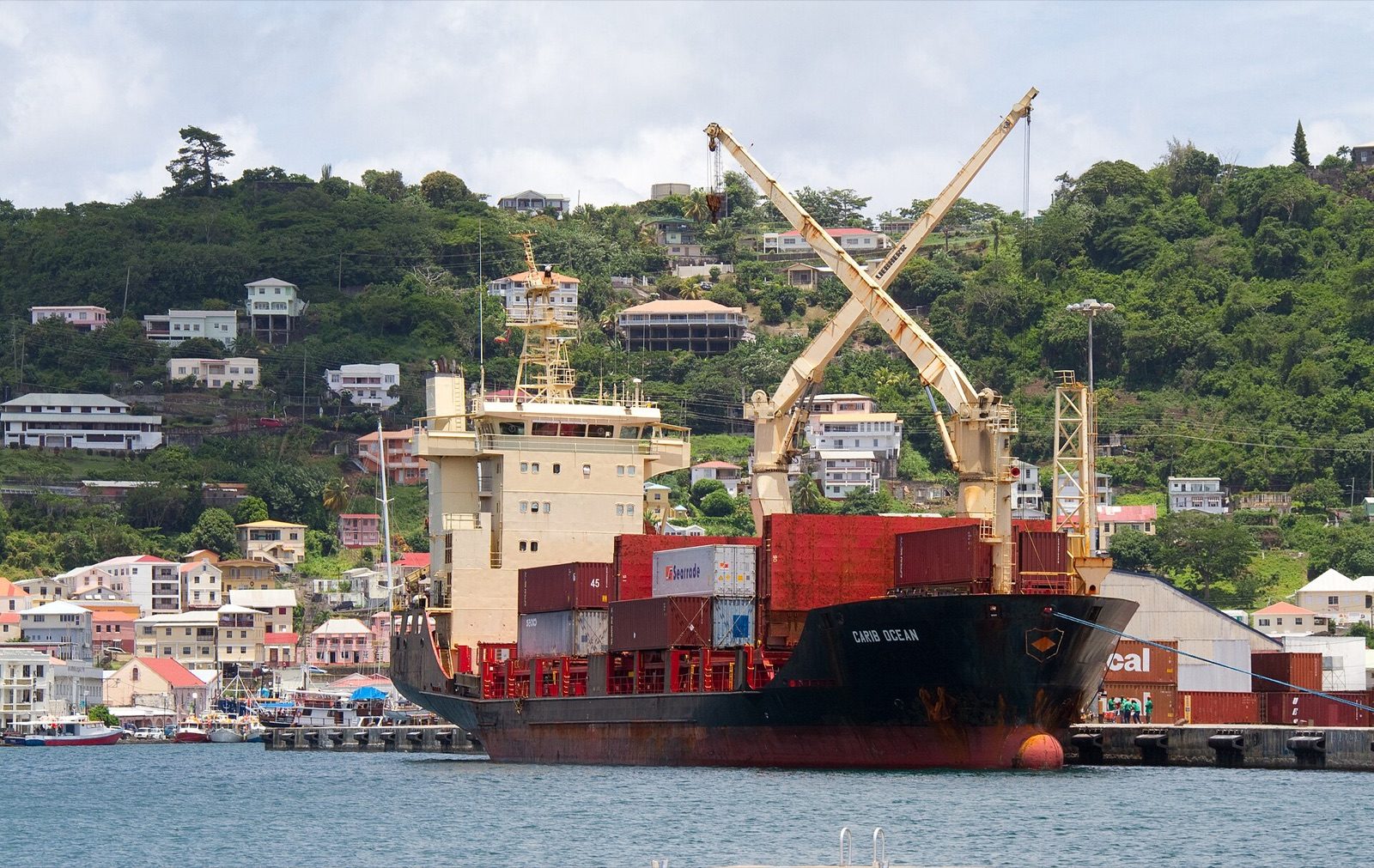
Photo: Port of St. George's, Grenada. Tony Hisgett from Birmingham, UK, CC BY 2.0, via Wikimedia Commons.
Ready to ship your freight?
