
On this page13
You ship to St Kitts and Nevis by ocean LCL or FCL into Basseterre or Long Point Port (Nevis), or by air into SKB or NEV; LCL from Miami takes 4 to 5 days, clears Customs in ASYCUDA World and pays CARICOM duty, a 6% service charge and 17% VAT. The federation is two islands with one customs service, one tariff and one VAT, but separate port authorities and separate cargo gateways, so a container booked to "St Kitts" does not reach a job site on Nevis by default. The market is small, import-dependent and driven by construction, tourism and residential real estate. Most freight therefore arrives as consolidated LCL out of Miami rather than full containers.
St Kitts and Nevis Shipping at a Glance: Transit Times and Options
Ocean LCL from Miami reaches Basseterre in 4 days and Nevis in 5 days port to port, air freight takes 1 to 3 days, and cargo from Asia needs 35 to 50 days via a Caribbean transshipment hub.
| Route & mode | Indicative cost | Transit | Best for |
|---|---|---|---|
| Miami to St Kitts (Basseterre), ocean LCL | about $1,095 for 5 CBM / 1,500 kg (IWF published LCL rate, September 2026; excludes destination duties, taxes and local charges) | 4 days port to port | mixed pallets, building supplies, retail stock |
| Miami to Nevis, ocean LCL | about $1,220 for 5 CBM / 1,500 kg (IWF published LCL rate, September 2026; excludes destination duties, taxes and local charges) | 5 days port to port | Nevis villas, hotels and contractors |
| USA to St Kitts, ocean FCL 20ft/40ft | Quote on request | 1 to 2 weeks | full loads, steel, cement, fit-out packages |
| USA to St Kitts and Nevis, air freight | Quote on request | 1 to 3 days | spare parts, urgent and high-value cargo |
| China/Asia to St Kitts and Nevis, ocean LCL or FCL | Quote on request | 35 to 50 days via transshipment | factory orders, fixtures, finishes |
| Europe to St Kitts and Nevis, ocean | Quote on request | 3 to 5 weeks via relay | equipment and specialist materials |
Freight markets move with fuel, season and space. Use the table to plan, then confirm a firm quote for your cargo.
How to Ship to St Kitts and Nevis: Step by Step
Shipping to St Kitts and Nevis follows eight steps:
- Classify the goods and check permits. Assign an HS code to every line to find the CARICOM CET rate, and secure any Plant Quarantine Unit permit or ministry licence before shipping.
- Choose the mode, the Incoterm and the island. Pick LCL, FCL or air, agree the Incoterm, and name Basseterre or Long Point Port as the destination.
- Book from Miami or origin. US cargo joins the weekly Miami LCL consolidation (4 days to St Kitts, 5 to Nevis); Asian and European cargo books via a transshipment hub or through Miami.
- Prepare the documents. Issue a commercial invoice with unit values, a packing list that matches the packages and a bill of lading consigned to the correct island, plus a CARICOM certificate of origin when claiming duty-free entry.
- File the US export record. For cargo leaving the US, file Electronic Export Information (EEI) in AES before departure whenever a Schedule B line exceeds $2,500 or the goods need an export licence.
- Declare in ASYCUDA World. A licensed customs broker (or a registered importer) files the entry with the Customs and Excise Department on arrival.
- Pay duty, the 6% Customs Service Charge and 17% VAT. Charges are assessed in Eastern Caribbean dollars on the CIF value and paid before release.
- Release and deliver. Customs releases the cargo for collection at the port or delivery to site on the island it was booked to.
The sections below expand each step, starting with the United States.
Shipping From the USA to St Kitts and Nevis
Miami is the gateway for US cargo to St Kitts and Nevis: consolidation services out of South Florida reach Basseterre in four days and Nevis in five, and any US supplier can truck to a Miami CFS and catch the next sailing on the Miami-to-Eastern-Caribbean feeder network. Interworld Freight's published LCL rate for a 5 CBM, 1,500 kg shipment from Miami is about $1,095 to St Kitts and about $1,220 to Nevis (September 2026, excluding destination duties, taxes and local charges).
LCL is the default on this lane. A villa fit-out, restaurant opening or retail restock rarely fills a 20ft container, and paying by the cubic meter keeps the freight line proportional to the cargo. Our Caribbean container shipping service covers both modes: consolidated LCL for mixed purchases and FCL once the volume justifies a full box. Full containers make sense for cement, rebar, roofing, tile and other dense or bulky construction packages, and for any shipment you want sealed from origin to the consignee's yard.
Air freight lands at Robert L. Bradshaw International (SKB) on St Kitts or Vance W. Amory International (NEV) on Nevis. Use it for spare parts that stop a project or a generator, pharmaceuticals, electronics and anything where a week of downtime costs more than the airfreight premium. Our Caribbean air freight service runs out of Miami.
Two rules apply to every US shipper. First, book to the correct island: Nevis cargo booked to Nevis moves on the right feeder and clears at the right port. Second, consolidate purchases from multiple US vendors in Miami before export, because one master shipment with one set of documents clears faster and costs less in local handling than five small ones. The federation is a fully foreign destination with its own tariff, unlike the territory in our guide to shipping to the US Virgin Islands, where CBP clears the cargo.
Shipping From China, Asia and Europe to St Kitts and Nevis
Cargo from China, Asia and Europe reaches St Kitts and Nevis by transshipment, because no direct mainline service calls the federation. Asian cargo moves on a mainline vessel to a Caribbean hub and then onto a regional feeder, which puts transit at 35 to 50 days door to port, with the hub connection deciding where in that range a shipment lands. The common relay points are covered in our guide to Caribbean transshipment hubs.
For smaller factory orders, a second route works better: ship from China to Miami, consolidate with US-sourced items in the Miami warehouse, and send one combined LCL shipment to Basseterre or Nevis. One arrival, one customs entry and one delivery to site suit developers who buy fixtures and finishes in Asia and structural or MEP materials in the US. The same Miami consolidation serves the neighbouring Leeward Islands, as our guide to shipping to Anguilla and St Maarten shows for the territories to the north.
Europe-origin cargo, mainly specialist equipment, kitchen packages and finishes, follows the same relay logic: three to five weeks from a North European port with one transshipment. Whatever the origin, the invoice and packing list must match the final consignment, because Customs assesses the goods as declared on arrival at the port of discharge.
Which Ports and Airports Handle Cargo in St Kitts and Nevis?
Commercial cargo enters St Kitts and Nevis through two seaports, Basseterre's Deep Water Harbour and Long Point Port on Nevis, and air cargo through SKB and NEV. On St Kitts, the St Christopher Air and Sea Ports Authority (SCASPA) runs the Deep Water Harbour cargo port, the Port Zante cruise terminal and the Basseterre ferry terminal as separate facilities.
- Deep Water Harbour, Basseterre (St Kitts), UN/LOCODE KNBAS: the federation's main cargo port, operated by SCASPA, handling containerized, breakbulk and consolidated cargo for St Kitts. Port Zante, also in Basseterre, is the cruise terminal, not a cargo gateway.
- Long Point Port (Nevis): on the south coast just outside Charlestown, operated by the Nevis Air and Sea Ports Authority (NASPA), which describes it as the port tasked with all of the island's import needs, working with shipping lines and Customs on clearance. Charlestown Port (UN/LOCODE KNNEV) handles ferries, yachts and cruise calls rather than main cargo.
- Robert L. Bradshaw International Airport (SKB): the air cargo gateway for St Kitts.
- Vance W. Amory International Airport (NEV): the Nevis airport for smaller air shipments.
The ferry link between Basseterre and Charlestown can move small items between islands, but planned freight should be booked to its final island from origin. Once the cargo is discharged at either port, the same customs procedure applies.
How Does Customs Clearance Work in St Kitts and Nevis?
Customs clearance in St Kitts and Nevis runs through the St Kitts and Nevis Customs and Excise Department under the Customs Act, 2014 (Cap. 20.04), with every declaration filed electronically in ASYCUDA World. The department's ASYCUDA World portal handles manifests, customs declarations, payments and transit procedures, and publishes the registration form for users. Importers can register and file their own entries, but most commercial importers clear through a licensed customs broker who files the entry on their behalf, because classification and valuation errors are what trigger holds.
The sequence for a commercial shipment:
- Manifest and arrival: the carrier submits the manifest; cargo is discharged at Basseterre or Long Point.
- Declaration: the broker files the entry in ASYCUDA World with invoice, packing list and bill of lading, each line classified by HS code.
- Assessment: duty and the Customs Service Charge are calculated on the CIF value in Eastern Caribbean dollars, then VAT on the total.
- Examination: selected entries are inspected; undervaluation or mismatched documents trigger holds and penalties.
- Payment and release: charges are paid and the cargo is released.
A clean entry clears in a few working days. The common causes of delay are invoices that do not show unit values, packing lists that do not match the boxes, and cargo booked to the wrong island. The assessment step is where the cost is decided, so the tariff deserves a close look.
What Are the Import Duties and Taxes in St Kitts and Nevis?
Commercial imports into St Kitts and Nevis pay three charges: CARICOM Common External Tariff duty on the CIF value, a 6% Customs Service Charge, and 17% VAT on the duty-inclusive total. The Customs and Excise Department sets out the rates in its tariff and duty information:
- Import duty under the CARICOM Common External Tariff (CET): as a CARICOM member, the federation applies the CET to goods from outside the bloc, including the US, China and Europe, on the CIF value. Rates run from 0% to 70%, and most commodities attract 25%. Machinery and parts, raw materials, textile fabric, chemicals, office equipment and hand tools fall between 0% and 10%; computers and accessories pay 0% duty; refrigerators, stoves, freezers, microwaves, clothing and shoes pay 25%. Classification by HS code decides the rate.
- Customs Service Charge (CSC) at 6%: charged on the CIF value of imports, including goods that pay 0% duty. The government cuts the CSC on specific goods as a relief measure from time to time (on gasoline, for example), so check for temporary orders before you quote.
- VAT at 17%: charged on imported goods on the CIF value plus duty plus CSC, so it compounds. The government cut the rate to 13% for the first half of 2025 and returned it to 17% from July 2025. A reduced 10% rate applies to accommodation and restaurant supplies, not to imported goods in general.
- Excise duty: tobacco products pay an additional 20% excise duty on top of duty and taxes.
A worked example for a line at 25% duty with a CIF value of EC$10,000: duty EC$2,500, CSC EC$600, VAT 17% of EC$13,100 = EC$2,227, for EC$5,327 in border charges, about 53% of CIF. Customs converts foreign-currency invoices to Eastern Caribbean dollars at the rate published with the Eastern Caribbean Central Bank (EC$2.70 to the US dollar). Goods produced in CARICOM are exempt from import duty when the importer presents a CARICOM certificate of origin. The same CET framework applies next door, as our guide to shipping to Antigua and Barbuda sets out for the other main Leeward Islands market.
Concessions matter for construction. Approved development projects can receive duty concessions under government agreements, and the government has suspended duty and the CSC on selected goods through stimulus packages. Concessions are granted case by case, so secure the approval before the goods arrive. Our overview of Caribbean import duties and taxes compares how duty and VAT stack across the region.
What Documents Are Required to Ship to St Kitts and Nevis?
Shipping to St Kitts and Nevis requires these documents:
- Commercial invoice showing seller, buyer, Incoterm, unit values and total value
- Packing list matching the physical packages, with weights and dimensions
- Ocean bill of lading or air waybill, consigned to the correct island
- Importer details for the ASYCUDA World entry, plus broker authorization
- Certificate of origin when claiming CARICOM preferential treatment
- Duty concession or exemption approval, where one applies
- Permits or licences for restricted goods (see below)
Restricted Goods and Import Permits in St Kitts and Nevis
Food, plants and animal products need a permit before they ship to St Kitts and Nevis, and most other controlled goods need a licence from the relevant ministry. The Department of Agriculture requires an import permit from the Plant Quarantine Unit before plants and plant products are imported, and animals and animal products, firearms and ammunition, and pharmaceuticals are also controlled. Agricultural goods are inspected on arrival, and wood packaging should meet the ISPM 15 heat-treatment and marking standard to avoid treatment or rejection.
Vehicles have their own regime. Motor vehicles pay 45% import duty, the 6% CSC and 17% VAT, plus an Environmental Levy based on age: EC$1,000 under two years old, EC$3,500 from two to under four years, and EC$5,000 at four years or older. Customs requires the commercial invoice and the certificate of title or salvage certificate, and every imported vehicle goes through a physical Customs evaluation of age, make, model, engine and chassis numbers and mileage before release, according to the department's vehicle importation procedure.
Hazardous materials such as paints, solvents, lithium batteries, gas cylinders and fuel additives must be declared and packed under IMDG (ocean) or IATA (air) rules. They are accepted on fewer sailings and flights, so allow extra lead time.
LCL, FCL or Air Freight to St Kitts and Nevis: Which to Choose?
For St Kitts and Nevis, choose LCL below 12 to 15 CBM, FCL above it or for dense cargo, and air for urgent or light consignments:
- Under 12 to 15 CBM: LCL. At about $1,095 for 5 CBM to St Kitts, LCL is the efficient option for mixed or modest volumes. See how LCL container shipping works for the consolidation steps.
- Above 15 CBM, or heavy and dense cargo: FCL. A 20ft container becomes cheaper per unit once you fill most of it, and it keeps project materials together under one seal.
- Urgent, light or high-value: air. Under a few hundred kilograms, or when downtime is expensive, airfreight to SKB or NEV is the right call.
On Nevis, factor in the extra day of transit and plan site deliveries around the Long Point arrival schedule.
Key Industries Shipping Freight to St Kitts and Nevis
Construction and real estate drive the largest share of import volume into St Kitts and Nevis. Hotel projects, residential villas and the government-approved developments tied to the Citizenship by Investment Programme pull in cement, steel, roofing, windows, tile, sanitaryware, MEP equipment and furniture packages, most of it from the US and Asia. These projects ship in phases, so a developer moves a dozen LCL consignments and several full containers over a build.
Tourism, hospitality and retail are the other steady importers: food and beverage for hotels and restaurants, linens and amenities, consumer goods, vehicles and spare parts. Most of this moves weekly through Miami. For developers, the hardest part is sequencing materials to site on two islands, which we cover in detail in Shipping Construction Materials for St Kitts Real Estate Projects.
Choosing a Freight Forwarder for St Kitts and Nevis
The right forwarder for St Kitts and Nevis runs a reliable weekly Miami consolidation to both islands, books cargo to the correct port, and prepares documents that clear ASYCUDA World on the first pass. Interworld Freight was founded in Miami in 1992 and operates its own Miami hub with warehousing, so US and Asian purchases can be received, consolidated and shipped as one consignment. We handle ocean FCL and LCL, air freight and customs coordination with the local broker, with coverage on every major trade lane. Start with our Miami to Caribbean freight forwarding service; quotes are answered within one business day.
Frequently Asked Questions
How long does shipping to St Kitts and Nevis take?
LCL from Miami takes 4 days to St Kitts and 5 days to Nevis port to port. Air freight arrives in 1 to 3 days. Cargo from China takes 35 to 50 days because it transships at a Caribbean hub.
How much does it cost to ship 5 CBM to St Kitts?
Interworld Freight's published LCL rate from Miami is about $1,095 for 5 CBM / 1,500 kg to St Kitts and about $1,220 to Nevis (September 2026). Destination duties, VAT and local charges are extra.
What VAT applies to imports into St Kitts and Nevis?
The standard VAT rate is 17%, charged on imported goods on the value plus duty. The rate was temporarily cut to 13% in the first half of 2025 and returned to 17% in July 2025.
How much will I pay in duties and taxes to import into St Kitts and Nevis?
For a line at 25% duty, border charges come to about 53% of the CIF value: 25% CARICOM CET duty, a 6% Customs Service Charge on CIF, and 17% VAT on the duty-inclusive total. Machinery, raw materials and tools pay 0% to 10% duty, while vehicles pay 45% plus an age-based Environmental Levy.
Can I do my own customs clearance in St Kitts and Nevis?
Yes. Importers can register as ASYCUDA World users with the Customs and Excise Department and file their own declarations. Most commercial importers still use a licensed customs broker, because a wrong HS code or an incomplete invoice is the main cause of holds and penalties.
Can I import food into St Kitts and Nevis?
Yes, with the right permits. Plants and plant products need an import permit from the Plant Quarantine Unit of the Department of Agriculture before shipping, and animal products are also controlled. Food shipments are inspected on arrival.
Can I ship to Nevis directly, or does everything go through St Kitts?
Cargo can be booked directly to Nevis, where Long Point Port handles commercial freight. Booking to the correct island from origin avoids an extra transfer and handling charges.
Are building materials duty free in St Kitts and Nevis?
Not by default. Duty concessions exist for approved projects and specific programmes, but they are granted case by case and must be approved before the cargo arrives.
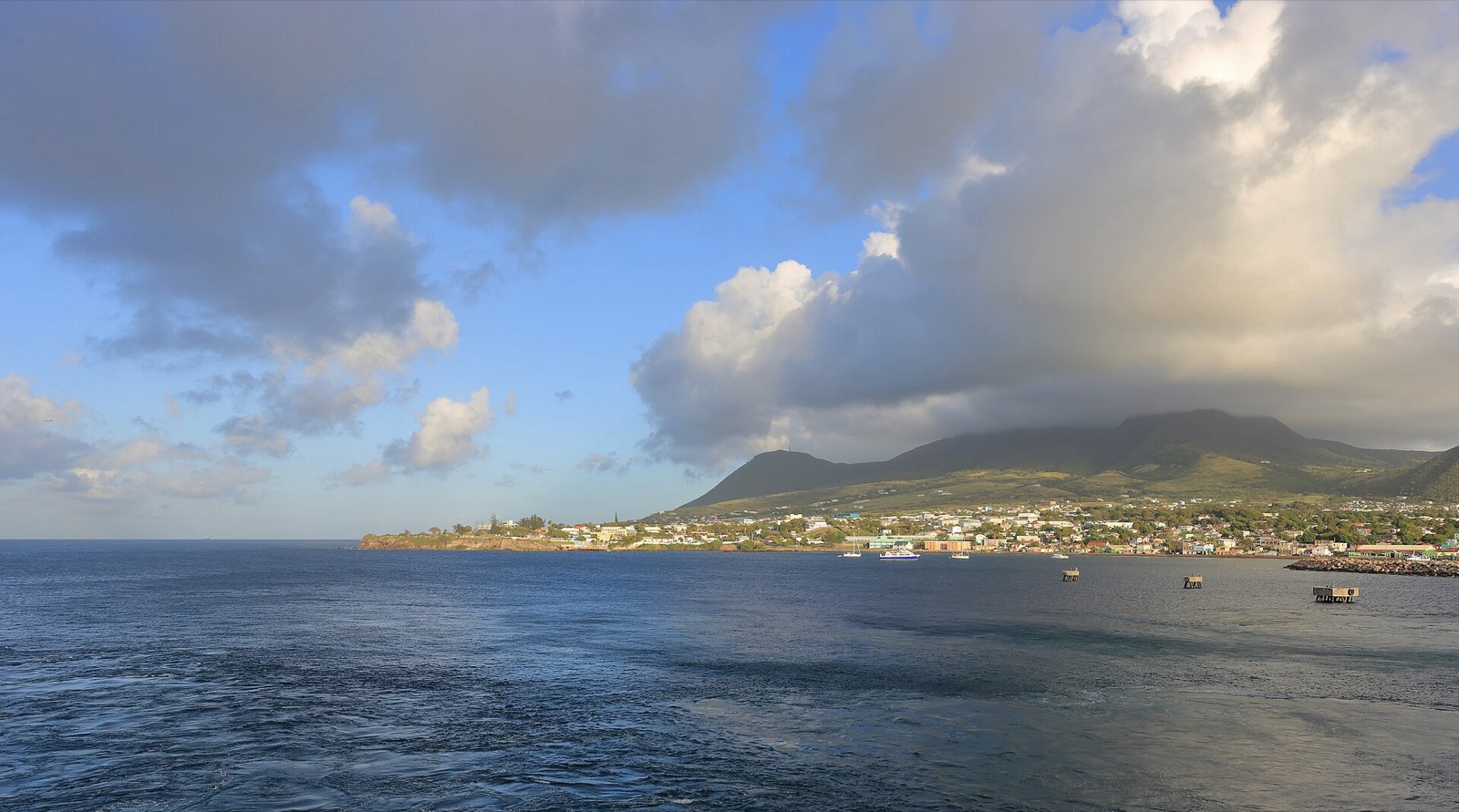
Photo: Basseterre harbour, St Kitts. Martin Falbisoner, CC BY-SA 4.0, via Wikimedia Commons.
Ready to ship your freight?
