
On this page12
The DUCA (Declaración Única Centroamericana) is the single electronic customs declaration that Central American customs services use in place of national forms: the DUCA-D covers imports and exports with countries outside the region, the DUCA-F covers trade in goods that originate in the region, and the DUCA-T covers customs transit. For a US supplier shipping from Miami, the form that matters is the DUCA-D, filed by a licensed customs agent in the destination country, as on our Guatemala container shipping lane.
The DUCA is neither a tax nor a tariff. It is the document that carries a shipment's classification, value, origin and regime to customs, and the duty and tax are calculated from it. A container stalls at the port when the wrong version is filed, when anyone other than a licensed agent files it, or when the declaration contradicts the supporting documents.
DUCA at a Glance
| Item | Detail |
|---|---|
| Full name | Declaración Única Centroamericana |
| Replaced | FAUCA (Formulario Aduanero Único Centroamericano), the national declaration of goods (DUA) and the single transit document (DUT) |
| Versions | DUCA-D (third countries), DUCA-F (regional trade), DUCA-T (transit) |
| Regional framework | CAUCA (Uniform Customs Code) and RECAUCA (its regulation), under SIECA and COMIECO |
| Tariff | Arancel Centroamericano de Importación, built on the SAC classification |
| Countries covered in our guides | Guatemala, El Salvador, Honduras |
| US trade preference | CAFTA-DR, claimed with a certification of origin |
| Who files | Licensed customs agent (agente aduanero) in the destination country, for most commercial imports |
What Are CAUCA, RECAUCA and SIECA, and How Do They Connect to the DUCA?
The DUCA sits at the bottom of a regional legal pyramid. At the top is the Central American Uniform Customs Code (CAUCA), which sets the common rules on customs obligations, regimes and the role of customs auxiliaries. Below it is the RECAUCA, the regulation that turns those rules into procedure: how a declaration is transmitted, what it must contain, how value is determined and how risk analysis works.
The Council of Ministers of Economic Integration (COMIECO) approved both texts in 2008. Resolution 223-2008 modified the CAUCA and Resolution 224-2008 approved the RECAUCA, as the official COMIECO text of the RECAUCA records. SIECA, the Secretariat for Central American Economic Integration, is the regional body that supports the process and administers parts of the electronic platforms.
Each country adds its own law on top. Guatemala's tax authority SAT, El Salvador's Dirección General de Aduanas and Honduras' customs administration all apply the same regional code but publish their own administrative rules, tax laws and systems. That is why a Guatemalan and a Honduran import look alike on the DUCA and differ in the taxes charged after it.
DUCA-D, DUCA-F and DUCA-T: Which One Applies?
The version depends on where the goods come from and where they are going, not on the commodity.
- DUCA-D (Declaración de mercancías con terceros países): imports and exports between a Central American country and the rest of the world. A container of US goods arriving in Puerto Quetzal, Acajutla or Puerto Cortés is declared on a DUCA-D, even when the goods benefit from CAFTA-DR.
- DUCA-F (Factura y Declaración Única Centroamericana): trade in goods that originate in the region and move between Central American countries under regional free trade. It merges the commercial invoice and the declaration.
- DUCA-T: goods moving in customs transit through the region, for example cargo landed in one country and destined for another.
The platforms went live in the region in 2019. According to the Diario de Centro América, the three electronic platforms had stabilized within two months of implementation, with acceptance rates between 94% and 97%. In Guatemala the DUCA-D is administered by SAT, the DUCA-F is operated through the Guatemalan exporters association, and the DUCA-T is administered by SIECA.
How Does Customs Clearance Work With the DUCA?
The RECAUCA fixes the sequence that every member country follows, with national variations in systems and deadlines.
- Appoint the agent. The importer gives a licensed customs agent the mandate to act. The agent becomes the importer's legal representative for the clearance, and under RECAUCA Article 91 is jointly liable with the declarant before the tax authority.
- Classify and value the goods. The agent assigns the SAC tariff code and builds the customs value from the commercial invoice, adding international freight, handling and insurance up to the first port of arrival (RECAUCA Article 188).
- Transmit the declaration. The DUCA-D is filed electronically, with duties and taxes paid in advance by electronic means when the national system requires it (RECAUCA Article 318).
- Acceptance. The declaration is accepted once the customs system validates and registers it (Article 334).
- Risk analysis. The accepted declaration goes through risk analysis. If it is selected, customs performs either a documentary review or a physical and documentary examination (Articles 335 and 336).
- Examination. A physical examination must take place within 24 hours of the goods being made available to the officer, unless the nature of the goods requires more time.
- Release. When the declaration is cleared, the cargo is released and leaves the port or terminal.
Advance filing is allowed for definitive imports under Article 330, so the agent can transmit the DUCA-D before the vessel arrives. One restriction matters for LCL: goods that arrive under consolidated transport documents cannot use advance declaration. That is a rule of the regional regulation, and national customs services can set further exclusions.
Documents Behind a DUCA
The RECAUCA requires the declaration to be supported by documents, and the content of the DUCA must match them line by line. Article 320 lists the data fields: the identification and tax registry of the declarant, the agent, the carrier and means of transport, the regime, country of origin and provenance, the cargo manifest number, package details, gross weight, tariff code and commercial description, customs value and the amount of duty and tax.
The support documents for a commercial import from the United States are:
- Commercial invoice showing real transaction prices, Incoterm and every element that affects the tax base
- Bill of lading or air waybill, consistent with the cargo manifest
- Packing list with weights and package counts that match the transport document
- Certification of origin when the importer claims CAFTA-DR preference
- Sanitary, phytosanitary or other permits for regulated products
- Power of attorney or mandate for the customs agent
Any mismatch between the DUCA and these documents is a ground for rejection or a rectification, and rectification after acceptance is subject to national rules and penalties.
Which Countries Use the DUCA, and What Is the Customs Union?
The DUCA is the regional customs form for the Central American integration countries, and it runs alongside a customs union that today operates among Guatemala, Honduras and El Salvador.
The U.S. International Trade Administration traces the steps. A common external tariff was implemented in 1998. In 2015 Guatemala and Honduras established a customs union framework, Guatemala ratified the protocol in 2016, and implementation began in 2017, with free movement of goods and people, according to its Guatemala trade agreements page. El Salvador formalized its intention to join in 2018, and its trade agreements page reports that coffee, sugar and goods with different FTA rules of origin or tariffs stay outside the union, and that integrated border posts at El Amatillo and Anguiatú-La Ermita operate.
At the border, the union shows up as joint declarations. El Salvador's customs directorate made advance DUCA-F declarations mandatory for trade with Guatemala from August 22, 2023 at the Hachadura, Las Chinamas, San Cristóbal and Anguiatú posts, under resolutions of the ministerial body of the customs union of El Salvador, Guatemala and Honduras, as its administrative provision DACG DGA.005.2023 states.
The union covers three countries, and each has its own post:
- Guatemala customs clearance and import duties
- El Salvador customs clearance and import duties
- Honduras customs clearance and import duties
How Does the DUCA Relate to Imports From the USA and CAFTA-DR?
A US shipment to Central America is a third-country import, so it uses the DUCA-D and pays duty under the common tariff unless CAFTA-DR applies. The agreement removes duties on qualifying goods, but only when the importer claims the preference.
CAFTA-DR links the United States with Costa Rica, the Dominican Republic, El Salvador, Guatemala, Honduras and Nicaragua, as the Office of the U.S. Trade Representative describes it. The trade.gov guides report that 100% of US consumer and industrial goods enter duty free when they meet the rules of origin, and that the importer must claim the preference. The claim travels with the DUCA-D and rests on a certification of origin, which needs the right preference criterion and HS classification. In Honduras the same guide warns that even minor errors can lead to fines and to non-CAFTA duties.
The tax side does not change. IVA or ISV is charged on every import regardless of origin, so a duty-free CAFTA-DR shipment still pays the national consumption tax.
How Are Duty and Tax Calculated on a DUCA-D?
The regional customs value is the same everywhere, and the national tax rates differ.
| Country | Consumption tax on imports | Tax base on imports |
|---|---|---|
| Guatemala | 12% IVA | Customs value plus duties |
| El Salvador | 13% IVA | CIF or customs value plus duties and specific consumption taxes |
| Honduras | 15% ISV | CIF value plus duties, selective and specific taxes and other import charges |
The cascade is: customs value (invoice plus freight, handling and insurance to the first port, the CIF logic), then duty from the tariff, then other levies, then the consumption tax on the accumulated base. The country posts work through an illustrative example in each case. The sources for these rates are SAT for Guatemala, the Salvadoran VAT law for El Salvador and the Honduran sales tax law, all detailed in the country posts.
Customs Agents and Registration for DUCA Filing
The regional code makes the customs agent the standard filer. The RECAUCA says the agent's authorization is personal and non-transferable, requires an annual refresher course, and makes the agent the importer's legal representative for the clearance (Articles 86, 89 and 90). It also lists cases where an agent is not required, such as operations by government bodies and legal entities represented by a special customs attorney (Article 87).
Honduras' notification to the WTO Trade Facilitation Agreement database names the CAUCA, the RECAUCA and the national Customs Law as the framework for these rules. A foreign supplier files nothing: the importer in the destination country holds the tax registration, appoints the agent, and the agent transmits the DUCA.
Common DUCA Problems and How to Avoid Them
- Value below the price database. Customs compares declared values with reference prices. A low invoice triggers revaluation, extra tax and delay. The RECAUCA lets the importer request release against a guarantee while value is being determined (Article 202).
- Origin certificate errors. A wrong preference criterion loses the CAFTA-DR rate on the DUCA-D.
- Documents that do not match. Weight, package count or description on the invoice that differ from the bill of lading cause rejection or an examination.
- Wrong version. Filing a DUCA-D for regional goods or the reverse produces rework and fees.
- LCL with advance declaration. Consolidated cargo cannot be pre-declared, so plan the clearance time after arrival.
- Missing permits. Food, medicines and cosmetics need sanitary registration before the declaration is accepted.
Clearing Central American Cargo With Interworld Freight
Interworld Freight was founded in Miami in 1992 and runs a Miami hub with warehousing, ocean FCL and LCL, air freight, and customs coordination with licensed brokers at destination. For Central America that means the invoice, packing list and certification of origin are checked in Miami against the data the agent will put on the DUCA-D. The transport and port details are in our guides to shipping to Guatemala, shipping to El Salvador and shipping to Honduras. Send the shipment details and you will receive a quote within one business day.
Frequently Asked Questions
What does DUCA stand for?
DUCA stands for Declaración Única Centroamericana, the Central American Single Declaration. It is the electronic customs declaration used by the regional customs services in place of national forms.
What is the difference between DUCA-D, DUCA-F and DUCA-T?
The DUCA-D is used for imports and exports with countries outside Central America, the DUCA-F for trade in goods that originate in the region, and the DUCA-T for goods in customs transit. A US shipment uses the DUCA-D.
Who files the DUCA for an import from the United States?
A licensed customs agent in the destination country files it for most commercial imports. The importer appoints the agent with a mandate and supplies the invoice, transport document and any certification of origin.
Does CAFTA-DR change the DUCA?
No. US goods are still declared on the DUCA-D. CAFTA-DR changes the duty calculated from it, and only when the importer claims the preference with a valid certification of origin.
Is the DUCA the same in Guatemala, El Salvador and Honduras?
The form and the regional rules are common, because all three apply the CAUCA and the RECAUCA. The tax rates, systems, permits and administrative procedures are national.
What replaced the FAUCA?
The DUCA replaced the FAUCA, the national declaration of goods and the single transit document when the electronic platforms started in 2019. The Diario de Centro América reported the three versions as stable two months after launch.
Can LCL cargo be declared before it arrives?
No, not under the regional regulation. The RECAUCA excludes goods arriving under consolidated transport documents from advance declaration, so declaration happens after arrival.
How long does a physical examination take?
The RECAUCA sets the examination at 24 hours from the moment the goods are available to the customs officer, unless the nature of the cargo requires more time.
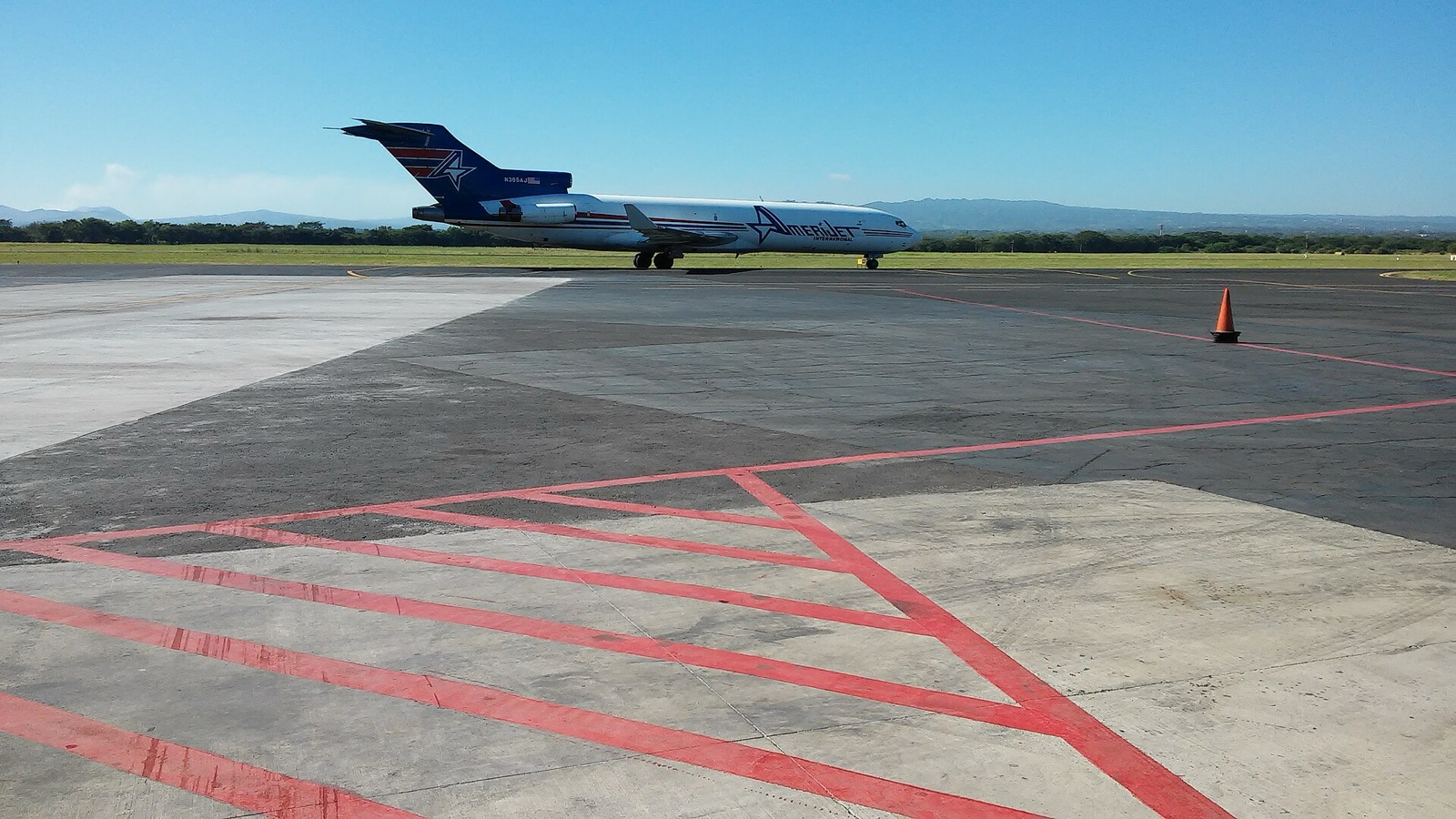
Photo: Cargo freighter at Managua airport, Nicaragua. Eveliojose10, CC BY-SA 4.0, via Wikimedia Commons.
Ready to ship your freight?
