
On this page13
Ship to Curaçao by LCL, FCL or air into Willemstad or CUR (4 to 8 days by sea from South Florida), clearing Douane Curaçao on ASYCUDA World with import duty plus 9% OB; Bonaire cargo enters Kralendijk under Douane Caribisch Nederland with 0% duty and 8% ABB. The two islands share a southern Caribbean rotation but are two different customs and tax systems, and treating them as one market is the most common costing mistake on this lane. Curaçao is an autonomous country within the Kingdom of the Netherlands, with its own customs administration, its own import tariff, a sales tax (OB) charged at import, and since March 2025 its own currency, the Caribbean guilder. Bonaire is a special municipality of the Netherlands (part of the Caribbean Netherlands), uses the US dollar and levies a general expenditure tax (ABB) instead of import duty. Curaçao is also an industrial port with a deep-water container terminal, ship repair and oil terminals, while Bonaire is a small, tourism-led island with lower volumes and fewer sailings. Both sit outside the EU customs territory, and both lie off the Venezuelan coast, whose import rules are covered in our guide to shipping to Venezuela. This guide treats each island separately wherever the rules differ.
Curaçao and Bonaire Shipping at a Glance: Transit Times and Options
Curaçao is 4 to 8 days from South Florida by full container and 1 to 3 days by air; Bonaire takes 1 to 2 weeks by sea because it has fewer sailings.
| Route & mode | Transit (port to port) | Best for |
|---|---|---|
| South Florida to Curaçao (Willemstad), Ocean FCL | 4 to 8 days | industrial equipment, food, building materials |
| South Florida to Curaçao, Ocean LCL | 5 to 10 days, plus consolidation cut-off | mixed pallets, spare parts, retail supply under ~15 CBM |
| South Florida to Bonaire (Kralendijk), Ocean FCL/LCL | 1 to 2 weeks, depending on sailing frequency | hotel, dive and retail supply, construction materials |
| Miami to CUR or BON, Air freight | 1 to 3 days | urgent spares, pharma, high-value parts |
| China to Curaçao, Ocean FCL | 30 to 45 days via transshipment | machinery, steel, furniture, fixtures |
| China to Curaçao or Bonaire, Ocean LCL | 35 to 50 days via transshipment | smaller Asian orders |
| Europe (Rotterdam area) to Curaçao or Bonaire, Ocean | 2 to 4 weeks depending on routing | Dutch food, equipment, building products |
Each range depends on sailing day, cut-offs and hub connections. Bonaire has fewer direct calls than Curaçao, so confirm the routing at booking. The sequence below applies to both islands, with one declaration per island.
How to Ship to Curaçao and Bonaire: Step by Step
Shipping to Curaçao or Bonaire follows eight steps, and every step runs once per island because each is a separate customs territory.
- Classify and check permits. Assign an HS code to every line under Curaçao's import tariff (Bonaire charges no duty but still requires the declaration), and request a UO Veterinaire Zaken permit before shipping meat, dairy or eggs to Curaçao.
- Choose the mode and Incoterm. Pick LCL below about 15 CBM, a 20ft container above it and air for breakdown spares, then agree who pays freight and who pays Curaçao's duty and OB or Bonaire's ABB.
- Book from Miami or origin. Deliver US cargo to a Miami container freight station before the weekly cut-off, with a separate booking and bill of lading for Willemstad and for Kralendijk.
- Prepare the documents. Issue an itemized commercial invoice per island with HS codes, a packing list, the transport document consigned to the importer on the correct island, and any health or phytosanitary certificate.
- File the US export data. Submit Electronic Export Information (EEI) in AES when a Schedule B line is valued over $2,500 or the goods need an export licence.
- Transit and manifest. The carrier transmits the manifest electronically before arrival; Bonaire cargo waits for the next direct call or a connection.
- Declare in ASYCUDA World. A licensed broker files with Douane Curaçao for Willemstad and CUR; a registered importer, broker or representative files with Douane Caribisch Nederland for Bonaire, attaching the invoice and bill of lading as PDF files.
- Pay and take delivery. Pay import duty, 9% OB and excise in Curaçao, or 8% ABB and excise on Bonaire, then collect the cargo for final delivery.
The booking in step 3 starts, for most importers, in South Florida.
Shipping From the USA to Curaçao and Bonaire
South Florida is the main US gateway for both islands, with weekly services from Port Everglades and Miami and published port-to-port transit to Willemstad of four to eight days. The same rotations call all three ABC islands, so the lead times and cut-offs match those for shipping to Aruba. Curaçao is the larger and better-connected port; Bonaire receives fewer calls, so its effective lead time is driven by sailing frequency rather than distance.
LCL is the right default for most US shipments to either island. Cargo is received at a Miami container freight station, consolidated, and you pay by the cubic meter or weight ton; IWF runs that consolidation weekly from its Miami warehouse. Because Curaçao and Bonaire are separate customs territories, each island needs its own bill of lading, consignee and declaration: a pallet for Kralendijk cannot be cleared in Willemstad and forwarded on as domestic cargo. Once a recurring shipment reaches 15 CBM, a 20ft container is cheaper per unit; full loads move under Caribbean container shipping, including flat racks and open tops for out-of-gauge equipment going to Curaçao's industrial and port users.
Air cargo lands at Curaçao International Airport (CUR) at Hato and at Flamingo International Airport (BON) on Bonaire. Air suits replacement parts for marine and power equipment, pharmaceuticals and urgent hospitality supply; see air freight to the Caribbean for options. Rule of thumb: if a breakdown idles a crane, a generator or a vessel, the air premium is the cheaper cost. Asian cargo reaches the same islands by a longer route.
Shipping From China, Asia and Europe to Curaçao and Bonaire
No regular direct service links China with either island: Asian cargo transships at a regional hub (Panama, Cartagena, Kingston or Caucedo) and continues on a feeder to Willemstad, with Bonaire cargo taking a further connection where no direct call is available. Plan on 30 to 45 days for a full container to Curaçao, and 35 to 50 days for LCL and for Bonaire. The trade-offs between those hubs are covered in Caribbean transshipment hubs.
Two routings work. Full containers of machinery, steel, furniture or fixtures go via a hub directly to Willemstad. Smaller Asian orders are more efficient routed through Miami, where they are received, combined with US-origin cargo and sent on the weekly consolidation, which turns several partial lots into one arrival with one set of documents. For product-level guidance on the China lane, see the China to Curaçao shipping guide.
Shipping From Europe to Curaçao and Bonaire
The Dutch connection keeps a regular flow of European cargo on this lane: Dutch dairy and processed food, beverages, building products and technical equipment. Transatlantic services from North European ports reach the ABC islands either directly or via a regional hub, with transit of two to four weeks. Being part of the Kingdom of the Netherlands does not make either island part of the EU customs territory: European goods are imported and taxed locally like any other origin, under Curaçao's tariff and OB, or Bonaire's ABB. All of these routings end at the ports below.
Which Ports and Airports Handle Cargo in Curaçao and Bonaire?
Curaçao's cargo moves through the Port of Willemstad and CUR airport, and Bonaire's through the Port of Kralendijk and BON airport.
- Port of Willemstad, St. Anna Bay (UN/LOCODE CWWIL): Curaçao's main commercial port, managed by Curaçao Ports Authority (CPA). The Willemstad Container Terminal is operated by Curaçao Port Services (CPS) under concession, has an annual capacity of around 100,000 TEU, about 1,000 m of total berth (460 m maximum berth length), two ship-to-shore gantry cranes that went into operation in December 2020, 12.2 m maximum depth, and RoRo and LoLo capability. The bay also hosts cruise terminals, a refinery and a drydock.
- Bullenbaai and Fuik Bay (Curaçao): Bullenbaai is the oil and gas terminal; Fuik Bay, Caracas Bay and St. Michael Bay complete CPA's port portfolio for bulk and specialized cargo.
- Curaçao International Airport (CUR): the air cargo gateway at Hato.
- Port of Kralendijk (Bonaire): Bonaire's commercial port in the capital, handling cargo at a much smaller scale than Willemstad.
- Flamingo International Airport (BON): Bonaire's air cargo gateway.
Two ports and two airports mean two customs offices, which is where the islands diverge most.
How Does Customs Clearance Work in Curaçao and Bonaire?
Both islands clear imports on ASYCUDA World, but through two separate customs administrations, so each shipment needs its own declaration on its own island.
Customs Clearance in Curaçao
Curaçao imports clear through Douane Curaçao (Curaçao Customs) on ASYCUDA World, the UNCTAD platform, as documented in the UNCTAD ASYCUDA case study on Curaçao. Carriers submit manifests electronically, and declarations are filed electronically by a licensed local customs broker acting for the consignee.
- Manifest transmitted by the carrier before arrival
- Electronic import declaration in ASYCUDA World with HS classification under Curaçao's tariff
- Valuation on CIF (cost, insurance and freight)
- Risk-based inspection, plus veterinary or phytosanitary checks for regulated goods
- Payment of import duty, OB and excise, then release
Customs reclassifies goods after control when the declared code does not match the product, which can move a line from a low rate to a much higher one. Line-level HS codes on the invoice are the best protection.
Customs Clearance in Bonaire
Bonaire imports clear through Douane Caribisch Nederland (Caribbean Netherlands Customs, part of the Belastingdienst Caribisch Nederland), a Dutch administration separate from Douane Curaçao. Declarations are filed electronically in ASYCUDA World as well, by importers, customs brokers or representatives registered with Douane Caribisch Nederland, with the invoice and bill of lading attached as PDF files, according to the Belastingdienst Caribisch Nederland. Import duty is nil, but goods are still declared and the ABB is assessed at import, so a broker and complete documents are still required. That ABB is the core of the tax difference between the two islands.
What Are the Import Duties and Taxes in Curaçao and Bonaire?
Curaçao charges import duty plus 9% OB on imports, while Bonaire charges no import duty and 8% ABB.
Curaçao Import Duties and OB
- Import duty: set by HS code under the Curaçao import tariff ordinance (Landsverordening tarief van invoerrechten), calculated on the customs value (goods price plus freight and insurance). Rates vary widely by product, so classification sets the cost.
- Sales tax (OB) on import: 9%: import duties, OB and excise are all calculated on the customs value, and OB on imported goods is 9%, as Douane Curaçao shows in its worked example. Domestically, OB runs at 6% standard, 7% for insurance and short stays, and 9% for listed goods such as vehicles, beverages, tobacco and mobile phones. Basic necessities such as bread, rice, flour, eggs and fresh fruit and vegetables are exempt.
- Anticumulation relief: qualifying business importers can apply to deduct 50% of the OB paid on imported trade goods in their monthly OB return, according to the Belastingdienst Curaçao.
- Excise: gasoline, cigarettes, beer, wine and spirits carry excise duty.
- Economic zones: goods leaving a Curaçao e-zone for the local market are subject to OB at import.
Bonaire Import Duty and ABB (Caribbean Netherlands)
- Import duty: 0% on all goods.
- ABB (general expenditure tax): 8% on goods, levied on the customs value including freight, insurance, packaging and commission costs, according to the Belastingdienst Caribisch Nederland. Passenger cars are taxed at 25% and zero-emission electric cars at 0% (since 1 January 2020). Defined basic-need food categories (including dairy, vegetables, fruit, grains, oils and sugars) are exempt.
- Excise: applies on Bonaire to petrol, beer, wine, spirits and tobacco, under the BES Customs and Excise Duties Act.
- Currency: Bonaire uses the US dollar; Curaçao uses the Caribbean guilder (XCG), which replaced the Netherlands Antillean guilder on 31 March 2025.
The practical difference is large: the same container of building materials pays duty plus 9% OB in Curaçao and only 8% ABB in Bonaire. For a regional comparison, see Caribbean import duties and taxes. Both assessments start from the same set of documents.
What Documents Are Required to Ship to Curaçao and Bonaire?
Each island needs its own set: commercial invoice, packing list and transport document, plus health, phytosanitary or permit documents for regulated goods.
- Commercial invoice per island, itemized with HS codes, unit values, currency and Incoterm (see commercial invoice requirements)
- Packing list with weights, dimensions and package marks
- Bill of lading or air waybill consigned to the importer on the correct island
- Health certificates for products of animal origin; phytosanitary certificates for plants, fruit and vegetables
- Import licence or permit where the product requires one
- Certificate of origin when requested
- Broker authorization for the declaration in Curaçao or Bonaire
The permit and certificate lines apply to the regulated categories in the next section.
Restricted Goods and Import Permits in Curaçao and Bonaire
Regulated cargo to Curaçao and Bonaire is mainly food of animal origin, plants, vehicles, excise goods and heavy lifts.
- Products of animal origin (Curaçao): meat, dairy, eggs, honey and gelatin must come from establishments recognized by the USDA, the EU or Curaçao's veterinary service, travel with an official international health certificate, and need an import permit valid for 30 days, issued by UO Veterinaire Zaken after the documents are submitted. All meat is physically inspected at the port of entry.
- Plants and produce (Curaçao): plants, flowers, fruit and vegetables should travel with a phytosanitary certificate from origin; confirm the requirement for the specific product before shipping.
- Vehicles (Bonaire): passenger cars carry the 25% ABB rate unless zero-emission electric.
- Excise goods: alcohol, tobacco and fuels are controlled and taxed on both islands.
- Out-of-gauge and heavy lift: port equipment, generators and marine machinery to Willemstad need flat racks or breakbulk planning and a crane plan at destination.
- Dangerous goods: hazmat moves under IMDG and IATA DGR rules with correct declarations; check acceptance before booking LCL.
With permits in place, the choice of mode comes down to volume and urgency.
LCL, FCL or Air Freight to Curaçao and Bonaire: Which to Choose?
Volume decides the mode for Curaçao and Bonaire: LCL below 15 CBM, a 20ft container above it, and air when downtime costs more than freight.
- Under 15 CBM: LCL from Miami, one shipment per island, consolidated weekly.
- 15 CBM and above: a 20ft FCL costs less per unit and reduces handling.
- Above 30 CBM or heavy machinery: 40ft, flat rack or open top to Willemstad.
- Bonaire: with fewer sailings, consolidate orders into a regular cycle rather than shipping ad hoc, and allow for longer transit.
- Air: for breakdown spares, pharma, and small high-value cargo where downtime costs more than freight.
Those thresholds map closely onto the industries that import the most.
Key Industries Shipping Freight to Curaçao and Bonaire
Curaçao has the most industrial profile of the Dutch Caribbean. Its port complex combines a container terminal, oil and gas terminals at Bullenbaai, a drydock and ship repair, so it imports machinery, spare parts, steel, cranes and marine equipment alongside the food, beverages and consumer goods its population and tourism sector need. Tourism and construction add hotel FF&E and building materials, and the island's e-zones handle goods for regional distribution.
Bonaire's demand is driven by tourism, diving, construction and public works, with a heavy share of food, building materials and vehicles, much of it sourced in the US and the Netherlands. Industrial cargo to Curaçao (heavy lifts, out-of-gauge units and critical spares) has its own planning rules, which we cover in Shipping Industrial and Port Equipment to Curaçao.
Choosing a Freight Forwarder for Curaçao and Bonaire
On this lane the forwarder must keep two customs systems straight: separate documents, consignees and declarations for Willemstad and Kralendijk, correct HS codes for Curaçao's tariff, and the right ABB treatment for Bonaire. Interworld Freight has operated from Miami since 1992, with a Miami warehouse that receives and consolidates cargo from US, Asian and European suppliers, and handles ocean FCL and LCL, air freight and customs coordination with the destination broker, with coverage on every major trade lane. For South Florida routings, see Miami freight forwarding to the Caribbean. Quotes are answered within one business day.
Frequently Asked Questions
Are Curaçao and Bonaire the same customs territory?
No. Curaçao is an autonomous country with its own customs (Douane Curaçao), tariff and sales tax. Bonaire is a special municipality of the Netherlands under Douane Caribisch Nederland, with 0% import duty and an 8% ABB on goods. Each island needs its own documents and declaration.
How long does shipping to Curaçao take?
Ocean freight from South Florida to Willemstad takes 4 to 8 days port to port, and air freight to CUR takes 1 to 3 days. From China, plan on 30 to 45 days for a full container because cargo transships at a regional hub.
What taxes apply when importing into Curaçao?
Curaçao charges import duty by HS code on the customs value, plus 9% sales tax (OB) on imported goods, calculated on the same customs value. Excise applies to fuel, tobacco, beer, wine and spirits, and qualifying business importers can deduct half of the import OB on trade goods.
Is there import duty on Bonaire?
No. Import duty in the Caribbean Netherlands is nil for all goods. Bonaire levies an 8% ABB on goods at import, 25% on passenger cars (0% on zero-emission electric cars), and excise on fuel, alcohol and tobacco.
What currency is used in Curaçao and Bonaire?
Curaçao uses the Caribbean guilder, which replaced the Netherlands Antillean guilder on 31 March 2025. Bonaire uses the US dollar, which simplifies invoicing for US exporters.
Do I need a health certificate to ship food to Curaçao?
For products of animal origin, yes: meat, dairy and eggs need an official health certificate, an approved producing establishment and an import permit from UO Veterinaire Zaken, valid for 30 days. Fresh plants, fruit and vegetables should travel with a phytosanitary certificate.
Should I ship LCL or a full container?
Ship LCL from Miami below 15 CBM, with a separate shipment per island, and a full container above it. A 20ft container costs less per unit from that volume, and heavy or oversized equipment to Willemstad moves on flat racks or as breakbulk.
What goods are restricted when shipping to Curaçao or Bonaire?
The main controls fall on products of animal origin, plants and produce, excise goods (alcohol, tobacco and fuel), passenger cars on Bonaire, and dangerous goods. Curaçao requires a veterinary import permit for meat, dairy and eggs, and hazmat must be declared under IMDG or IATA DGR rules before booking.
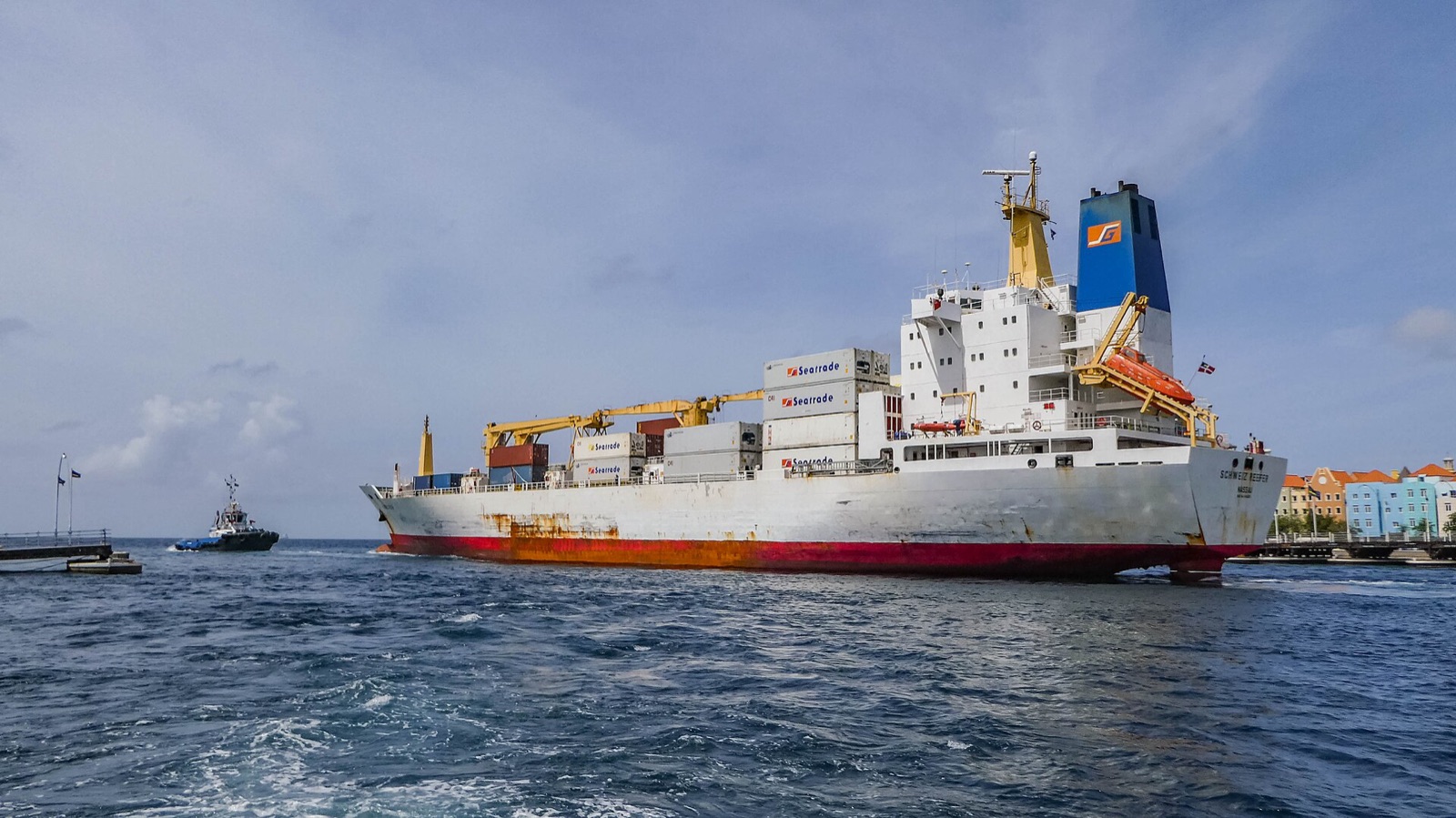
Photo: Container ship leaving Willemstad harbour, Curaçao. -JvL- from Netherlands, CC BY 2.0, via Wikimedia Commons.
Ready to ship your freight?
