
On this page14
The four Dutch Caribbean islands share a language of administration but not a tariff. Aruba, Curaçao and Bonaire clear imports on ASYCUDA World, Sint Maarten runs a different model, and the taxes range from 0% duty plus 8% on Bonaire to a 12% median duty plus border levies on Aruba.
Importers who price the four as one market get the landed cost wrong. Our container shipping to the Caribbean service moves FCL and LCL cargo to all four, and this guide sets out what each customs administration collects.
What Aruba, Curaçao, Bonaire and Sint Maarten Have in Common
Each island has its own customs and tax legislation. Aruba, Curaçao and Sint Maarten are countries within the Kingdom of the Netherlands that set their own tariffs and taxes, and Bonaire is a public body of the Netherlands where the Caribbean Netherlands rules apply: the Belastingdienst Caribisch Nederland states that Bonaire, Sint Eustatius and Saba have their own customs legislation, and that it covers goods arriving from the European Netherlands too.
What carries across is short: the declaration is a single administrative document (the Dutch "Enig Document"), the electronic route runs on ASYCUDA World where it exists, and goods are released only after duties and taxes are paid.
Our Caribbean import duties and taxes overview puts these four next to the rest of the region.
Dutch Caribbean Customs at a Glance
| Territory | Customs authority | Electronic system | Main import taxes | Duty on goods |
|---|---|---|---|---|
| Aruba | Departamento di Aduana Aruba | ASYCUDA World | BBO/BAVP 4% and BAZV 3% at the border on customs value | Median 12%, necessities 0% to 12%, luxury goods higher |
| Curaçao | Douane Curaçao | ASYCUDA World | Turnover tax (OB) 6% general, 9% on listed goods | Set by HS code in the import tariff |
| Bonaire | Douane Caribisch Nederland | ASYCUDA World | ABB 8% on customs value | 0% on all goods |
| Sint Maarten | Customs Sint Maarten | Not described by Customs | Excise on unleaded gasoline only | None levied by Customs |
Taxes on Aruba and Bonaire run on customs value, which includes transport and insurance to destination. Aruba Customs converts at Afl. 1.80 per US dollar, and Bonaire works in US dollars, the legal tender of the Caribbean Netherlands since January 1, 2011. Curaçao and Sint Maarten replaced the Netherlands Antillean guilder with the Caribbean guilder (XCG) on March 31, 2025, pegged at 1.79 per US dollar, so an amount you still see in "Naf." for Curaçao or Sint Maarten is now quoted in Caribbean guilders.
How Does Customs Clearance Work in the Dutch Caribbean?
The sequence is shared; the details are not.
- Register as importer or appoint a broker. On Curaçao a broker needs the expediteur license; on Bonaire you register with customer service of Douane Caribisch Nederland.
- Obtain system access. ASYCUDA World logins come from Customs on Aruba, Curaçao and Bonaire.
- Classify the goods. The HS code sets the duty under each island's tariff law.
- Lodge the Enig Document. The declaration carries value, origin and the attached invoice and transport document.
- Selectivity. Customs can pick a declaration for a document check, ask for originals or inspect the goods; on Bonaire a green selection means no substantive check.
- Pay. Duties and taxes are settled before release. Curaçao accepts debit card, bank deposit, online payment and credit accounts.
- Release and collect. Cargo leaves the port once Customs releases the declaration.
Most commercial importers hand steps 1 to 5 to a licensed customs broker.
Documents Required for Dutch Caribbean Customs
- Commercial invoice with Incoterm, currency and unit values.
- Packing list matching the invoice.
- Bill of lading or air waybill.
- Enig Document, the single administrative document.
- Permits for exemptions or regulated goods, filed before arrival.
- Broker authorization where a third party declares.
- Temporary import form or private entrepot permit application on Aruba, when the regime applies.
Aruba Customs and Import Duties
Aruba's customs service, the Departamento di Aduana, has been autonomous since 2013 and declares on ASYCUDA World. The government requires every shipment to be declared on the Enig Document and recommends a local customs broker. The tariff itself rests on the Landsverordening Tarief van Invoerrechten.
Duty runs from 0% to 12% on basic goods and primary necessities, with a median of 12%, higher rates on luxury goods and duty-free entry for raw materials used in manufacturing. Excise applies to alcohol, tobacco and mineral oil products.
Importers most often miss the Aruban border levy. Since August 1, 2023, Customs charges 4% BBO/BAVP and 3% BAZV at the border, calculated on customs value, according to the Departamento di Aduana Aruba. Importers who resell can deduct the BBO paid at import from their BBO return to the Tax Department (DIMP), and the declarant must enter the customer's correct personal number before paying. Aruba converts customs value to florins at Afl. 1.80 per US dollar. The freight-and-insurance surcharges on the Customs website (16.5%, 11.5% and 21.5% by origin region) belong to the passenger-luggage method for travelers, not to commercial shipments, which are valued on the CIF basis from the documents. For the island and port, see our Aruba shipping guide.
Curaçao Customs and Import Duties
Douane Curaçao, an executive service of the Ministry of Finance, provides ASYCUDA World free of charge; frequent declarants request a username and password from the Head of Customs. Anyone declaring in their own name holds a permit, and filing for third parties requires the expediteur (customs broker) license; Customs also licenses ship agents and storage facilities.
Import duties, turnover tax (omzetbelasting) and excise are due on imports unless an exemption permit applies, and goods are released only after payment, according to Douane Curaçao. The Belastingdienst Curaçao lists the general turnover tax rate at 6%, with 7% for insurance and short-term tourist rentals. The statute adds a 9% rate for goods listed in its annex. Since September 27, 2019, Douane Curaçao applies an import exemption from turnover tax to bread, eggs, rice, potatoes, grain, flour, baby food, fruit, vegetables, medical aids and medicines.
Ships must report to Customs within 6 hours of arrival. For port details and the Bonaire route, see our Curaçao and Bonaire shipping guide.
Bonaire Customs and Import Duties
Bonaire has the simplest tariff of the four. Import duty is 0% on all goods, and the General Expenditure Tax (ABB) is 8% on Bonaire, against 6% on Saba and Sint Eustatius, per the Belastingdienst Caribisch Nederland. Passenger and delivery vehicles carry 25%, and zero-emission ones 0% since January 1, 2020.
ABB is charged on customs value, which includes import duties, taxes and levies plus commission, packaging, transport and insurance to the destination. On Bonaire, excise is paid on import and on removal of petrol, beer, wine, other alcohol and tobacco products.
Imports are declared on ASYCUDA World. You register with Douane Caribisch Nederland customer service, submit the Autorisatieformulier Asycuda World, install Java and attach the invoice, bill of lading and other support as PDF or JPEG files, as the Douane Caribisch Nederland explains.
Sint Maarten Customs and Import Duties
Customs Sint Maarten is a law enforcement agency under the Minister of Justice. It safeguards import duties and controls goods at the airport, the marinas, Great Bay harbor, the cruise terminal and the Post Office. On its own website, Customs Sint Maarten states that the only tax levied by Customs is excise on unleaded gasoline.
Consumption is taxed elsewhere. The Tax Administration's exemption list for the turnover tax ordinance records the rate rising from 3% to 5% on February 11, 2011, and it falls on business turnover, not at the border. The Customs page describes neither a declaration format nor a tariff schedule, so a broker confirms the entry procedure shipment by shipment. For the island and the neighboring routing, see our Anguilla and St Maarten shipping guide.
How to Calculate Import Duty and Taxes in the Dutch Caribbean
Value first, then duty, then the island's tax on customs value. The base differs by island, so build the cascade island by island.
Illustrative example, Aruba: goods with a customs value of US$10,000, converted at Afl. 1.80, which is Afl. 18,000, with a 12% duty rate.
- Duty at 12%: Afl. 2,160
- BBO/BAVP at 4% of customs value: Afl. 720
- BAZV at 3% of customs value: Afl. 540
- Total: Afl. 3,420
Illustrative example, Bonaire: the same goods at a customs value of US$10,000. Duty is 0%, ABB at 8% is US$800, and the total is US$800. Curaçao applies its 6% turnover tax plus the HS-coded duty, and the broker confirms the base on the declaration.
Exemptions, Free Zones and Special Regimes in the Dutch Caribbean
Curaçao offers temporary import and active processing, each tied to a declaration and a permit, and grants exemption from import duties by permit. Aruba publishes the temporary import and export form and the private entrepot permit application, and Bonaire publishes an overview of exemptions for temporary import. File every permit before arrival, because Customs applies the regime at the declaration.
Import Permits and Licensing in the Dutch Caribbean
Customs releases the tax; the technical authorities release the product. Curaçao prohibits some goods outright and permits others, with certain medicines and protected species as the standard examples. On every island, regulated food, plants, animals and medicines need the relevant ministry's clearance. Ask the broker for the permit list at booking.
Common Customs Delays in the Dutch Caribbean and How to Avoid Them
- Wrong personal number on Aruba. A BBO paid against the wrong customer number needs a refund request and a new declaration.
- Wrong customs value. Aruban levies run on customs value, so a miscalculation repeats across duty, BBO and BAZV.
- No system access. A broker without an ASYCUDA login or license cannot file; on Curaçao that means the expediteur license.
- Missing exemption permit. Without it Curaçao charges full duty and turnover tax.
- One quote for four markets. One landed-cost formula misses the 0% duty on Bonaire and the BBO on Aruba.
Clearing Cargo to the Dutch Caribbean With Interworld Freight
Interworld Freight has operated from Miami since 1992. Our Miami hub handles warehousing, ocean FCL and LCL, air freight, and customs coordination with licensed brokers at destination. Send the documents and HS codes and you get a quote within one business day.
Frequently Asked Questions
Do Aruba, Curaçao, Bonaire and Sint Maarten share one customs system?
No. Each island has its own customs legislation, authority and tariff. Aruba, Curaçao and Bonaire use ASYCUDA World.
What are the import taxes in Aruba?
Customs charges 4% BBO/BAVP and 3% BAZV on customs value at the border, plus import duty with a median of 12%.
Is there import duty in Bonaire?
No. Import duty is 0% for all goods, and the General Expenditure Tax is 8%. Vehicles carry 25%.
What is the turnover tax in Curaçao?
The general rate is 6%, with 7% for insurance and short-term tourist rentals and 9% for goods in a statutory list.
Does Sint Maarten charge import duty?
The Customs department states that the only tax it levies is excise on unleaded gasoline. Turnover tax of 5% applies to businesses.
Do I need a customs broker in Curaçao?
To declare for a third party you need the expediteur license, so most importers hire a licensed broker.
Is duty calculated on CIF in the Dutch Caribbean?
Customs value is the base for taxes on Aruba and Bonaire, and it includes transport and insurance to destination. Confirm the Curaçao base with your broker.
Does the same product pay the same tax on every island?
No. A US$10,000 consignment pays 8% ABB and no duty on Bonaire, while the same goods on Aruba pay duty plus 7% in border levies.
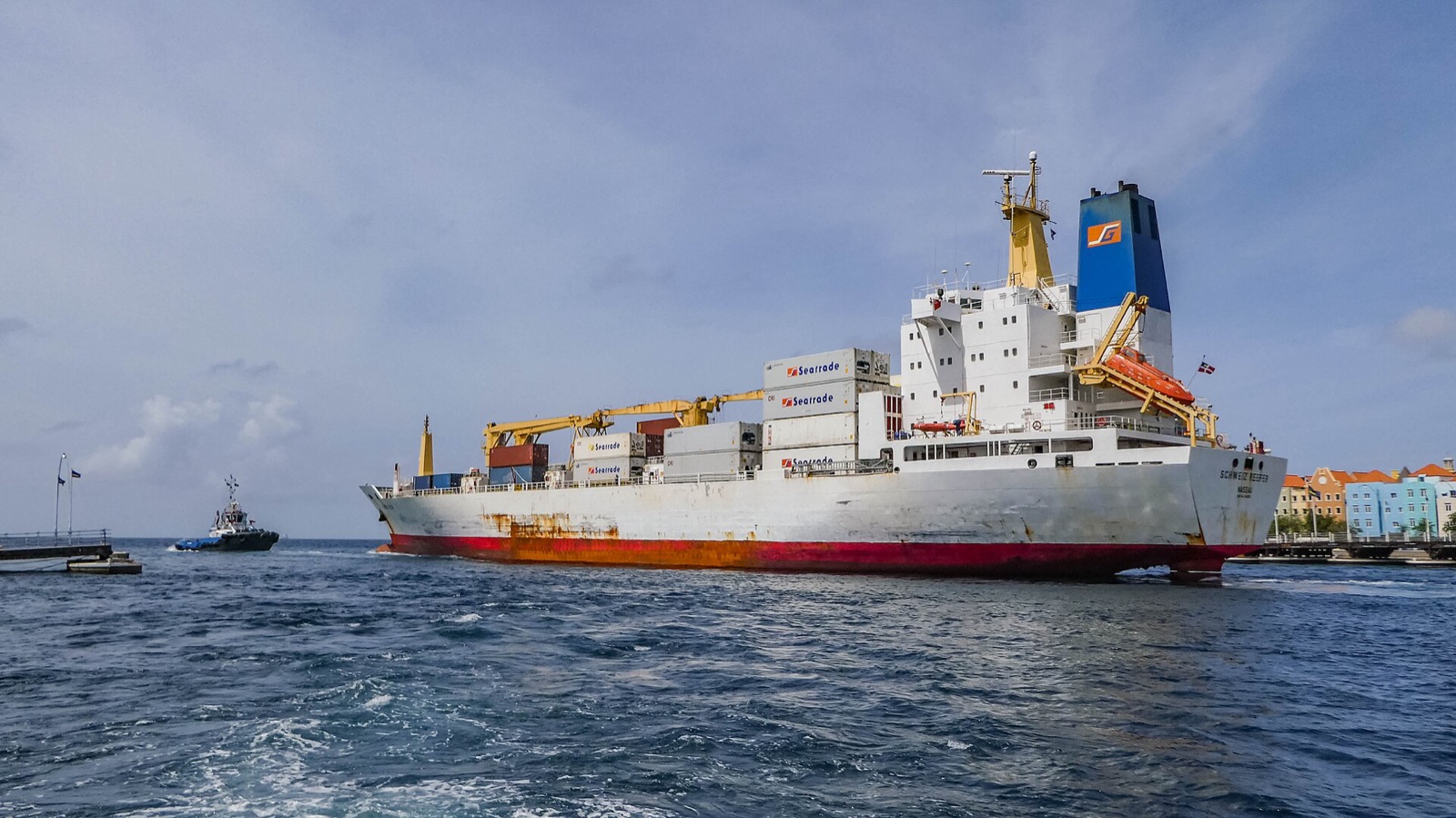
Photo: Container ship leaving Willemstad harbour, Curaçao. -JvL- from Netherlands, CC BY 2.0, via Wikimedia Commons.
Ready to ship your freight?
