
On this page13
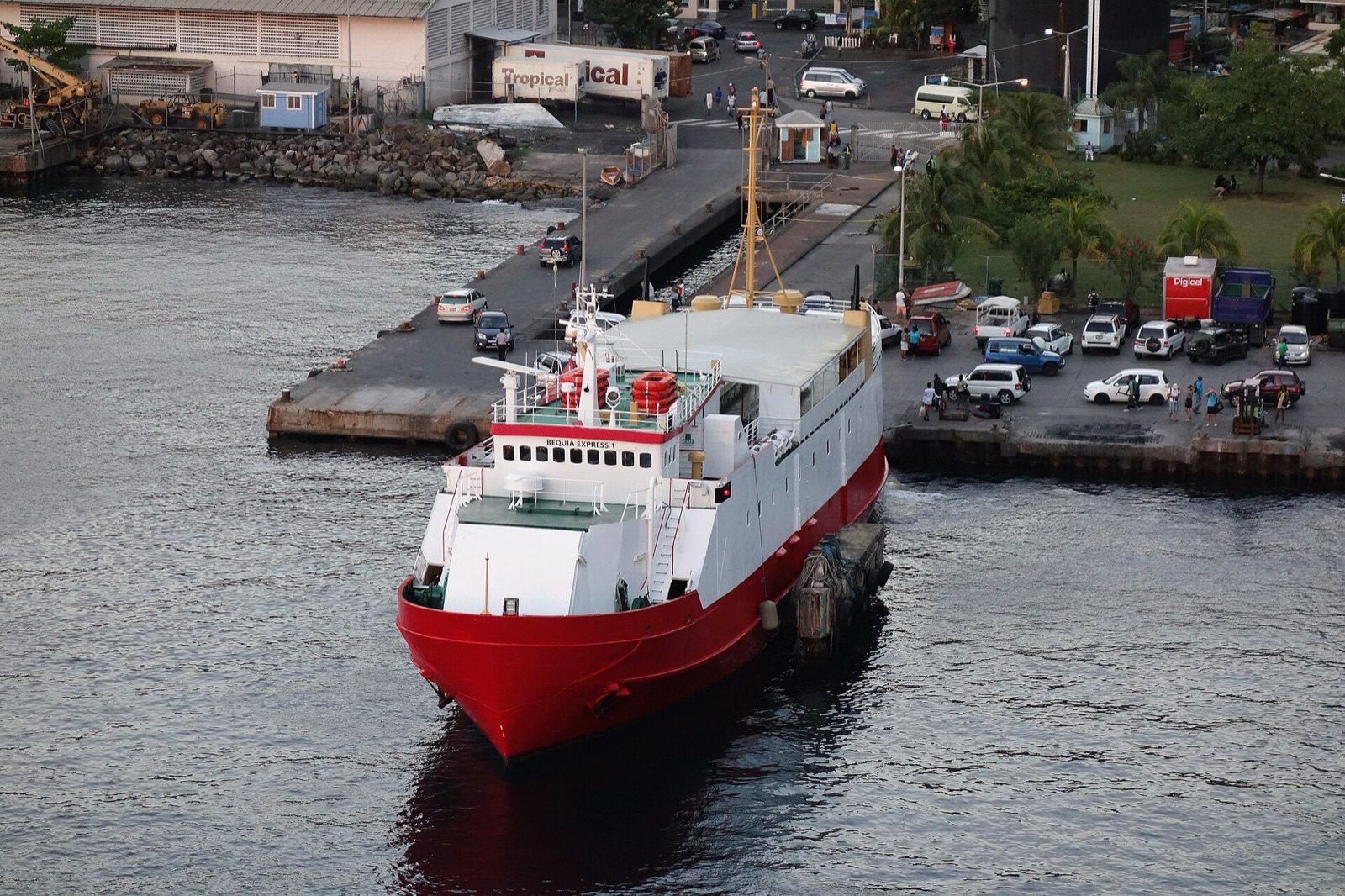
You ship to St Vincent and the Grenadines by ocean LCL or FCL into Kingstown Port or by air into Argyle (SVD): LCL from Miami takes about 5 days, and cargo clears Customs and Excise on ASYCUDA World with CARICOM CET duty, a 6% Customs Service Charge and 16% VAT. St Vincent is a multi-island market with a single main gateway: cargo for Bequia, Canouan, Mustique or Union Island lands in Kingstown and moves onward by inter-island vessel after clearance. The gateway itself changed recently: a new deepwater port at Rose Place, Kingstown, opened on 25 October 2025 and now handles container, breakbulk and vehicle cargo, while the older Campden Park terminal is being repositioned for bulk materials. Commercial entries went paperless on ASYCUDA World in June 2026, so the Kingstown discharge, the electronic entry and the onward island leg are three separate planning steps.
St Vincent and the Grenadines Shipping at a Glance: Transit Times and Options
LCL from Miami reaches Kingstown in about 5 days, air freight to Argyle takes 1 to 3 days, and Asian cargo needs 35 to 50 days through a transshipment hub.
| Route & mode | Indicative cost | Transit | Best for |
|---|---|---|---|
| Miami to Kingstown, ocean LCL | About $955 for 5 CBM / 1,500 kg (IWF published LCL rate, September 2026; excludes destination duties, taxes and local charges) | About 5 days (CFS Miami to port) | Retail restocking, groceries, building supplies under 15 CBM |
| Miami to Kingstown, ocean FCL 20ft / 40ft | On request | 5 to 10 days, depending on direct or relay sailing | Full loads of food, beverages, construction materials |
| Miami to Argyle (SVD), air freight | On request | 1 to 3 days, depending on flight connections | Spare parts, pharmaceuticals, urgent and high-value cargo |
| China / Asia to Kingstown, ocean (via transshipment) | On request | 35 to 50 days, depending on the feeder connection | Factory orders, hotel FF&E, hardware |
| Europe (UK / Netherlands) to Kingstown, ocean | On request | 12 to 18 days on the direct UK and Netherlands service | UK and EU consumer goods, vehicles, machinery |
Rates move with fuel, season and equipment availability. Use the table for planning and request a firm quote for your commodity.
How to Ship to St Vincent and the Grenadines: Step by Step
Shipping to St Vincent takes eight steps, from HS classification to the Kingstown gate pass.
- Classify and check permits. Find the HS code in the Customs and Excise online tariff search (HS 2022) and confirm whether the goods need a Ministry of Agriculture permit, a police permit (arms) or a health certificate.
- Choose the mode and Incoterm. LCL from Miami fits loads under 15 CBM, FCL fits full loads of a single product, and air to Argyle fits urgent or high-value cargo; agree who pays freight and insurance (FCA, CIF or DAP) with the buyer.
- Book from Miami or origin. Deliver the goods to the Miami CFS for the next weekly consolidation, or book FCL space on a direct or relay sailing to Kingstown.
- Prepare the documents. Issue the commercial invoice with HS codes and Incoterm, the packing list, the bill of lading or air waybill, and the CARICOM certificate of origin or permits where they apply.
- File the US export data. For US exports, file the Electronic Export Information in AES when any Schedule B line exceeds $2,500 or the goods need an export license.
- Transit and manifest. The carrier transmits the manifest before arrival at Kingstown Port (Rose Place) or Argyle, and the LCL deconsolidation data links each house bill to its consignee.
- Lodge the entry and pay. A licensed customs broker lodges the declaration in ASYCUDA World, and duty, the 6% Customs Service Charge, excise and 16% VAT are paid online through GovPay or at the cashier.
- Release and deliver. After customs release and settlement of port charges, the port issues the gate pass; cargo for Bequia, Canouan, Mustique or Union Island then moves by inter-island vessel or regional air.
For most Vincentian importers the origin lane starts in Miami.
Shipping From the USA to St Vincent and the Grenadines
Miami is the gateway for US cargo to St Vincent: suppliers across Florida, the Southeast and the Midwest truck freight to a Miami consolidation warehouse, where it is received, measured, labeled and loaded into a container that sails directly or via a relay port to Kingstown. On the IWF consolidation service, a 5 CBM / 1,500 kg shipment moves FCA Miami CFS to Kingstown in about 5 days, at about $955 (IWF published LCL rate, September 2026; excludes destination duties, taxes and local charges).
LCL is the default on this lane. Most Vincentian importers (supermarkets, hardware stores, pharmacies, hotel operators in the Grenadines) buy in volumes that fill a pallet or a few cubic meters, not a container. Ocean freight consolidation to the Caribbean lets those buyers combine orders from several US vendors into one booking and one customs entry in Kingstown, which matters because every separate entry carries its own broker fee and port charges. Once a regular flow reaches 15 CBM, a 20ft container starts to compete on cost; dense loads such as tiles, cement products or canned goods hit the container weight limit before they fill the space, so check both volume and weight.
Air freight lands at Argyle International Airport (SVD), which opened in 2017 and replaced the old E.T. Joshua airfield as the international gateway. Use air freight to the Caribbean for machinery parts that are holding up a project, medical supplies and perishables with short shelf lives. For cargo going to the Grenadines, factor the inter-island leg into the timeline: air or ocean, it clears in St Vincent first and then moves by local vessel or regional air carrier.
US freight is the short leg; factory orders from Asia take a longer and less direct route.
Shipping From China, Asia and Europe to St Vincent and the Grenadines
Asian cargo reaches St Vincent only through a transshipment hub, while Europe has a direct liner service from the UK and the Netherlands.
Shipping From China and Asia to St Vincent
There is no direct Asia to Kingstown service. Containers from Shanghai, Ningbo, Shenzhen or other Asian ports transship at a regional hub such as Kingston (Jamaica), Cartagena, the Panama Canal ports or the Dominican Republic, then move on a feeder vessel to the Eastern Caribbean. Door to port transit runs 35 to 50 days, and a missed feeder connection adds a week. The guide to Caribbean transshipment hubs explains how those connections are built.
For smaller Asian orders, the most reliable route is two-legged: ship LCL or FCL from Asia into Miami, then consolidate with US-origin freight for Kingstown. That gives one customs entry in St Vincent for mixed Asian and US goods, lets the importer inspect or relabel in Miami, and avoids paying for a half-empty container on a long feeder rotation. Full containers of a single product (tiles, furniture, hotel case goods) still move direct via a transshipment hub when the volume justifies it.
Shipping From Europe to St Vincent
Europe has a direct link to St Vincent. Geest Line loads in Portsmouth (UK) and Vlissingen (Flushing, Netherlands) and lists St Vincent and the Grenadines among its Eastern Caribbean ports of call, alongside Barbados, St Lucia, Grenada and Dominica. Plan on 12 to 18 days port to port. Importers with buyers on several islands can compare this lane with shipping to St Lucia and shipping to Barbados on the same rotation. European cargo also routes through the French Caribbean or a Caribbean hub on the larger carriers' networks. UK-origin goods remain common in Vincentian retail, and the UK service also carries reefer and breakbulk.
Every origin ends at the same two gateways.
Which Ports and Airports Handle Cargo in St Vincent and the Grenadines?
St Vincent has one main cargo port (Kingstown, at Rose Place), one international cargo airport (Argyle, SVD) and a set of Grenadines landings fed after clearance.
- Kingstown Port (Rose Place), Kingstown: the primary cargo port since it opened on 25 October 2025. Built under the Kingstown Port Modernization Project with Caribbean Development Bank and UK Caribbean Infrastructure Fund financing, it has a 380 m quay with a draft of about 12.5 m, container, breakbulk and vehicle storage areas, reefer racks and a design capacity of about 56,000 TEU a year. UN/LOCODE VCKTN.
- Campden Park, north of Kingstown: the former container terminal. The government plans to reposition it as a regional transshipment hub for bulk materials with a digital yard management system. Confirm with the carrier which terminal your vessel discharges at.
- Argyle International Airport (SVD), east coast of St Vincent: the international air cargo gateway.
- Grenadines: Bequia (Port Elizabeth), Canouan, Mustique and Union Island receive cargo by inter-island vessel and regional air after clearance on St Vincent.
Release from either gateway depends on the customs entry.
How Does Customs Clearance Work in St Vincent and the Grenadines?
Imports into St Vincent clear through the Customs and Excise Department (Upper Bay Street, Kingstown) on ASYCUDA World, with the entry lodged by a licensed customs broker. On 8 June 2026 the department went live with ASYCUDA World 4.4.0, moving commercial entries and entries for home use to a paperless workflow: declarations, supporting documents and approvals are handled electronically, and duties are paid online through GovPay on the customs portal. The department also publishes a tariff search (HS 2022), duty calculators and a broker directory. The next step is the Vincy Single Window for Trade Facilitation (VSWIFT), which the 2026 Budget Address says will connect 16 trade-related government agencies to one digital interface, alongside an updated Customs (Management) Act covering post-clearance audits, advance rulings and penalties.
- Manifest: the carrier or vessel agent transmits the cargo manifest before arrival; for LCL, the consolidator's deconsolidation data links each house bill to its consignee.
- Declaration: a licensed customs broker lodges the entry in ASYCUDA World with the commercial invoice, bill of lading and any permits.
- Assessment: goods are classified under the CARICOM tariff and valued on a CIF basis; ASYCUDA calculates duty, service charge, excise and VAT.
- Payment and inspection: charges are paid (online or at the cashier), and selected entries are routed to physical examination.
- Release and gate pass: after customs release, the port authority issues the gate pass once port handling and storage charges are settled.
Storage accrues quickly after free time, so have documents ready before the vessel arrives. The assessment step fixes the landed cost, built from the tax layers below.
What Are the Import Duties and Taxes in St Vincent and the Grenadines?
Imports into St Vincent pay CARICOM Common External Tariff duty by HS code, a 6% Customs Service Charge on CIF value and 16% VAT, plus excise on specific goods. St Vincent and the Grenadines is a member of CARICOM and the OECS, and the landed cost of a non-CARICOM shipment is built in layers:
- Import duty (CARICOM Common External Tariff): rates set by HS code. Basic foods, raw materials and capital inputs sit at low or zero rates; finished consumer goods sit higher. Goods of CARICOM origin with a valid certificate of origin enter duty free.
- Customs Service Charge (CSC): 6% of the CIF value of nearly all imports, including many duty-free goods. The rate rose from 5% to 6% from June 2021, a one percentage point increase announced in the 2021 Budget Address to fund regional bodies. Temporary waivers apply to specific goods (in May 2026 the CSC on LPG and on diesel for power generation was lifted for three months).
- Excise tax: on alcoholic beverages, tobacco, petroleum products, used tires, motor vehicles, non-alcoholic beverages and water, among others.
- VAT at 16%: collected by Customs on the duty-inclusive value when goods are entered for home use. A reduced 11% rate applies to hotel accommodation (a domestic supply, not an import). The government is assessing a general VAT cut and VAT removal on essentials, with an implementation target of October 2026, so confirm the rate in force on your entry date.
Because VAT compounds on top of duty and service charge, an error in classification multiplies through the whole landed cost. The CET duty layer is shared across CARICOM, so a buyer comparing St Vincent with shipping to Grenada, its southern OECS neighbour, sees the same tariff structure with different national charges on top; for a regional comparison, see Caribbean import duties and taxes. Duty concessions for approved investments are granted case by case, not automatically, and the 2026 Budget proposes tightening them (a 20% reduction in total import concessions) while adding a duty-free regime for yacht parts and services.
How to Estimate Customs Fees for St Vincent
Classify the goods in the customs tariff search, then run the CIF value through the department's duty calculator: duty first, then the 6% CSC, excise where it applies, and VAT on the total. Textbooks are free of duty and taxes but still pay the service charge.
The calculator only works if the paperwork supports the values and origin you declare.
What Documents Are Required to Ship to St Vincent and the Grenadines?
A St Vincent entry needs a commercial invoice, packing list and transport document, plus origin, permit and health papers where the goods call for them.
- Commercial invoice with full description, HS code, unit values, currency and Incoterm
- Packing list (pieces, weights, dimensions per package)
- Bill of lading (ocean) or air waybill (air); house bill for LCL
- Certificate of origin when claiming CARICOM duty-free treatment
- Import licence or permit where the product requires one
- Phytosanitary or veterinary health certificate for plants, produce, meat and animal products
- Broker authorization and the importer's tax registration details for ASYCUDA World
The permit and health certificate lines apply to a defined group of goods, listed next.
Restricted Goods and Import Permits in St Vincent and the Grenadines
Food and agricultural products, firearms and vehicles carry the main permit and tax rules in St Vincent, and a short list of goods is banned outright.
- Food and agricultural products: plants, fresh produce, meat and dairy need permits and health certificates from the exporting country and clearance from the Ministry of Agriculture's plant protection and veterinary services before arrival.
- Arms and ammunition: restricted, and need an import permit from the Commissioner of Police.
- Prohibited goods: counterfeit currency and coins, food unfit for human consumption, and indecent or obscene prints and publications cannot be imported.
- Motor vehicles: import duty of 0% to 35% and excise of 35% to 60% depending on fuel type, engine size, seating, use and age, plus VAT, and an environmental tax on vehicles more than four years old, scaled by engine capacity. Use the department's vehicle duty calculator before buying.
- Hazardous materials: must be declared and moved under IMDG (ocean) or IATA DGR (air) rules; not every LCL service accepts them.
- Wood packaging: pallets and crates must be ISPM 15 treated and marked.
LCL, FCL or Air Freight to St Vincent and the Grenadines: Which to Choose?
Choose LCL from Miami for St Vincent shipments under 15 CBM, FCL above that, and air when the cargo is light, valuable or urgent.
- Under 15 CBM: LCL from Miami. It is the most common mode for Vincentian importers, and the IWF rate above shows the cost for a 5 CBM shipment.
- 15 to 28 CBM, or heavy dense cargo: compare LCL with a 20ft container; FCL also reduces handling for fragile goods.
- Above 28 CBM: a 40ft container wins on cost per cubic meter.
- Air: chargeable weight under a few hundred kilos, high value per kilo, or a stock-out costing more than the freight premium.
For the Grenadines, add the inter-island leg to the comparison: a full container bound for Bequia or Union Island is stripped in Kingstown anyway, which narrows the advantage of FCL.
Key Industries Shipping Freight to St Vincent and the Grenadines
Food and beverages are the largest import flow into St Vincent. The islands depend on imported staples, packaged foods, frozen and chilled proteins and beverages, much of it bought from US distributors in South Florida, and supermarkets and wholesalers replenish on short cycles that suit weekly LCL from Miami. Construction materials, hardware and household goods follow, supported by public works at the new port and airport and by resort and villa development in Canouan, Mustique and Bequia.
On the export side, agriculture leads: bananas, root crops and other produce move mainly to regional CARICOM markets, with arrowroot as a niche product. Tourism, concentrated in the Grenadines, pulls in hotel supplies, yacht provisions and FF&E. The largest single recurring flow is food, which is why our next guide focuses on food and grocery distribution and how Vincentian importers supply St Vincent from Miami.
Choosing a Freight Forwarder for St Vincent and the Grenadines
A forwarder for St Vincent earns its fee at the Miami end and the Kingstown end. You need a consolidation warehouse that receives from many US vendors, checks the paperwork before the box closes, and books space on a regular sailing, plus documents prepared so a Vincentian broker can lodge a clean ASYCUDA World entry on arrival. Interworld Freight was founded in Miami in 1992 and runs ocean FCL and LCL, air freight, Miami warehousing and customs coordination, with coverage on every major trade lane into the Caribbean. Learn how LCL consolidation works, review our Miami to Caribbean freight forwarding service, and request a quote: we answer within one business day.
Frequently Asked Questions
How long does shipping to St Vincent take from Miami?
LCL cargo moves from the Miami CFS to Kingstown in about 5 days on the IWF consolidation service. Air freight to Argyle International takes 1 to 3 days. Allow extra time for customs clearance and any onward leg to the Grenadines.
How much does it cost to ship LCL to St Vincent?
IWF's published LCL rate for 5 CBM / 1,500 kg from Miami to Kingstown is about $955 (September 2026). That figure excludes duties, VAT, the Customs Service Charge and local port and broker charges in St Vincent.
Which port handles cargo in St Vincent?
The main cargo port is the new Kingstown Port at Rose Place, open since 25 October 2025. The older Campden Park terminal is being repositioned for bulk materials, so confirm the discharge terminal with your carrier.
What taxes apply to imports into St Vincent and the Grenadines?
Imports pay CARICOM Common External Tariff duty, a 6% Customs Service Charge on CIF value, excise on specific goods and VAT at 16% on the duty-inclusive value. Rates depend on the HS code, so classify before you quote a landed price.
What items are exempt from import duty in St Vincent?
Goods of CARICOM origin with a valid certificate of origin enter free of import duty, and textbooks are free of duty and taxes. Most duty-free goods still pay the 6% Customs Service Charge. Other relief comes from case-by-case concessions for approved projects, not automatic exemptions.
How do I estimate customs fees for St Vincent?
Find the HS code in the Customs and Excise online tariff search, then use the department's duty calculator on the CIF value. The calculation stacks duty, the service charge, any excise and VAT on top of each other.
What happens if import duties are not paid?
Customs does not release goods until duties and taxes are paid, and port storage keeps accruing after free time. Pay online through the customs portal or at the cashier as soon as the entry is assessed.
How do I ship cargo to Bequia, Mustique or Union Island?
Cargo clears customs on St Vincent first, then moves to the Grenadines by inter-island vessel or regional air. Build that onward leg into your schedule and your cost estimate.
Photo: Kingstown harbour, St Vincent and the Grenadines. Ein Dahmer, CC BY-SA 4.0, via Wikimedia Commons.
Ready to ship your freight?
