
On this page14
You ship to Anguilla and St Maarten by ocean LCL or FCL into Philipsburg or Road Bay, or by air into SXM or AXA; Miami LCL takes 3 to 4 days, Sint Maarten and Saint-Martin charge no import duty, and Anguilla Customs (ASYCUDA World) charges duty plus 9% goods tax. One small island holds two countries: Sint Maarten, a constituent country of the Kingdom of the Netherlands, and Saint-Martin, a French overseas collectivity. Anguilla, a British Overseas Territory, sits eight kilometers north across the channel. Three customs administrations apply three different rule sets, none of them the CARICOM VAT model used in most of the Eastern Caribbean, and Port St. Maarten in Philipsburg serves as the container gateway and regional distribution point for the whole area.
Anguilla and St Maarten Shipping at a Glance: Transit Times and Options
Ocean LCL from Miami reaches Philipsburg in 3 days and Anguilla in 4 days port to port, air freight takes 1 to 3 days, and Asian cargo needs 35 to 50 days via a Caribbean transshipment hub.
| Route & mode | Indicative cost | Transit | Best for |
|---|---|---|---|
| Miami to St Maarten (Philipsburg), ocean LCL | about $815 for 5 CBM / 1,500 kg (IWF published LCL rate, September 2026; excludes destination duties, taxes and local charges) | 3 days port to port | hotel supplies, retail, F&B, building materials |
| Miami to Anguilla, ocean LCL | about $1,015 for 5 CBM / 1,500 kg (IWF published LCL rate, September 2026; excludes destination duties, taxes and local charges) | 4 days port to port | villas, resorts, contractors on Anguilla |
| USA to St Maarten, ocean FCL 20ft/40ft | Quote on request | 1 to 2 weeks | full fit-out packages, FF&E, steel, cement |
| USA to St Maarten or Anguilla, air freight | Quote on request | 1 to 3 days | spare parts, urgent and high-value cargo |
| China/Asia to St Maarten, ocean LCL or FCL | Quote on request | 35 to 50 days via transshipment | FF&E, fixtures, consumer goods |
| Europe to St Maarten, ocean | Quote on request | 3 to 5 weeks | French and Dutch-sourced goods, equipment |
Rates move with fuel, season and space. Use the table to plan and request a firm quote for your cargo.
How to Ship to Anguilla and St Maarten: Step by Step
Shipping to Anguilla and St Maarten follows eight steps, and the first one decides which customs rules apply:
- Identify the side and the authority. Dutch-side cargo clears with Sint Maarten Customs, French-side cargo with French Customs (DGDDI), and Anguilla cargo with the Anguilla Customs Department.
- Classify the goods and check permits. For Anguilla, the HS line in the Integrated Customs Tariff sets both duty and goods tax; on all three sides, firearms, pharmaceuticals, plants and animal products need permits before shipping.
- Choose the mode, the Incoterm and the port. Book Philipsburg for both sides of St Maarten and book Anguilla cargo directly to Road Bay, not via Philipsburg.
- Book from Miami or origin. US cargo joins the weekly Miami LCL consolidation (3 days to Philipsburg, 4 to Anguilla); Asian and European cargo relays at a Caribbean hub or consolidates in Miami.
- Prepare the documents. Issue a commercial invoice with unit values (and a CIF build-up for Anguilla), a matching packing list and a bill of lading with full local consignee details.
- File the US export record. For cargo leaving the US, file Electronic Export Information (EEI) in AES before departure whenever a Schedule B line exceeds $2,500 or the goods need an export licence.
- Declare on arrival. A local broker or the carrier's agent files with Sint Maarten Customs, a transitaire with French Customs, or a licensed broker in ASYCUDA World with Anguilla Customs.
- Pay and release. Anguilla collects duty, the 9% goods tax and the administrative fee before release; Dutch and French-side cargo pays no import duty and is released after declaration and any inspection.
The US leg comes first for most shippers, so the detail starts there.
Shipping From the USA to Anguilla and St Maarten
Miami is the main US gateway for Anguilla and St Maarten: consolidation services from South Florida reach Philipsburg in three days and Anguilla in four. Interworld Freight's published LCL rate for 5 CBM / 1,500 kg from Miami is about $815 to St Maarten and about $1,015 to Anguilla (September 2026, excluding destination duties, taxes and local charges). Cargo for the French side discharges at Philipsburg and moves by road across the island; the land border is open, but the consignee and the declaration must match the side where the goods are used.
LCL is the right tool for most shipments: a restaurant restock, a villa furniture package or a few pallets of building supplies rarely fill a container. Full containers make sense for hotel FF&E, cement, steel, roofing and phased construction packages, and for any shipment you want sealed from origin to site. Our Caribbean container shipping service covers both modes out of Miami.
For Anguilla, book directly to Anguilla. Cargo that lands in Philipsburg and is then re-shipped across the channel picks up a second set of handling charges and a second clearance. Direct LCL into Road Bay keeps it to one entry under Anguilla Customs. The same Miami consolidation logic applies across the Leeward Islands, as our guide to shipping to Antigua and Barbuda shows for the neighbouring market to the southeast.
Air freight lands at Princess Juliana International (SXM) on the Dutch side, the main air cargo gateway, or at Clayton J. Lloyd International (AXA) in Anguilla. Our Caribbean air freight service handles urgent parts, electronics and perishables out of Miami.
Shipping From China and Asia to Anguilla and St Maarten
Cargo from China and Asia reaches Anguilla and St Maarten by transshipment, because no direct Asia service calls the island. Cargo moves on a mainline vessel to a Caribbean hub and then on a regional feeder, 35 to 50 days in total, with the relay deciding where in that range a shipment lands. Our guide to Caribbean transshipment hubs explains how those connections work and where delays come from.
For hotel and villa projects that buy FF&E in Asia and building materials in the US, routing Asian cargo through Miami beats a separate China-to-Philipsburg booking. The goods are received, checked and consolidated in the Miami warehouse with US purchases and sail on the next St Maarten or Anguilla consolidation. One arrival, one set of documents and one delivery to site reduce the coordination load on a tight build schedule.
Shipping From Europe to Anguilla and St Maarten
Europe is a core origin for Anguilla and St Maarten, not a footnote: the Dutch side buys from the Netherlands, the French side from France, and both carry European brands in retail and hospitality. European cargo reaches Philipsburg in three to five weeks with one relay at a Caribbean hub. For Saint-Martin, check the tax treatment if goods might later move on to Guadeloupe or mainland France: French Customs treats those movements as imports, subject to VAT and octroi de mer on arrival. All of these origins converge on the same small set of ports.
Which Ports and Airports Handle Cargo in Anguilla and St Maarten?
Port St. Maarten in Philipsburg handles the container cargo for St Maarten and its neighbours, Road Bay is Anguilla's commercial cargo port, and SXM is the main air cargo airport:
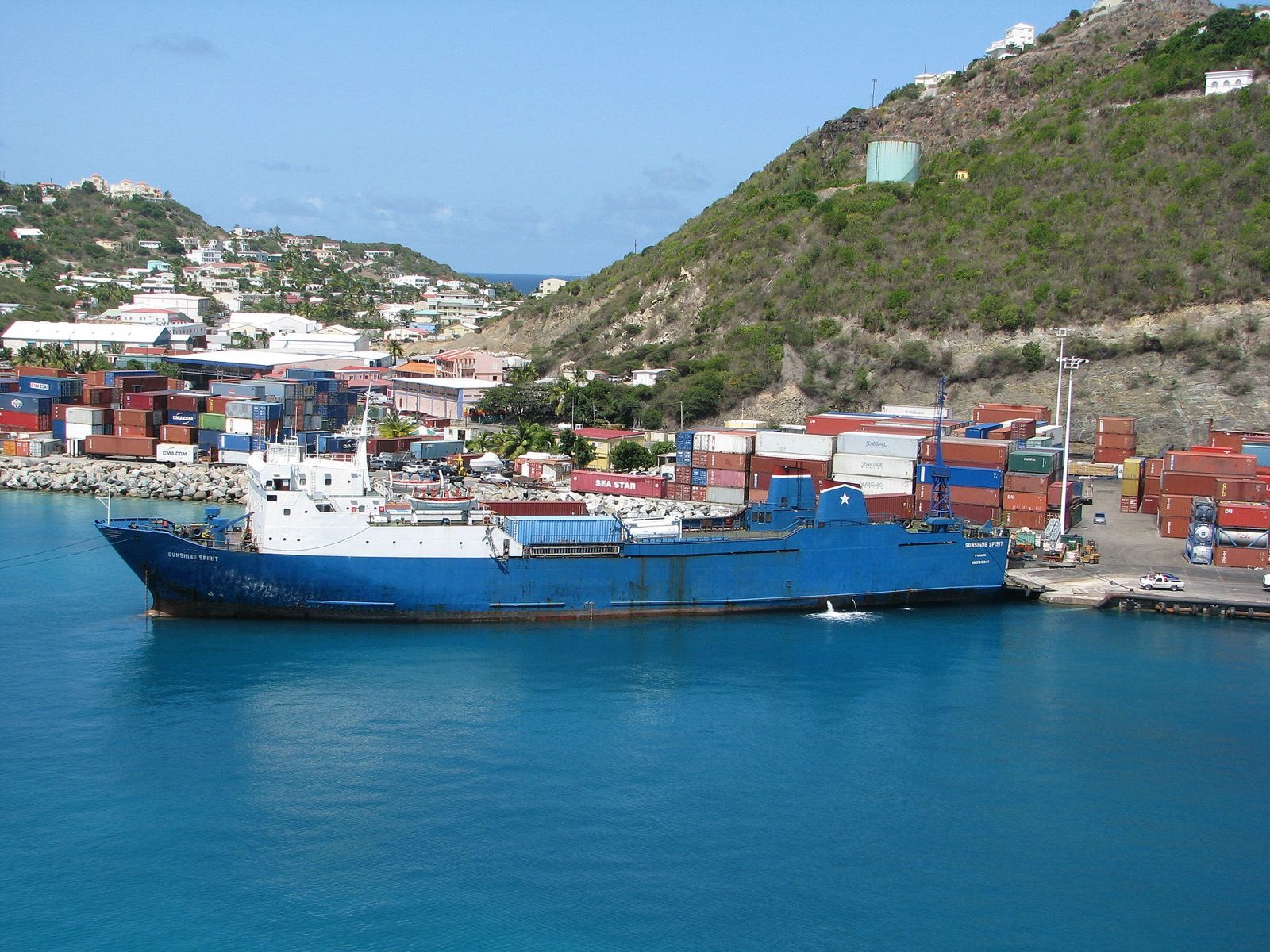
- Port St. Maarten, Philipsburg (Great Bay), Sint Maarten: the island's main container and general cargo terminal, serving St Maarten and surrounding islands; also a major cruise port.
- Galisbay commercial port, Marigot, Saint-Martin: the French side's cargo and ferry port, used mainly for regional and smaller vessels.
- Road Bay (Sandy Ground), Anguilla: Anguilla's commercial cargo port of entry, run by the Anguilla Air and Sea Ports Authority. The authority's Seaports Fees Regulations designate three ports, Road Bay, Blowing Point and Corito Bay, and levy a port security fee per container (TEU) and per ton of break-bulk cargo, charged to the vessel owner and usually passed through in local charges.
- Blowing Point, Anguilla: the ferry terminal for the Marigot crossing; not a main cargo gateway.
- Princess Juliana International (SXM): the main air cargo airport for the island.
- Grand Case-L'Esperance (SFG): the French side's regional airport.
- Clayton J. Lloyd International (AXA): Anguilla's airport, for smaller air shipments.
Which port the cargo lands at also decides which customs service clears it.
How Does Customs Clearance Work in Anguilla and St Maarten?
Each jurisdiction clears its own cargo: Sint Maarten Customs on the Dutch side, French Customs (DGDDI) on the French side, and the Anguilla Customs Department in Anguilla.
Sint Maarten (Dutch side). Imports clear through Sint Maarten Customs. The territory has been a duty-free port since 1939, so general merchandise does not pay import duty, but every commercial shipment is still declared and released by Customs. The government describes Customs Sint Maarten as mainly a law enforcement agency rather than a duty collector, and the only tax it levies is the excise on unleaded gasoline; its officers control animals, plants, hazardous items and transit cargo at Great Bay harbor and Princess Juliana airport. Bills of lading must show complete local consignee details. Most importers use a local customs broker or the carrier's agent to file and collect.
Saint-Martin (French side). French Customs (DGDDI) is present on the French side. According to French Customs, Saint-Martin is an outermost region of the European Union and part of the EU customs territory, but under a long-standing exception it keeps its free port status: imported goods pay no customs duties, no import VAT and no octroi de mer. Declarations still apply, and a local transitaire handles them for most importers.
Anguilla. Imports clear through the Anguilla Customs Department in ASYCUDA World, with a web portal for traders and brokers. Classification follows the Integrated Customs Tariff of Anguilla, based on the Harmonized System (2017 edition) and amended in 2025 to carry the new goods tax column. Anguilla Customs requires an entry through a licensed customs broker for all goods imported for business, all excisable goods (vehicles, alcohol, tobacco) and any full container for a single consignee. The process runs: manifest and arrival at Road Bay, entry filed by the broker, assessment of duty and goods tax, examination of selected cargo, payment and release.
What Are the Import Duties and Taxes in Anguilla and St Maarten?
Sint Maarten and Saint-Martin charge no general import duty and no import VAT, while Anguilla charges customs duty plus a 9% goods tax on the CIF value, so the same cargo lands at very different costs:
- Sint Maarten: no general import duty, 5% turnover tax (BBO). Sint Maarten levies a 5% turnover tax (belasting op bedrijfsomzetten) on the local sale of goods and supply of services, not a VAT collected at the border. It is charged again at each local sale, so it shapes pricing for retailers and hotels rather than adding a border charge.
- Saint-Martin: free port. No customs duties, no import VAT and no octroi de mer on goods entering the French side. The Collectivite levies its own general turnover tax (TGCA) on local business operations, and a special consumption tax applies to fuel. Goods later shipped to Guadeloupe, other French overseas departments or mainland France become taxable on arrival there.
- Anguilla: customs duty plus 9% goods tax. Anguilla charges import duty by tariff line under the Customs Act and the Integrated Customs Tariff: most lines carry 10% or 15%, many basic inputs (cement and concrete blocks, for example) enter free, and alcohol and tobacco pay higher rates plus excise. A customs administrative fee under the Customs Administrative Costs Recovery Act is added. Since 1 August 2025, the Goods Tax Act, 2025 charges goods tax on the CIF value of imports, paid to the Comptroller of Customs at the rate in the tariff's goods tax column: 9% on most goods, non-compounded and non-refundable, with essential food exempt and some building inputs lower. It replaced the former 13% GST on imports. A separate 13% general services tax applies to services, not goods.
- Anguilla relief measures in force in 2026. From 10 April 2026, freight and insurance are excluded from the customs duty calculation on qualifying imports, so duty is assessed on the cost of the goods only; the measure was extended through October 2026, so check whether it still applies on your arrival date. The Executive Council also extended the exemption of specified essential food items from import duty and the administrative fee until 31 December 2026, and suspended excise tax on gasoline for the same period.
Anguilla is an associate member of CARICOM rather than a full member, so do not assume the CARICOM Common External Tariff when quoting. The British Virgin Islands follow the same model with their own tariff, as our guide to shipping to the British Virgin Islands explains, while full member St Kitts and Nevis applies the CET plus VAT (see our guide to shipping to St Kitts and Nevis). For a regional comparison, see our overview of Caribbean import duties and taxes.
What Documents Are Required to Ship to Anguilla and St Maarten?
Shipping to Anguilla and St Maarten requires a commercial invoice, a packing list and a bill of lading or air waybill with full local consignee details, plus importer and broker details for the destination authority:
- Commercial invoice with seller, buyer, Incoterm, unit values and total value (CIF build-up for Anguilla)
- Packing list matching the physical packages, with weights and dimensions
- Ocean bill of lading or air waybill with full local consignee details
- Importer and broker details for the destination authority (Sint Maarten Customs, French Customs or Anguilla Customs)
- Permits or licences for restricted goods
- Duty concession approval for Anguilla projects where one has been granted
A detailed, accurate invoice is the single biggest factor in a fast release, especially in Anguilla where duty and goods tax are calculated from it. Our guide to commercial invoice requirements covers the fields customs officers look for.
Restricted Goods and Import Permits in Anguilla and St Maarten
Free port status in St Maarten removes duty, not controls: firearms and ammunition, controlled drugs and pharmaceuticals, plants, animals and animal products need permits or are restricted on all three sides, and agricultural cargo can be inspected on arrival. Wood crates and pallets should meet ISPM 15. Vehicles and boats are declared and assessed as their own category; check registration rules with the relevant side before shipping.
Hazardous materials (paints, solvents, gas cylinders, lithium batteries, pool chemicals) must be declared and packed under IMDG for ocean and IATA for air, and not every feeder or flight accepts them. Allow extra lead time on hazmat during hotel refurbishments.
LCL, FCL or Air Freight to Anguilla and St Maarten: Which to Choose?
For Anguilla and St Maarten, choose LCL below 12 to 15 CBM, FCL above it or for dense cargo, and air for urgent or light consignments:
- Under 12 to 15 CBM: LCL. At about $815 for 5 CBM to St Maarten, consolidation is the efficient choice for most shipments. Our explainer on LCL container shipping walks through the process.
- Above 15 CBM, or dense cargo: FCL. Once you fill most of a 20ft container, a full box wins on cost per unit and keeps a project package together.
- Urgent or light: air. Under a few hundred kilograms, or when a closed restaurant or hotel room costs more than the freight, fly it into SXM or AXA.
For Anguilla, book direct LCL rather than discharging in Philipsburg and re-shipping across the channel.
Key Industries Shipping Freight to Anguilla and St Maarten
Tourism drives the import mix into Anguilla and St Maarten on all three sides. Hotels, resorts and villas buy FF&E, linens, kitchen equipment, food and beverage, pool and spa supplies, and the building materials for constant renovation. Hurricane exposure keeps construction and refurbishment cycles running, and large hotel builds move in phases: structure, MEP, fit-out and FF&E, each with its own shipments.
Retail is the second engine. Philipsburg's duty-free shopping and the French side's European brands pull in electronics, jewelry, apparel, wines and spirits, while Port St. Maarten also feeds distributors serving smaller neighboring islands. For hotel owners and contractors, the real challenge is sequencing deliveries to an open, operating property, which we cover in Shipping Hotel Build and Refurbishment Cargo to St Maarten.
Choosing a Freight Forwarder for Anguilla and St Maarten
A forwarder for Anguilla and St Maarten has to know which side of the border, and which island, the cargo belongs to. Interworld Freight was founded in Miami in 1992 and runs its own Miami hub with warehousing, so purchases from multiple US and Asian suppliers can be received, checked and consolidated before sailing. We handle ocean FCL and LCL, air freight and customs coordination with brokers on the Dutch side, the French side and in Anguilla, with coverage on every major trade lane. See our Miami to Caribbean freight forwarding service; quotes are answered within one business day.
Frequently Asked Questions
How long does shipping from Miami to St Maarten take?
LCL from Miami reaches Philipsburg in 3 days port to port, and Anguilla in 4 days. Air freight takes 1 to 3 days. Cargo from China takes 35 to 50 days via transshipment.
How much does it cost to ship 5 CBM to St Maarten or Anguilla?
Interworld Freight's published LCL rate from Miami is about $815 for 5 CBM / 1,500 kg to St Maarten and about $1,015 to Anguilla (September 2026). Destination duties, taxes and local charges are extra.
Does Sint Maarten charge import duty?
No general import duty applies, because Sint Maarten has been a duty-free port since 1939. Goods are still declared to Customs, and a 5% turnover tax (BBO) applies to local sales of goods and services.
Is French Saint-Martin part of the EU VAT and customs system?
Saint-Martin is in the EU customs territory but keeps its free port status, so imports pay no customs duties, no import VAT and no octroi de mer. Goods shipped on to Guadeloupe or mainland France are taxed on arrival there.
What taxes apply to imports into Anguilla?
Anguilla charges customs duty by tariff line, mostly 10% or 15%, plus a 9% goods tax on the CIF value of imports, in force since 1 August 2025. The goods tax replaced the former 13% GST on imports, and essential food is exempt. Through October 2026, freight and insurance are excluded from the duty calculation on qualifying imports.
Can cargo for Anguilla go through St Maarten?
It can, but it means two handlings and a re-shipment across the channel. Booking LCL directly to Road Bay is simpler and keeps clearance to one entry with Anguilla Customs.
Which customs system does Anguilla use?
Anguilla Customs uses ASYCUDA World, with a web portal for brokers and traders to file declarations and manifests.
Do I need a customs broker to import into Anguilla?
Yes, for commercial cargo. Anguilla Customs requires a broker entry for all goods imported for business, all excisable goods such as vehicles, alcohol and tobacco, and any full container belonging to one consignee. Brokers are registered ASYCUDA World users approved by the Comptroller of Customs.
Photo: Container port at Philipsburg, Sint Maarten. Thomas from USA, CC BY 2.0, via Wikimedia Commons.
Ready to ship your freight?
