
On this page11
Customs clearance in Chile is handled by the Servicio Nacional de Aduanas, which receives an import declaration (the DIN, Declaración de Ingreso) filed on the CIF value. As a general rule, imports pay a 6% customs duty on CIF and 19% IVA on CIF plus duty. US-origin goods enter duty-free under the US-Chile Free Trade Agreement. If you ship full containers, our container shipping to Chile service is the place to start.
For US suppliers, that changes the math. A Chilean buyer of US-origin machinery or inputs with a valid certificate of origin pays only IVA. The same buyer sourcing from a country without an agreement pays 6% first. A licensed customs agent files the declaration, which leaves the importer one job: having the documents right before the cargo arrives.
Chile Customs at a Glance
| Item | Chile |
|---|---|
| Customs authority | Servicio Nacional de Aduanas |
| Declaration | Declaración de Ingreso (DIN), filed by the customs agent over the internet |
| Tariff framework | Uniform 6% ad valorem for goods without a preference; specific duties and price bands on some farm goods such as wheat and sugar |
| Trade agreement with the US | US-Chile Free Trade Agreement, in force since January 1, 2004; all bilateral trade duty-free since January 1, 2015 |
| Duty valuation basis | CIF (cost, insurance and freight) |
| VAT | IVA 19% on CIF plus duty |
| Other import levies | Additional taxes on luxury goods, alcohol, sugary drinks, tobacco, fireworks; 50% surcharge on the duty for authorized used goods |
| Importer ID | Chilean tax ID (RUT) |
| Broker requirement | Customs agent required above US$1,000 FOB |
| De minimis | Simplified self-filing for commercial goods up to US$1,000 invoiced; online purchases up to US$500 follow a separate consumer regime that this post does not cover |
How Does Customs Clearance Work in Chile?
For a commercial import above the simplified threshold, clearance has seven steps.
- Classify the goods and check controls. Confirm the tariff subheading and whether a state agency must approve the product before import.
- Appoint a customs agent. Above US$1,000 FOB the importer must hire a customs agent from the official roster, according to the Servicio Nacional de Aduanas.
- Hand over the base documents. The agent needs the bill of lading, commercial invoice and the importer's sworn statement of price (a form the agent supplies).
- Agent prepares the DIN. The declaration is filed with the Servicio over the internet. The manifest number on the DIN must match the vessel and port, or the declaration is rejected.
- Declaration is legalized and taxes assessed. Customs notifies the legalization of the DIN, which starts the payment clock.
- Pay. The payment deadline is 15 calendar days from notification, or 60 days where payment is guaranteed, per the Compendio de Normas Annex 18.
- Take delivery. The importer cannot freely dispose of the goods until the DIN has been processed and the taxes paid.
Small commercial shipments up to US$1,000 invoiced can be filed personally by the importer at the customs office, with the bill of lading, commercial invoice and any approvals.
Documents Required for Chile Customs
The Servicio separates mandatory documents for every commercial import from those required only in some operations.
Mandatory for commercial imports:
- Original bill of lading, waybill or air waybill, proving the consignee owns the goods. See the bill of lading glossary entry.
- Original commercial invoice showing the goods and their values.
- Importer's sworn statement of price, on a form supplied by the customs agent.
- Mandate, constituted by endorsing the original bill of lading.
Required only for some operations:
- Certificate of origin, if the import claims a trade agreement preference.
- Packing list, always for containerized goods.
- Insurance certificate, when the premium is not on the invoice.
- Expense note, when charges are not on the invoice.
- Permits and approvals when the product is controlled.
Chile Import Duty Rates by Product Category
Chile's tariff is uniform. The Servicio states that the customs duty is 6% of CIF value as a general rule, and that it can be lower or zero when a trade agreement grants preferential treatment. The additional taxes below sit on top, on the same base (CIF plus duty), according to the Servicio's tax page.
| Category | Tax |
|---|---|
| General merchandise | 6% duty on CIF; 0% if an agreement applies (US origin: duty-free) |
| Mineral waters, artificial drinks, syrups | Additional 13% |
| Gold, platinum, jewelry, fine carpets, furs, caviar, air guns, wine, cider, beer | Additional 15% |
| Spirits, pisco, whisky, liqueurs | Additional 27% |
| Motorhomes, fireworks (non-industrial) | Additional 50% |
| Cigars / manufactured tobacco / cigarettes | 51% / 57.4% / 60.4% |
| Authorized used goods | New-goods duties plus a 50% surcharge on the ad valorem duty, plus IVA |
Wheat and sugar fall under specific duties or rebates set by range, and the HS code decides every case.
How to Calculate Import Duty and Taxes in Chile
The cascade is short: CIF, duty, additional taxes, IVA.
- CIF = cost + insurance + freight.
- Duty = CIF x 6% (or 0% under an agreement).
- Additional taxes, where the product carries them, on CIF plus duty.
- IVA = 19% x (CIF + duty + additional taxes).
Illustrative example (round numbers, not a quote): CIF value USD 10,000 of non-US-origin equipment, no additional tax.
- Duty: 10,000 x 6% = USD 600
- IVA: 10,600 x 19% = USD 2,014
- Total customs taxes: USD 2,614
The same US-origin equipment with a valid certificate of origin: duty 0, IVA 10,000 x 19% = USD 1,900.
The saving is USD 714 on a USD 10,000 shipment, so settle the origin paperwork before the supplier ships. Ask the US supplier for the origin documentation your agent specifies, since the Servicio asks for it when the import claims the preference.
Importer Registration and Customs Brokers in Chile
Commercial importers are identified by their Chilean tax ID (RUT), which the Servicio's rules require on the customs agent's mandate (a passport number is accepted for foreign individuals). The real gatekeeper is the customs agent: above US$1,000 FOB only a licensed agent can prepare and file the DIN. The Servicio publishes the current roster of agents, so you can check a broker's standing before granting the mandate. The customs broker glossary entry describes how the role works.
Exemptions, Free Zones and Special Regimes in Chile
The U.S. International Trade Administration reports that the US-Chile Free Trade Agreement took effect on January 1, 2004, and that on January 1, 2015 100 percent of bilateral trade became tariff-free. Chile also has agreements with Canada, China, Mexico, the EFTA states, the CPTPP members, Peru, Colombia and others. Claim a preference with a certificate of origin and verify the rule of origin for your product before you ship.
The Servicio's customs rulebook (Compendio de Normas, Chapter 3) lists the special destinations an importer can use:
- Admisión temporal: temporary entry of goods for re-export.
- Admisión temporal para perfeccionamiento activo: temporary entry for processing before re-export.
- Almacén particular and depósito: suspensive storage regimes.
- Zonas francas: Chile authorizes free zones in Iquique and Punta Arenas under DFL 341, and manufacturing companies set up in Arica receive the same preferential regime as the Iquique zone.
Terms and conditions differ by regime and by customs office. Have your agent confirm them before you commit.
Import Permits and Licensing Agencies in Chile
Any product can be imported unless the law prohibits it (used vehicles and motorcycles, asbestos and toxic industrial waste are examples). Controlled goods need prior approval from the responsible agency, according to the Servicio.
- SAG (Servicio Agrícola y Ganadero): alcohol and vinegar, plant and animal products and by-products, fertilizers and pesticides.
- SEREMI de Salud: food products of any kind, toxic or hazardous substances.
- ISP (Instituto de Salud Pública): pharmaceutical and medical food and cosmetic products, narcotics and psychotropic substances.
- SUBTEL: radiocommunication equipment, which needs prior authorization of its transmission band.
- Subsecretaría de Pesca: fishery and hydrobiological products.
- DGMN: firearms, ammunition, explosives.
- CCHEN: radioactive materials and equipment that generate ionizing radiation.
Common Customs Delays in Chile and How to Avoid Them
- Missing approval. A SAG, ISP or SEREMI authorization must be in hand before the DIN, not after.
- Wrong manifest number. A DIN with a manifest number that does not match the vessel and port is rejected.
- Value mismatch. The sworn price statement, the invoice and the bill of lading must agree, because the base is CIF.
- Origin proof not ready. Without a certificate of origin, US goods pay the 6% duty.
- Payment deadline. The 15-day clock runs from legalization of the DIN, so arrange funds with your agent before arrival.
- Used goods. Authorized used goods carry a 50% surcharge on the duty, and used vehicles are prohibited.
Clearing Cargo to Chile With Interworld Freight
Interworld Freight has operated from Miami since 1992. Our Miami hub consolidates US suppliers into one booking, ocean FCL, LCL or air, and we coordinate customs clearance with licensed brokers at destination. For ports, routing and transit, read our shipping to Chile guide, or see container shipping to Chile. Send the commercial invoice and HS code and we quote within one business day. The customs clearance glossary entry defines the term.
Frequently Asked Questions
What is the import duty in Chile?
The general customs duty is 6% of the CIF value, according to the Servicio Nacional de Aduanas. It drops to 0% or a reduced rate when a trade agreement applies.
What is the IVA on imports to Chile?
IVA is 19%, charged on the CIF value plus the customs duty. It also applies to goods that enter duty-free under an agreement.
Does Chile have a free trade agreement with the United States?
Yes. The US-Chile Free Trade Agreement took effect on January 1, 2004, and all bilateral trade has been duty-free since January 1, 2015. Present a certificate of origin to claim it.
Do I need a customs agent in Chile?
Yes, when the goods exceed US$1,000 FOB. Below that, commercial imports up to US$1,000 invoiced can be filed personally in a simplified procedure.
What is the DIN?
The DIN is the Declaración de Ingreso, Chile's import declaration. The customs agent prepares it from your documents and files it over the internet.
How long do I have to pay customs taxes?
The deadline is 15 calendar days from notification of the legalization of the DIN, or 60 days with guaranteed payment.
Which agency approves food imports to Chile?
The SEREMI de Salud controls food products of any kind, and SAG controls products of animal or plant origin. Pharmaceutical and cosmetic goods go through the ISP.
Can I import used goods into Chile?
Only when authorized, and used vehicles and motorcycles are prohibited. Authorized used goods pay the new-goods duties plus a 50% surcharge on the ad valorem duty.
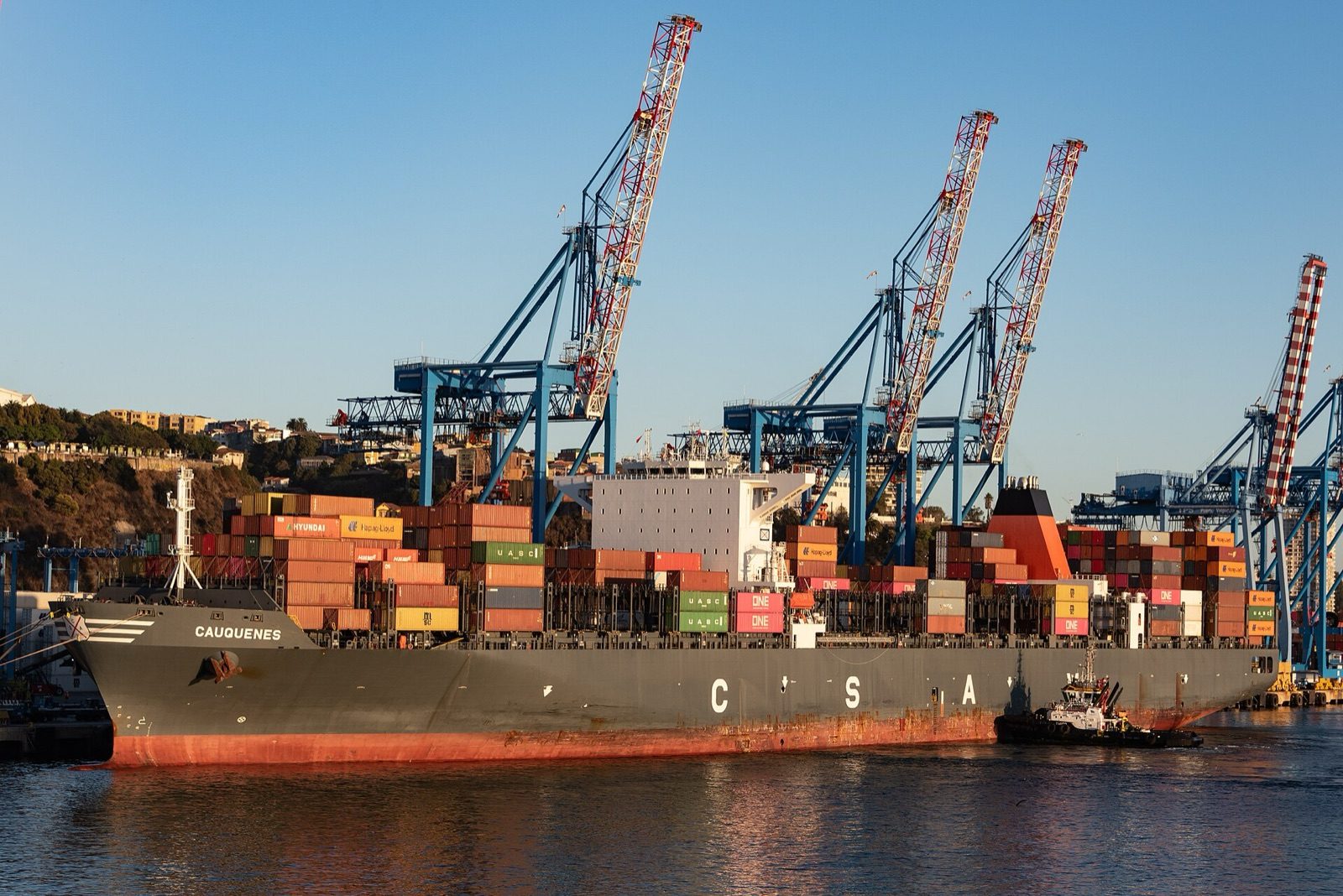
Photo: Container ship at the Port of Valparaíso, Chile. Gordon Leggett, CC BY-SA 4.0, via Wikimedia Commons.
Ready to ship your freight?
