
On this page14
You ship to Chile by ocean FCL or LCL into San Antonio, Valparaíso or Antofagasta, or by air into Santiago (SCL), with 12 to 20 days of ocean transit from Miami, a DIN filed with the Servicio Nacional de Aduanas, 6% duty (0% for US goods) and 19% IVA. Chile is the most predictable customs environment on the west coast of South America: since January 1, 2015, all trade between the US and Chile has been duty-free under the bilateral FTA, goods from countries without an agreement pay a uniform 6% tariff, and everything pays 19% IVA. The challenge is geography. Chile is more than 4,000 km long, the main container ports sit in the center near Santiago while the copper mines sit in the northern desert, and cargo from Miami transits the Panama Canal and runs the full length of the Pacific coast. Choosing the right port for the final destination (San Antonio for Santiago, Antofagasta or Mejillones for the mining north) saves more than any freight negotiation.
Chile Shipping at a Glance: Transit Times and Options
Shipping to Chile from Miami takes 12 to 20 days by ocean FCL to the central ports and 1 to 3 days by air to Santiago; Asia and Europe add two to four weeks.
| Route & mode | Transit | Best for |
|---|---|---|
| Miami to San Antonio or Valparaíso, ocean FCL | 12 to 20 days | full loads, machinery, retail stock |
| Miami to Chile, ocean LCL | 15 to 25 days (port to port) | shipments under 15 CBM |
| Miami to Antofagasta or Mejillones, ocean FCL | 12 to 22 days | mining equipment and spares for the north |
| Miami (MIA) to Santiago (SCL), air | 1 to 3 days | urgent parts, electronics, pharma |
| China to San Antonio, ocean FCL | 30 to 45 days | full containers from Asia |
| North Europe or Spain to San Antonio, ocean FCL | 28 to 40 days | EU machinery and consumer goods |
The low end of each range applies to direct sailings and the high end to transshipped rotations; confirm the sailing with your forwarder before you commit a delivery date. Whatever the lane, the import itself follows one sequence.
How to Ship to Chile: Step by Step
Shipping to Chile follows eight steps, from HS classification to release at the destination port.
- Classify the goods and check permits. Assign the HS code in Chile's Arancel Aduanero and check whether the product needs SAG, ISP or other agency authorization through SICEX.
- Choose the port for the final destination. Route Santiago cargo to San Antonio or Valparaíso and mining cargo to Antofagasta, Mejillones or Iquique when the rotation calls there.
- Choose the mode and Incoterm. Pick air under 2 CBM, LCL from 2 to 15 CBM and FCL above that, and fix the Incoterm in writing, because it sets the CIF value Customs uses.
- Book from Miami or origin. Consolidate US suppliers in Miami into one container and one DIN, or book Asian and European cargo direct into the chosen port.
- Prepare the documents and origin proof. Issue the commercial invoice, packing list, bill of lading or air waybill and the certificate or statement of origin that claims the FTA rate.
- File the US export record. For US cargo, the exporter or forwarder files Electronic Export Information (EEI) in AES when any Schedule B line exceeds $2,500 or the goods need an export license.
- Declare through a customs agent. For commercial imports above US$1,000 FOB, a licensed agente de aduanas files the DIN with the Servicio Nacional de Aduanas, which selects shipments for inspection.
- Pay duty and IVA, then take delivery. The importer pays duty, 19% IVA and any additional tax, Customs releases the cargo, and it moves by truck to Santiago or the mine site.
Port choice in step 2 starts with the US lane, which most Chile-bound consolidated cargo uses.
Shipping From the USA to Chile
US cargo ships to Chile through Miami, the main US gateway for Chile-bound consolidated cargo and air freight. Ocean services from South Florida and the US East Coast run through the Panama Canal and down the Pacific coast to the central ports, with some rotations calling Arica, Iquique, Antofagasta or Mejillones in the north. Interworld Freight consolidates purchases from several US suppliers in Miami into one container and one import declaration. Chile is the Pacific-side market of the Southern Cone; for the Atlantic-side equivalent through Buenos Aires, see our guide to shipping to Argentina.
For full loads, container shipping to Chile on 20ft and 40ft equipment is the efficient choice once volume passes 15 CBM. Below that, LCL consolidation is billed by cubic meter or weight, and it is also the cheapest way to move a few pallets from the US to Chile: you pay only for the space your cargo occupies (see how LCL container shipping works). Time-critical spares for mining, energy and industry move by air freight to Chile into Arturo Merino Benítez International (SCL) in Santiago, with domestic connections north.
The US-Chile FTA makes origin worth documenting: with a valid origin claim, US goods enter at 0% duty and pay only the 19% IVA plus any product-specific tax. Without it, the same goods pay the general 6% tariff first. The agreement entered into force on January 1, 2004, and its 12-year tariff phase-out ended in 2015, so there is no remaining duty schedule to track for US-origin goods. Asian cargo enters on equally favorable terms, through a different set of agreements.
Shipping From China and Asia to Chile
Asian cargo reaches Chile in 30 to 45 days for a full container, on direct transpacific services from China, Korea and Japan to San Antonio and Valparaíso or on services with transshipment in Peru, Panama or Mexico. Callao is the Peruvian relay hub on that coast, covered in our guide to shipping to Peru. LCL takes longer because of consolidation and deconsolidation. Chile has an FTA with China, and it is a member of the CPTPP and the Pacific Alliance, so qualifying goods from many Asian and Pacific origins enter with reduced or zero duty when the certificate of origin is correct.
Northern mining customers import Asian equipment and consumables directly to Antofagasta, Mejillones or Iquique, avoiding a 1,000 km truck run from the central ports. Check whether your carrier calls the northern port directly or relays the box, as relays add time.
Shipping From Europe to Chile
European goods reach Chile in 28 to 40 days and, since February 1, 2025, under better preference terms. The EU-Chile Interim Trade Agreement entered into force on that date and, according to the European Commission, makes 99.9% of EU exports to Chile tariff-free (all products except sugar). It also replaced the old proof-of-origin rules, so EU suppliers now issue origin statements under the new agreement's format; an origin statement drafted under the previous association agreement is a common reason for a lost preference. Transit from North Europe and the Mediterranean to San Antonio depends on the rotation and transshipment. Mining equipment from Scandinavia and Germany, machinery from Italy and Spain, and food and wine imports are the main flows, landing at a port network that stretches from Arica to the Biobío.
Which Ports and Airports Handle Cargo in Chile?
San Antonio is Chile's main container port, with Valparaíso as the second central gateway and Antofagasta, Mejillones, Iquique and Arica serving the mining north and Bolivian transit.
- San Antonio (CLSAI), Valparaíso region: Chile's main container port, closest to Santiago, run by Empresa Portuaria San Antonio. Chile approved the Puerto Exterior expansion (a new outer harbor with a breakwater and two container terminals) in May 2026, with works projected to start in 2027.
- Valparaíso (CLVAP): second central container port, also serving Santiago.
- Antofagasta (CLANF): northern port serving the Antofagasta mining region, including general cargo, project cargo and concentrate exports.
- Mejillones (CLMJS): northern port complex near Antofagasta used for mining inputs, containers and bulk.
- Iquique (CLIQQ), Tarapacá: northern port next to the Iquique free trade zone (ZOFRI); also handles Bolivian transit cargo.
- Arica (CLARI): northernmost port, with a large share of Bolivian transit cargo, the route explained in our guide to shipping to Bolivia.
- San Vicente, Lirquén and Coronel, Biobío region: southern ports for forestry, pulp and fishing.
- Arturo Merino Benítez International (SCL), Santiago: the main air cargo hub.
- Cerro Moreno International (ANF), Antofagasta: the main airport for the northern mining region.
How Does Customs Clearance Work in Chile?
Imports into Chile clear through the Servicio Nacional de Aduanas (Chilean Customs) on an electronic import declaration, the DIN (Declaración de Ingreso), which a licensed customs agent files for any commercial shipment above US$1,000 FOB. Permits and certificates from other agencies run through SICEX, Chile's foreign trade single window, which Chilean Customs describes as the integrated system for import and export formalities, origin certificates and the Authorized Economic Operator (OEA) program.
- Customs agent: for commercial imports above US$1,000 FOB, the importer must hire a licensed customs agent (agente de aduanas), as set out by Chile's National Customs Service. Below that, simplified procedures let the importer handle the formality directly.
- Classification: the goods are classified in Chile's customs tariff (Arancel Aduanero), which follows the Harmonized System; a precise HS code decides the duty, the preference and any permit.
- Permits: goods controlled by SAG (agricultural and livestock products, plants, wood), ISP (medicines, medical devices, cosmetics) or other agencies need their authorization before release.
- Declaration: the customs agent files the DIN with invoice, transport document, packing list and certificate of origin where a preference applies.
- Valuation and inspection: Customs applies WTO valuation on a CIF basis, and selected shipments are inspected.
- Payment and release: duty, IVA and any additional tax are paid and the cargo is released.
Customs agents' fees in Chile are not standardized, so request them in writing before the shipment arrives. Agree the Incoterm with the supplier up front: under FOB or FCA the Chilean buyer controls freight and insurance, which also fixes the CIF value on which duty and IVA are calculated.
What Are the Import Duties and Taxes in Chile?
Chile charges a uniform 6% import duty on goods without preferential origin and 19% IVA on all imports, according to the US Commercial Service country guide.
- Import duty: a uniform 6% ad valorem on CIF value for goods without a preferential origin.
- US-origin goods: 0% duty under the US-Chile FTA, fully phased in since January 1, 2015.
- Other FTAs: Chile has FTAs with China, the EU, CPTPP and Pacific Alliance partners and many others, so most imports qualify for reduced or zero duty with correct origin documents.
- IVA (VAT): 19% on customs value plus duty. For duty-free goods, IVA is calculated on customs value alone.
- Luxury tax: 15% on goods such as jewelry, precious stones, fine furs and caviar; pyrotechnics pay 50%.
- Alcohol and beverages: additional taxes from 20.5% (wine and beer) to 31.5% (spirits); sugary drinks pay 18% and other soft drinks and mineral waters 10%.
- Tobacco: specific and ad valorem taxes apply.
- Used goods: Customs values second-hand goods by discounting the current new value of similar goods by 10% per year of use, up to a 70% discount. Used goods of non-FTA origin can also face a used-goods surcharge on the duty, which the US-Chile FTA eliminated for US goods.
A worked example: a US-origin machine with a valid origin claim and a CIF value of $50,000 pays $0 duty and $9,500 IVA; the same machine from a non-FTA origin pays $3,000 duty and $10,070 IVA. The rule for Chile: the duty is either 0% or 6%, the IVA is always 19%, and the origin certificate decides which duty you pay. For companies registered for IVA, import IVA is creditable against sales IVA, so it is a cash-flow cost rather than a final cost, provided the documents support the entry.
What Documents Are Required to Ship to Chile?
Every commercial import into Chile needs a commercial invoice, a packing list, the bill of lading or air waybill, and a certificate or statement of origin when claiming FTA duty.
- Commercial invoice with value, Incoterm, HS code and full description
- Packing list with weights and dimensions per package
- Bill of lading or air waybill
- Certificate or statement of origin for FTA preferences (US, EU, China, CPTPP and others)
- Insurance certificate where applicable
- SAG, ISP or other agency authorizations for regulated goods
- Technical documentation for machinery and equipment classification
- Mandate to the customs agent for shipments above US$1,000 FOB
Restricted Goods and Import Permits in Chile
Chile has very few outright import bans, but used vehicles are one of them and agricultural products face strict SAG controls. Used vehicles cannot be imported, with the exception of the free zones of Iquique and Punta Arenas, and vehicles brought into those zones face restrictions on moving to the rest of the country: a resident who relocates and wants to sell the vehicle before the restriction period ends must first pay the full duties and taxes. Used goods other than vehicles can be imported but are valued with the depreciation formula above.
SAG controls plant and animal products and enforces ISPM 15 on wood packaging; its inspections are thorough and non-compliant pallets are treated or rejected. Medicines, medical devices and cosmetics need ISP registration. Explosives, chemicals and hazardous cargo used by mining need specific authorizations and move under IMDG or IATA DGR. Oversized mining equipment needs route surveys and road permits for the inland leg, which feeds straight into the choice of mode.
LCL, FCL or Air Freight to Chile: Which to Choose?
For Chile, use air below 2 CBM or when downtime is expensive, LCL from 2 to 15 CBM, and FCL above 15 CBM.
- Under 2 CBM or urgent: air freight to SCL, or to ANF for northern mines with a domestic connection.
- 2 to 15 CBM: LCL consolidated through Miami; above US$1,000 FOB, budget the customs agent fee.
- Above 15 CBM: a 20ft FCL costs less per unit; above 30 CBM, quote a 40ft or 40ft high cube.
- Heavy, out-of-gauge equipment: flat racks, open tops or breakbulk. See breakbulk vs container shipping and check container weight limits before booking dense mining spares in a 20ft.
- Destination north of Santiago: ship to Antofagasta, Mejillones or Iquique when the rotation allows instead of trucking from San Antonio.
Key Industries Shipping Freight to Chile
Mining is the industry that moves the most freight to Chile. Chile is the world's largest copper producer, with an estimated 5.3 million tonnes of mine output in 2025, about 23% of world production, according to the USGS Mineral Commodity Summaries. Large operations such as Escondida in the Antofagasta region drive imports of haul trucks, excavators, crushers, mill liners, conveyor components, tires, reagents and an endless flow of spares, much of it urgent. Lithium production in the Atacama adds further demand for process equipment.
Beyond mining, Chile imports machinery, vehicles, fuels, electronics and consumer goods, mostly through San Antonio and Valparaíso, and exports fruit, salmon, wine, pulp and copper. Our follow-up guide covers how to ship heavy equipment and spares to Chile's copper mines, from port choice to inland transport.
Choosing a Freight Forwarder for Chile
The right forwarder for Chile picks the correct port, consolidates your US suppliers and gets the FTA origin documents right. On this lane the value is in port selection (central versus northern ports), in consolidating US suppliers into one DIN, in getting origin documents right so the duty is zero, and in moving urgent mining spares by air when downtime costs more than freight. Interworld Freight was founded in Miami in 1992 and runs ocean FCL and LCL, air freight and customs coordination from its Miami hub with warehousing, with coverage on every major trade lane. For regional context, read shipping from Miami to Latin America. Quote requests are answered within one business day.
Frequently Asked Questions
How long does shipping from Miami to Chile take?
Ocean freight from Miami to San Antonio or Valparaíso takes 12 to 20 days port to port for FCL, and 15 to 25 days for LCL. Air freight from Miami to Santiago arrives in 1 to 3 days.
What is the cheapest way to ship goods from the USA to Chile?
LCL ocean consolidation through Miami is the cheapest option for commercial cargo below 15 CBM, because you pay only for the space used. Above that, a full 20ft container costs less per unit. Air freight is faster but costs several times more per kilo.
Does Chile have a free trade agreement with the US?
Yes. The US-Chile Free Trade Agreement entered into force on January 1, 2004, and since January 1, 2015 all US-origin goods enter Chile duty-free with a valid origin claim. IVA and product-specific taxes still apply.
What import duty does Chile charge?
Chile applies a uniform 6% tariff on goods without preferential origin. US goods enter duty-free under the US-Chile FTA, and most other origins qualify for reduced or zero duty under Chile's FTAs with the EU, China, CPTPP members and others.
How much import tax will I pay in Chile?
You pay 19% IVA on the customs value plus duty, plus the 6% duty if the goods have no preferential origin. Luxury goods, alcohol, sugary drinks and tobacco pay additional taxes on top.
What are the new import rules for Chile?
The main recent change is the EU-Chile Interim Trade Agreement, in force since February 1, 2025, which removes duty on almost all EU goods and introduces new origin statements. Chile's general 6% duty and 19% IVA are unchanged.
When do I need a customs agent in Chile?
For commercial imports above US$1,000 FOB, Chilean Customs requires a licensed customs agent. Below that threshold, the importer can complete the formality directly.
What are the shipping restrictions for Chile?
Used vehicles are prohibited except through the free zones of Iquique and Punta Arenas. Agricultural products and wood packaging need SAG compliance, and medicines, medical devices and cosmetics need ISP registration.
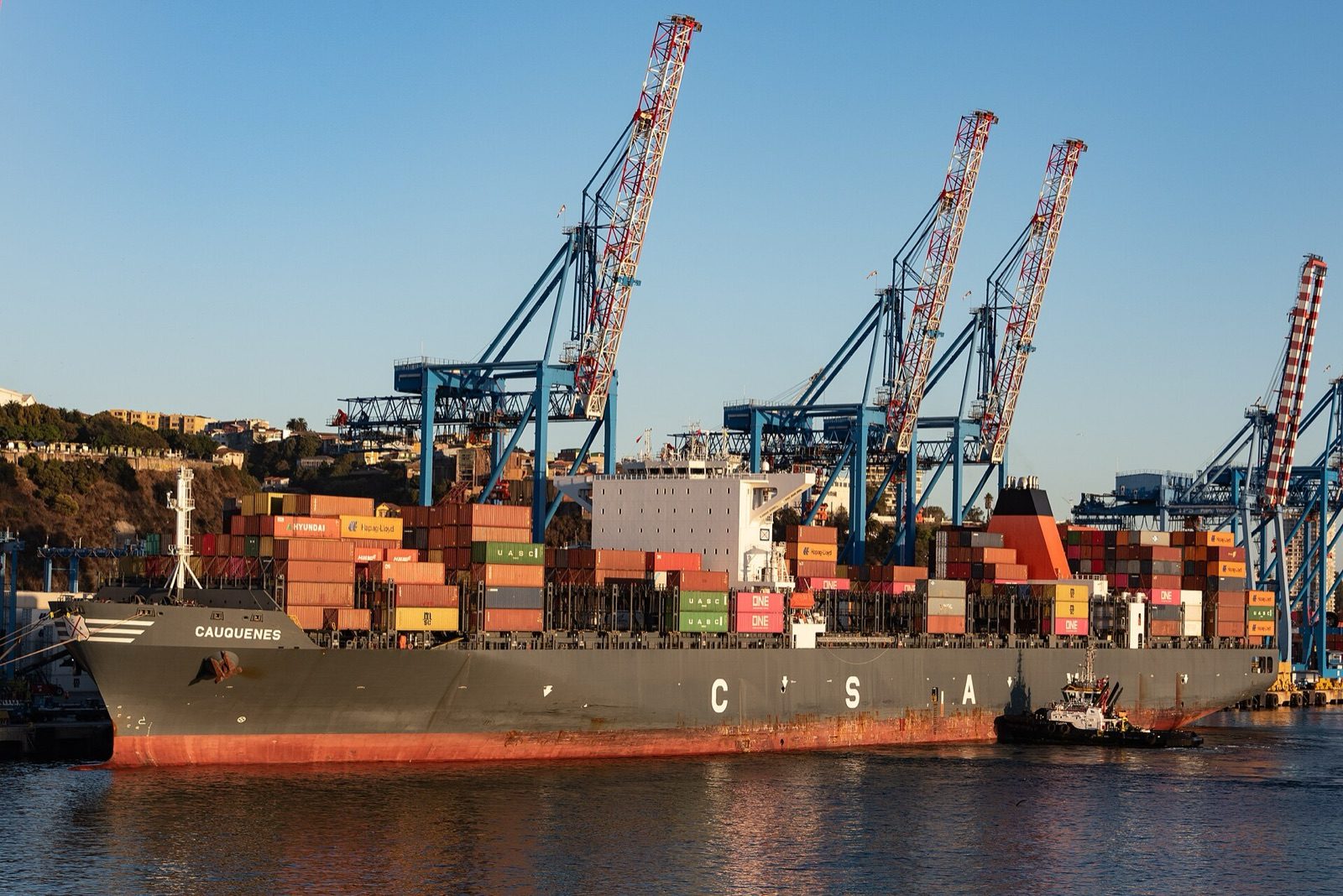
Photo: Container ship at the Port of Valparaíso, Chile. Gordon Leggett, CC BY-SA 4.0, via Wikimedia Commons.
Ready to ship your freight?
