
On this page13
You ship to Haiti by ocean (FCL or LCL) directly to Port-au-Prince, Lafito or Cap-Haïtien, or by air where an airport is accepting cargo; LCL from Miami takes about 4 days, and the AGD clears entries on SYDONIA, charging national-tariff duty, a 5% verification fee and a 10% turnover tax. Haiti sits close to Miami on short-sea and feeder services, yet it is one of the hardest Caribbean markets to clear cargo into. It applies its own national tariff rather than the CARICOM Common External Tariff, and a large share of inbound freight is donated or tax-exempt cargo for NGOs that clears only with a ministerial exemption (the "franchise"). Since October 2, 2026, customs no longer accepts third-country goods trucked in under transit through a neighboring country, and operating conditions at Port-au-Prince terminals and its airport change, so the port of entry has to be confirmed at booking. Shippers who prepare documents and exemptions before the vessel sails avoid most of the storage cost that Haiti is known for.
Haiti Shipping at a Glance: Transit Times and Options
Miami to Port-au-Prince is the shortest ocean lane into Haiti, at about 4 days for LCL; air takes 1 to 4 days where airports are open, and Asia 35 to 50 days.
| Route & mode | Transit | Indicative cost | Best for |
|---|---|---|---|
| Miami to Port-au-Prince, LCL (5 CBM / 1,500 kg) | about 4 days | about $1,050 (IWF published LCL rate, September 2026; excludes destination duties, taxes and local charges) | relief kits, distributor restocks, equipment under a full box |
| USA (Miami, East Coast) to Port-au-Prince or Lafito, FCL 20ft/40ft | 3 to 7 days from Florida | quote on request | food, building materials, bulk relief supplies |
| USA to Cap-Haïtien, FCL or LCL | 1 to 2 weeks | quote on request | northern consignees, Caracol-area operations |
| Miami to Haiti, air | 1 to 4 days, subject to airport status | quote on request | medical supplies, spares, urgent documents |
| China / Asia or Europe to Haiti, FCL or LCL | 35 to 50 days | quote on request | factory orders, solar and electrical equipment |
Transit is port to port. Confirm terminal and airport status with your forwarder before committing to a delivery date, then follow the eight steps below.
How to Ship to Haiti: Step by Step
Shipping to Haiti follows eight steps, and the first four happen before the cargo leaves Miami or origin.
- Classify the goods and secure permits. Assign the HS code under Haiti's national tariff and obtain any licence first: a Ministry of Commerce and Industry permit for pharmaceuticals, a Ministry of Agriculture permit for food (valid 15 days), or a franchise request for exempt cargo.
- Choose the mode, Incoterm and port of entry. Pick LCL, FCL or air, and confirm whether Port-au-Prince, Lafito or Cap-Haïtien (or Toussaint Louverture versus Cap-Haïtien airport) is accepting cargo on the sailing or flight you book.
- Book directly to a Haitian port. Deliver LCL to a Miami CFS or book an FCL to a Haitian seaport; overland transit through a neighbouring country and foreign dry ports are not accepted entry routes.
- Prepare the documents. Collect the original commercial invoice, packing list, signed bill of lading or air waybill, freight cost certificate, the importer's tax clearance, certificate of origin and any permit or franchise letter.
- File the US export record. For US-origin cargo, the exporter or forwarder files Electronic Export Information (EEI) in AES when a Schedule B line exceeds US$2,500 or the goods need an export licence.
- Transit and manifest. The vessel sails (about 4 days from Miami for LCL) and the carrier's manifest is registered in SYDONIA and assigned a number.
- File the declaration and pass verification. A licensed Haitian customs broker files the electronic declaration against the manifest number, and AGD verifies goods and documents.
- Pay duties and take delivery. Duty, the 5% verification fee, 10% TCA and 2% CFGDCT are settled (or the approved franchise is presented), and the goods are released for final delivery.
Steps 2 and 3 are decided mainly by the US leg, which carries most of Haiti's imports.
Can You Ship to Haiti From the USA?
Yes, you can ship commercial cargo from the USA to Haiti, and Miami is the shortest and most frequent gateway: LCL from Miami to Port-au-Prince runs about 4 days in transit on the IWF published lane. The US is Haiti's main source of imports. The reference rate is about $1,050 for 5 CBM / 1,500 kg (IWF published LCL rate, September 2026; excludes destination duties, taxes and local charges), quoted FCA Miami CFS to Port-au-Prince. Like shipping to Turks and Caicos, the Haiti lane from Miami is a short-sea run measured in days, not weeks.
LCL is the default for Haitian importers and NGOs shipping under 15 CBM: goods from several US suppliers are delivered to a Miami CFS, consolidated, and loaded into one Haiti-bound container. For larger programs (food aid, construction materials, generators), a 20ft or 40ft FCL from Miami keeps the cargo under one seal from origin to the consignee's yard, which matters on this lane. Interworld Freight handles container shipping to Haiti in both modes, with Miami warehousing for staging relief or project cargo until a site is ready to receive it.
Air freight is the option for medical supplies, cold-chain pharmaceuticals and critical spares, but routing depends on airport operating status. A Federal Aviation Administration NOTAM prohibits US air carriers and US-registered operators from flying below 10,000 feet in the Port-au-Prince area from September 1, 2026 until March 2, 2027; operations elsewhere in Haiti, such as Cap-Haïtien, are outside the prohibited zone. Air cargo planning must therefore check which carriers and airports (Toussaint Louverture in Port-au-Prince, or Cap-Haïtien in the north) are accepting shipments at the time of booking. Our Caribbean air freight team confirms the available routing before you commit.
Overland routing through the Dominican Republic is no longer an option for third-country goods. Under an AGD notice dated October 2, 2026, goods from third countries destined for the Haitian market cannot enter Haiti under the overland transit regime, and controls at land border points have been reinforced. Cross-border trade in goods produced or manufactured in the Dominican Republic is not affected; cargo for Santo Domingo itself follows the rules in our guide to shipping to the Dominican Republic. The same direct-routing rule governs cargo from Asia and Europe.
Shipping From China, Asia and Europe to Haiti
Asian cargo reaches Haiti in 35 to 50 days port to port, relayed by ocean via Panama, Kingston or other Caribbean hubs to Lafito or Port-au-Prince. Kingston's role as a relay hub is covered in our guide to shipping to Jamaica. European cargo follows the same relay pattern in three to six weeks. The cargo must be manifested to and declared at the Haitian port of discharge: the AGD notice on dry ports and transshipment states that no foreign dry port, transshipment center or transit platform is a recognized customs entry point, and that third-country goods must be routed directly to Haitian seaports or international airports. For order sizes, Chinese consolidation points and when LCL beats FCL from Asia, see our dedicated guide on shipping from China to Haiti, and for less-than-container loads the LCL shipping from China to Haiti service.
Many Haiti importers bring Asian and European goods into Miami first, then forward them to Haiti by sea with US cargo. That approach lets you inspect and relabel goods, combine several origins into one Haitian entry, and release cargo to Haiti only when the franchise or import permit is approved. Every routing ends at one of six Haitian gateways.
Which Ports and Airports Handle Cargo in Haiti?
Haiti's cargo gateways are Port-au-Prince and the private Lafito terminal for the capital, and Cap-Haïtien for the north.
- Port-au-Prince (HTPAP): the capital's public port, administered by the national port authority (APN), historically the main entry for containers and general cargo. Confirm terminal status before routing.
- Port Lafito: a privately owned container terminal north of Port-au-Prince, with feeder services connecting it to Panama and regional hubs.
- Cap-Haïtien (HTCAP): Haiti's second port, on the north coast, handling general cargo, inter-island vessels and northern consignees.
- Provincial ports with customs offices: Miragoâne, Saint-Marc, Gonaïves and Port-de-Paix handle smaller vessels and regional trade.
- Toussaint Louverture International Airport (PAP), Port-au-Prince: main air cargo gateway, subject to the operating restrictions above.
- Cap-Haïtien International Airport (CAP): the northern air gateway.
How Does Customs Clearance Work in Haiti?
Imports clear through the Administration Générale des Douanes (AGD), under the Ministry of Economy and Finance, on SYDONIA (the French-language name for ASYCUDA), and commercial entries are filed by a licensed Haitian customs broker. AGD reviews documents, determines tariff classification and valuation, and collects duties and taxes.
- Manifest: the carrier's manifest is registered in SYDONIA and assigned a number.
- Declaration: the customs broker or declarant files the detailed electronic declaration against that manifest number.
- Verification: goods and documents are inspected; the 5% verification fee covers this step.
- Exemption (if applicable): for donated or exempt cargo, the approved franchise is presented before release.
- Payment and release: duties, verification fee and taxes are settled, then goods are released.
The broker also handles the import notice and coordination with the terminal, and AGD publishes declaration status and its national tariff on its website. The payment in step 5 is where Haiti's tax stack shows up.
What Are the Import Duties and Taxes in Haiti?
Haiti charges import duty under its own national tariff, then a 5% verification fee, a 10% turnover tax and a 2% CFGDCT, with excise on specific goods. The U.S. Commercial Service guide to Haiti import tariffs notes that Haiti does not currently grant tariff preferences to any country; it will do so when the relevant provisions of the CARICOM Treaty come into effect. On top of import duty, expect:
- Verification fee: 5% of CIF value, waived for goods in transit, storage and temporary entry regimes, diplomatic missions and personal effects.
- Turnover tax (TCA): 10% on imports, which trade.gov describes as Haiti's value-added tax (TVA). It is applied to the CIF value plus customs duty, verification fee and excise.
- CFGDCT: 2% contribution to the local-government management fund on most imports, excluding petroleum products, pharmaceuticals, parcel post, some food products, agricultural inputs and paper.
- Excise taxes: on vehicles, fuel, tobacco and alcoholic beverages, at rates set by product (for example 50% of customs value on cigarettes and 20% on imported alcohol).
- Used vehicles: an additional 10% environmental protection tax.
Because the verification fee and TCA compound on top of duty, landed cost in Haiti is materially higher than freight alone suggests. Exemptions exist for NGO food and medical equipment with certification, educational materials, diplomatic goods and agricultural equipment. For a side-by-side view of how Haiti's charges compare with CARICOM CET islands, see our overview of Caribbean import duties and taxes. AGD verifies every one of these charges against the shipping documents.
What Documents Are Required to Ship to Haiti?
A Haitian entry needs a signed bill of lading or air waybill, the original commercial invoice, a freight cost certificate and any permit or exemption the goods require:
- Customs declaration (electronic, filed in SYDONIA)
- Commercial invoice with full description, values and Incoterm (see our checklist of commercial invoice requirements)
- List of products (packing list)
- Bill of lading (signed by the master or his delegate) or air waybill
- Freight cost certificate (freight invoice)
- Tax clearance of the importer
- Certificate of origin
- Import permit, where required (a Ministry of Agriculture food permit is issued per shipment and is valid for 15 days)
- Sanitary or phytosanitary certificate for food, plant and animal products
- Laboratory, weight and quality, fumigation, insurance or freeze certificates where applicable
- Approved franchise letter, for duty-exempt or donated cargo
The permit and franchise lines on that list depend on what the cargo is.
Restricted Goods, Import Permits and Sanctions Screening for Haiti
Firearms, pharmaceuticals, petroleum products, plants and animal products need a licence before shipment, according to the U.S. Commercial Service guide to Haiti import requirements.
- Pharmaceuticals: importers need a permit from the Ministry of Commerce and Industry plus sanitary registration with the Ministry of Public Health and Population.
- Food: phytosanitary or zoosanitary certificates from the country of origin, a certificate of origin, a Ministry of Agriculture import permit where required, and laboratory testing where required.
- Donated and NGO cargo: duty and tax exemption requires a franchise from the Ministry of Economy and Finance, requested through the organization's line ministry for each shipment. NGOs must first register with the Ministry of Planning (international organizations with the Ministry of Foreign Affairs) and obtain a fiscal identification number from the tax directorate (DGI).
- Vehicles: subject to excise and, if used, the 10% environmental protection tax.
- Hazardous materials: declared and packed to IMDG or IATA DGR rules; fuel and chemical imports are licensed.
- Sanctions screening: there is no US trade embargo on Haiti, but OFAC has designated Haitian gangs and individuals, including Viv Ansanm and Gran Grif in its May 2, 2025 counter-terrorism designations. Screen consignees, agents and truckers against the SDN List.
With permits and screening in place, the mode decision comes down to volume and urgency.
LCL, FCL or Air Freight to Haiti: Which to Choose?
LCL from Miami is the right mode for 2 to 15 CBM to Haiti, FCL above 15 CBM, and air only when a carrier and airport are accepting cargo.
- Under 2 CBM, urgent or medical: air, if a carrier and airport are accepting cargo; otherwise LCL from Miami at about 4 days.
- 2 to 15 CBM: LCL from Miami. Consolidating several suppliers into one Haitian entry also means one verification fee assessment and one set of broker charges.
- 15 CBM and up: a 20ft FCL; above 30 CBM, price a 40ft. FCL is also the right choice for high-value or sensitive relief cargo that should stay under one seal.
- Exempt cargo: whatever the mode, do not ship until the franchise request is filed, because cargo waiting on exemption accrues terminal storage.
Key Industries Shipping Freight to Haiti
Food, fuel, construction materials and consumer goods make up most of Haiti's imports, sourced largely from the US and the Dominican Republic, with manufactured goods and solar and electrical equipment from Asia. Humanitarian organizations, NGOs and international agencies are a major freight category in their own right: medical supplies, water and sanitation equipment, shelter materials and food aid, much of it under exemption.
Exports are led by apparel assembled in Haiti for the US market, notably from industrial parks such as Caracol near Cap-Haïtien, followed by agricultural products such as mango, coffee and essential oils. For relief agencies and NGOs, the next step is building a reliable pipeline for exempt cargo, which our follow-up on shipping humanitarian and NGO relief cargo to Haiti covers step by step.
Choosing a Freight Forwarder for Haiti
The right forwarder for Haiti earns its fee before the cargo sails: confirming terminal and airport status, routing cargo directly to a Haitian port of entry, preparing documents that match what AGD will verify, and making sure the franchise or permit is in motion so cargo does not sit in storage. Interworld Freight was founded in Miami in 1992 and moves ocean FCL and LCL, air freight and customs coordination from its Miami hub, with warehousing to stage cargo until release is assured. We cover every major trade lane into Port-au-Prince, Lafito and Cap-Haïtien, and quotes are answered within one business day.
Frequently Asked Questions
Can I ship to Haiti from the USA?
Yes. Commercial cargo ships from Miami by sea to Port-au-Prince, Lafito or Cap-Haïtien, as LCL or full containers, and by air where a carrier and airport are accepting cargo. Since October 2, 2026, third-country goods can no longer be trucked into Haiti under transit through the Dominican Republic, so ship directly to a Haitian port.
How long does shipping from Miami to Haiti take?
LCL from Miami to Port-au-Prince takes about 4 days in transit on the IWF published lane. Full containers from Florida take 3 to 7 days. Customs, verification and any exemption approval add time after arrival.
How much does it cost to ship to Haiti?
The IWF published LCL rate from Miami to Port-au-Prince is about $1,050 for 5 CBM / 1,500 kg (September 2026), quoted FCA Miami CFS to Port-au-Prince. It excludes Haitian duties, taxes and local charges. Full container and air rates are quoted per shipment.
What is required for customs clearance in Haiti?
A SYDONIA declaration filed by a customs broker, a signed bill of lading or air waybill, the original commercial invoice, packing list, freight cost certificate, the importer's tax clearance and a certificate of origin. Food, pharmaceuticals and other licensed goods also need permits, and exempt cargo needs an approved franchise.
What taxes apply to imports into Haiti?
Import duty under Haiti's national tariff (not the CARICOM CET), a 5% verification fee on CIF, a 10% turnover tax (TCA) on the duty-inclusive value, and a 2% CFGDCT on most goods. Excise applies to vehicles, fuel, tobacco and alcohol.
Are there US sanctions on Haiti?
No US embargo applies to trade with Haiti. OFAC sanctions target specific Haitian gangs and individuals, so screen every consignee, agent and service provider against the SDN List before shipping.
How do NGOs import duty-free into Haiti?
NGOs import duty-free with a per-shipment franchise. The NGO registers with the Ministry of Planning, obtains a fiscal identification number from the DGI, and then requests the franchise through its line ministry; the Ministry of Economy and Finance grants it, and it is presented to customs before release.
Can I ship air cargo to Port-au-Prince?
Only when a carrier and airport are accepting cargo at the time of booking. An FAA NOTAM prohibits US carriers and US-registered operators from operating in the Port-au-Prince area until March 2, 2027, so routing (carrier and airport, including Cap-Haïtien, which is outside the zone) must be confirmed at booking.
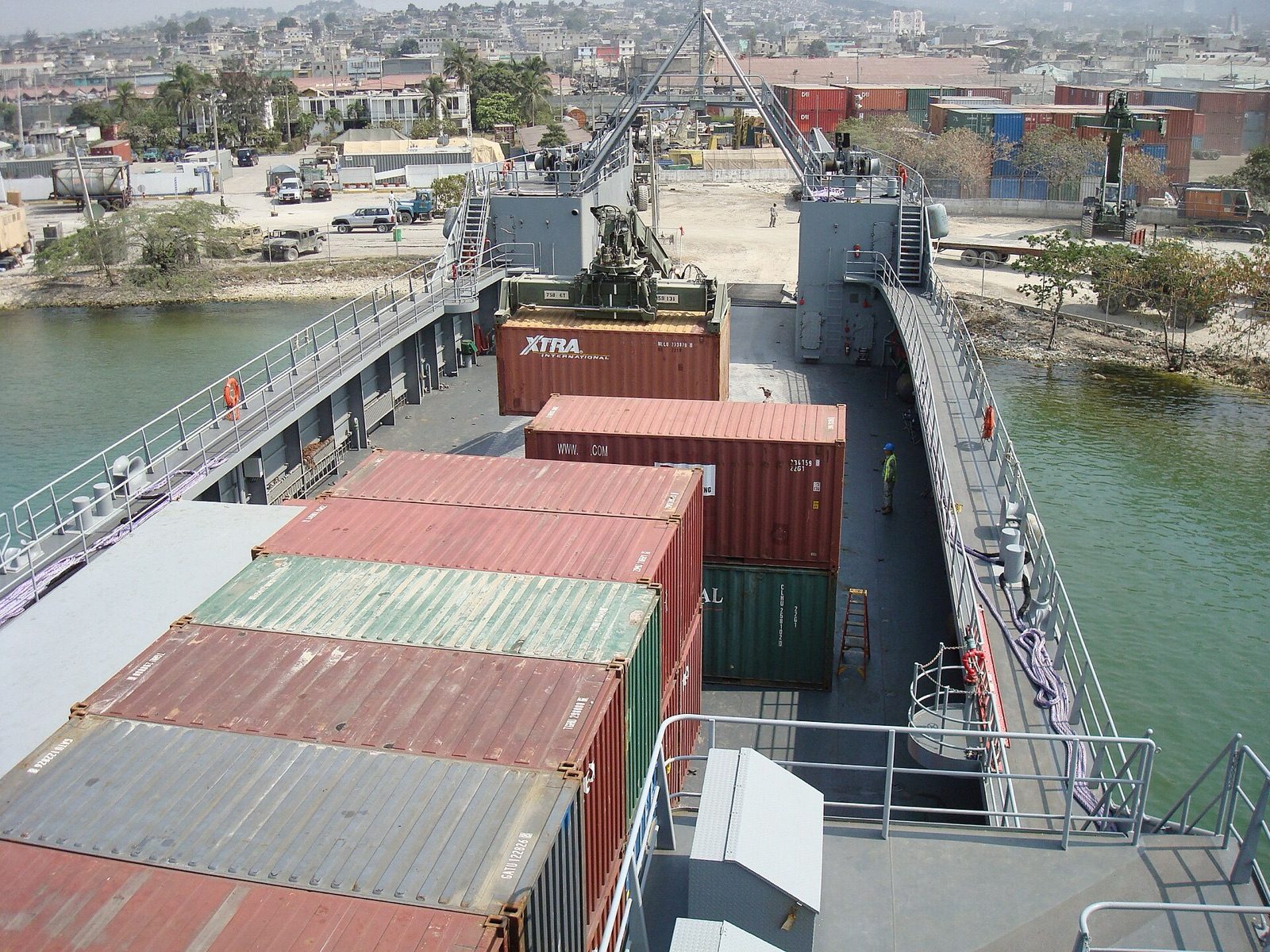
Photo: Container offloading at Port-au-Prince, Haiti. Maj. Paul Hayes, Public domain, via Wikimedia Commons.
Ready to ship your freight?
