
On this page11
Haiti's Administration Générale des Douanes (AGD) clears imports through its Sydonia declaration system. Duties and most taxes are assessed on the CIF value: a customs duty that runs from 0% to 58% for non-agricultural goods, a 10% TVA (VAT) applied to CIF plus duty and other charges, a 5% verification fee and further levies by product.
In Haiti the headline duty rate is rarely what hurts. The stack behind it does: the verification fee, the special levies, excise on cars, fuel, tobacco and alcohol, and storage charges that start running at the port. The rates below come from the AGD and the U.S. International Trade Administration. Operational lanes and ports are covered in our Haiti shipping guide. For FCL and consolidated cargo, our container shipping to Haiti service covers the move from Miami.
Haiti Customs at a Glance
| Item | Detail |
|---|---|
| Customs authority | Administration Générale des Douanes (AGD) |
| Electronic system | Sydonia, with declaration tracking on the AGD portal |
| Tariff framework / US agreements | National tariff published by the AGD; Haiti grants tariff preferences to no country today; CARICOM Common External Tariff legislation awaits Parliament |
| Duty valuation basis | CIF value (some taxes use ex-factory price) |
| VAT (TVA) | 10% on CIF plus customs duty, verification fee and excise |
| Other import levies | 5% verification fee on CIF; 2% CFGDCT; 2% special duty (droit spécial); excise on cars, fuel, tobacco and alcohol; environmental tax on used goods |
| Importer ID required | Not described in the sources reviewed; confirm with the AGD or a licensed customs broker |
| Broker requirement | Licensed customs brokers (commissionnaires en douane agréés) are recognized by the AGD |
| De minimis | Not published in the sources reviewed |
How Does Customs Clearance Work in Haiti?
The AGD portal shows the flow in outline: declarations are lodged in Sydonia, the portal provides a declaration status tracker and a list of unpaid declarations, and the AGD publishes the tariff, the code and a rates-and-taxes page. It also recognizes licensed customs brokers, called commissionnaires en douane agréés. The steps:
- Classify the goods against the national tariff published on the AGD portal. The HS line fixes the duty and any excise.
- Assemble the documents: a bill of lading signed by the captain or delegate and the original invoice, plus permits for regulated goods.
- Lodge the declaration in Sydonia through a licensed broker or the importer's authorized representative.
- Verification. The 5% verification fee on CIF value funds the inspection of the goods. Goods in transit, storage or temporary entry are waived.
- Pay duty and taxes. Duty, TVA, the verification fee and the special levies are settled with the declaration. The AGD portal lists declarations that remain unpaid.
- Release and unloading. Move the cargo out of the terminal promptly: customs storage is charged at 2% of customs value per month, and shipping lines charge demurrage if the goods are not unloaded within 17 days.
Check the declaration's status on the AGD portal before the cargo reaches the pier, and reconcile it with your broker.
Documents Required for Haiti Customs
The U.S. Commercial Service lists two documents that Haitian customs authorities request: a bill of lading signed by the captain or delegate, and an original invoice for the goods. The bill of lading must include:
- The vessel name (sea) or identification number (air) and the shipping company name
- The ports of origin and destination
- The complete cargo manifest and the volume used for freight calculation
- The nature of the goods, including bulk items
- The shipping cost
- The names of shipper and consignee
Add the packing list, the declaration lodged in Sydonia and any import permit the product requires. If you claim an exemption, such as NGO status, keep the ministry certification with the file. The invoice has to match the declaration line by line; our glossary note on CIF shows what the declared value must include.
Haiti Import Duty Rates by Product Category
The U.S. Commercial Service reports WTO-bound rates of 0% to 30% for agricultural goods and 0% to 58% for non-agricultural goods, with lower rates on raw materials than on semi-finished and finished goods, according to its Haiti import tariffs page. Your cargo's rate depends on the HS line. These are the selected rates the source publishes:
| Product category | Duty |
|---|---|
| Cereal flour, pasta, tomatoes and tomato paste, cigarettes | 50% |
| Sauces and condiments | 40% |
| Food preparations from unroasted cereal flakes | 35% |
| Fruit juices, citrus fruit | 30% |
| Certain edible animal products | 20% |
| Pork, sugars and confectionery, cotton, carpets, cut flowers, precious stones, jewelry, cigars | 15% |
| Toothpaste | 10% |
| Rice | 3% |
| Raw and unprocessed goods (live animals, fisheries products, ores, fertilizers) | Many listed as not always subject to duty |
Haiti currently grants tariff preferences to no country. The Common External Tariff of CARICOM, which Haiti joined in July 1999, was still awaiting parliamentary approval when the U.S. Commercial Service last updated its trade agreements page. US-origin cargo therefore pays the same duty as cargo from any other origin.
How to Calculate Import Duty and Taxes in Haiti
The cascade, using the bases the U.S. Commercial Service publishes:
- CIF value: goods, freight and insurance.
- Customs duty: CIF times the rate of the HS line.
- Verification fee: 5% of CIF.
- Excise, if the product carries it.
- TVA base: CIF plus customs duty, verification fee and excise duties, times 10%.
- Special levies: two separate 2% charges. The U.S. Commercial Service lists the 2% CFGDCT on all imports, except petroleum products, pharmaceuticals, parcel posts, some food products, agricultural inputs and paper. The AGD's rates-and-taxes page lists a 2% droit spécial added on top of the taxes and duties collected on the customs declaration (Budget 2016-2017, article 7), with the same exceptions. The CFGDCT base is not stated in the source, so confirm it with your broker.
Illustrative example, USD 10,000 CIF of a product with a 15% duty line, no excise (rates from the table above; the example leaves out the two 2% levies):
- Duty: 10,000 x 15% = USD 1,500
- Verification fee: 10,000 x 5% = USD 500
- TVA base: 10,000 + 1,500 + 500 = USD 12,000
- TVA: 12,000 x 10% = USD 1,200
- Duty, fee and TVA before the 2% levies: USD 3,200
Excise is separate and can outweigh everything else. The U.S. Commercial Service lists imported cars of 2,200 cc or more at 10%, gasoline at 90% of CIF, diesel at 40%, kerosene at 30%, imported tobacco at 50% of CIF and imported alcohol at 20% of CIF, each plus other taxes. Used goods add the Taxe pour la Protection de l'Environnement: the AGD's rates-and-taxes page quotes the 2015 budget law, which sets 10% of CIF on used tires, used batteries and used clothing, and 25% on passenger, utility and passenger-transport vehicles over 7 years old and on goods trucks above 5 tonnes payload over 12 years old. TVA is applied on top of excise, so a car or a fuel cargo is taxed on a base far above its invoice.
Importer Registration and Customs Brokers in Haiti
The AGD portal recognizes commissionnaires en douane agréés, the licensed customs brokers who lodge declarations in Sydonia, and it publishes notices addressed to them. For a foreign shipper a licensed broker is the practical route: the broker has the system access, knows the current tariff and checks the declaration against the invoice. Our entry on the customs broker role explains the split of tasks.
The sources reviewed do not describe the importer registration steps or the tax number format, so request the current requirements from the AGD (directiongenerale@douane.gouv.ht, listed on its portal) or from your broker before the first shipment. Settle who is consignee, who pays the duties and which Incoterm applies before the bill of lading is issued.
Exemptions, Free Zones and Special Regimes in Haiti
The U.S. Commercial Service lists these reliefs:
- Registered NGOs: exempt from customs duties on food and non-commercial medical imports after certification by the Ministries of Economy and Finance and of Planning.
- Duty-free categories: educational materials, national defense equipment, traveler's luggage, diplomatic and consular goods, household goods on relocation, correspondence course materials and agricultural equipment.
- Firms importing machinery, spare parts, semi-finished products or sector-development materials are exempt from duties.
- Special regimes: goods under transit, storage or temporary entry regimes, including inputs for export-only processing, are exempt from TVA and from the verification fee.
The sources reviewed do not describe free zone rules in detail, so ask the AGD or the broker which regime fits your cargo before you ship. For the US export side, the U.S. Commercial Service names the HOPE II and HELP preference programs for Haitian goods entering the United States, but it does not describe their terms.
Import Permits and Licensing Agencies in Haiti
Haitian law requires foreign exporters to obtain an import permit from the Ministry of Commerce for some agricultural and textile products, according to the U.S. Commercial Service. Registered NGOs need certification from the Ministries of Economy and Finance and of Planning to use their duty exemption. The sources reviewed list no other permit by agency, so ask the broker to confirm, by HS line, whether health, agriculture or other approvals apply before the cargo sails.
Common Customs Delays in Haiti and How to Avoid Them
- Charges on top of the duty rate. Budget for the 5% verification fee, the two 2% levies and TVA, not only the duty.
- Storage costs. Customs storage is 2% of customs value per month, and demurrage starts if goods are not unloaded within 17 days.
- Incomplete bill of lading. Customs expects the captain's signature and the full list of fields above.
- Invoice that does not match the declaration. Value and description must agree line by line.
- Misclassified HS line. Duty ranges from 0% to 58%, so a wrong line changes the whole cascade.
- Missing permit. Agricultural and textile products may need Ministry of Commerce approval.
- Unpaid declaration. The AGD lists unpaid declarations. Pay promptly, because cargo is not released until it is settled.
Clearing Cargo to Haiti With Interworld Freight
Interworld Freight was founded in Miami in 1992 and runs ocean FCL and LCL, air freight and customs coordination from its Miami hub, with Miami warehousing for consolidation. For Haiti we coordinate with licensed customs brokers at destination and check the invoice, the bill of lading content and the permits before the cargo sails. Buyers in Asia can read the order-side detail in shipping from China to Haiti, and a regional comparison is in Caribbean import duties and taxes. Quotes arrive within one business day.
Frequently Asked Questions
Who handles customs clearance in Haiti?
The Administration Générale des Douanes (AGD) clears imports through its Sydonia system. Licensed customs brokers, called commissionnaires en douane agréés, lodge declarations on behalf of importers.
What taxes do imports pay in Haiti?
Imports pay customs duty by HS line, a 10% TVA applied to CIF plus duty and other charges, a 5% verification fee on CIF and further levies by product. Cars, fuel, tobacco and alcohol carry excise on top.
What is the import duty in Haiti?
The U.S. Commercial Service reports WTO-bound rates of 0% to 30% for agricultural goods and 0% to 58% for non-agricultural goods. The exact rate depends on the HS line.
Does Haiti charge a verification fee?
Yes. The verification fee is 5% of CIF value. Goods in transit, storage or temporary entry, diplomatic goods and personal effects are waived.
Are US goods duty-free in Haiti?
No. The U.S. Commercial Service reports that Haiti currently grants tariff preferences to no country, so US-origin goods pay the same duty as other origins.
Which documents does Haitian customs ask for?
A bill of lading signed by the captain or delegate and an original invoice for the goods. The bill of lading must carry the vessel or flight identification, ports, manifest, nature of goods, shipping cost and the names of shipper and consignee.
How is TVA calculated in Haiti?
TVA is 10%, applied to the CIF value plus customs duty, the verification fee and excise duties. Petroleum products, books and newspapers, local agricultural products and goods under transit, storage or temporary entry regimes are exempt.
What storage charges apply at a Haitian port?
The U.S. Commercial Service lists customs storage at 2% of customs value per month. Shipping lines charge demurrage if goods are not unloaded within 17 days.
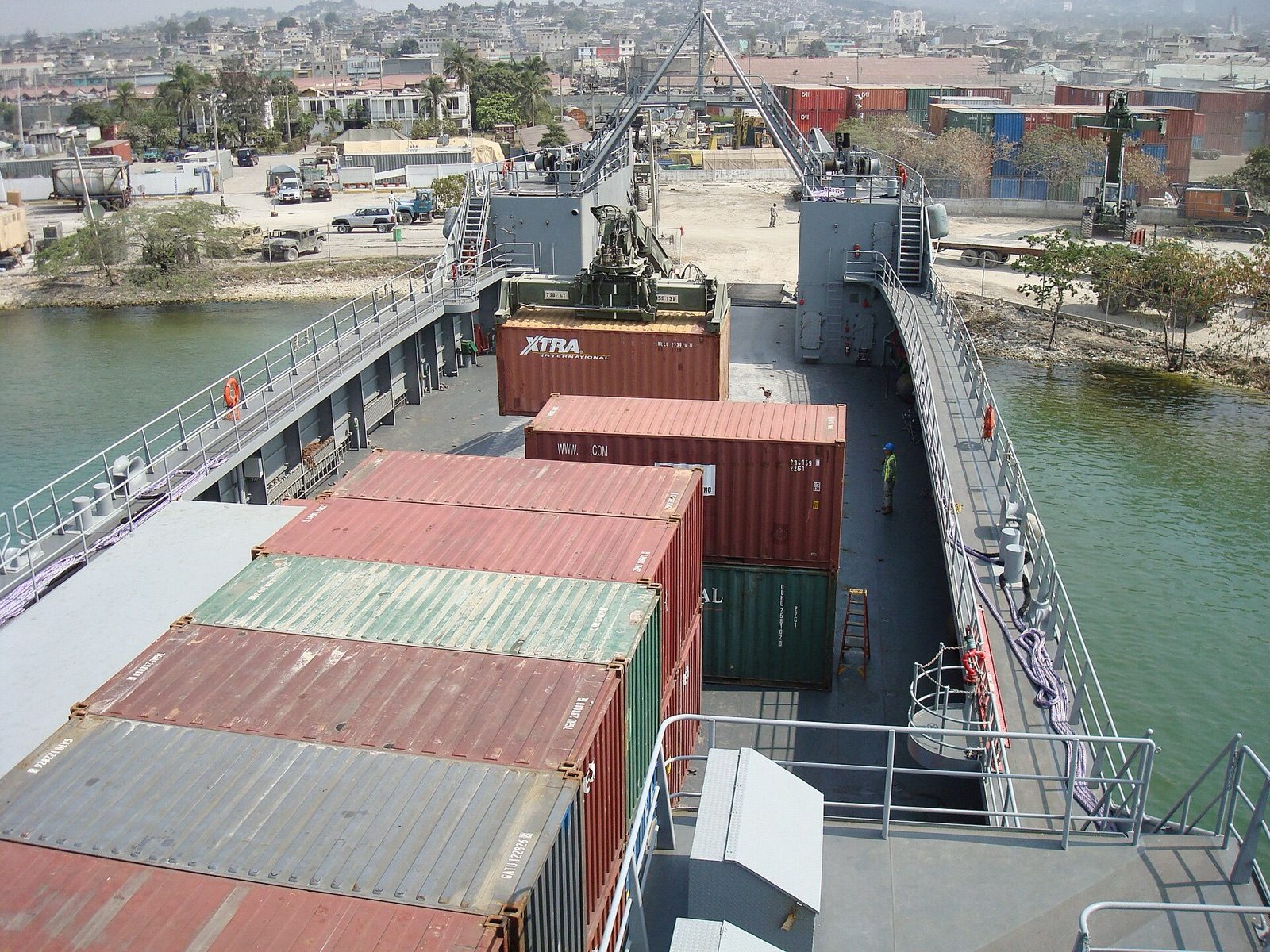
Photo: Container offloading at Port-au-Prince, Haiti. Maj. Paul Hayes, Public domain, via Wikimedia Commons.
Ready to ship your freight?
