
On this page15
Martinique and Guadeloupe are French overseas departments inside the EU customs territory, so imports pay the EU Common Customs Tariff, a local octroi de mer and an 8.5% VAT, all assessed on the declaration lodged in French Customs' DELTA IE system, which replaces DELTA G. The English-speaking islands around them work nothing like this.
An importer budgeting on CARICOM logic misses two of the three charges. Our container shipping to the Caribbean service reaches both departments, and this guide explains what French Customs actually collects.
What Martinique and Guadeloupe Have in Common
French Customs (the DGDDI) states that both departments belong to the customs territory of the European Union and yet count as third territories for tax purposes, according to its guidance for travelers to the Antilles. Two consequences follow. Duty comes from the EU Common Customs Tariff, applied uniformly across the Union and published in the TARIC database. And goods from mainland France or another EU state can still be treated as imports or exports for tax purposes.
The two departments form a single fiscal territory for VAT, excise and octroi de mer. Goods moving between Guadeloupe and Martinique go through no customs clearance, only a periodic declaration and an accompanying document.
Our Caribbean import duties and taxes overview shows how the French islands compare with the rest of the region.
French Antilles Customs at a Glance
| Item | Martinique and Guadeloupe |
|---|---|
| Customs authority | Direction générale des douanes et droits indirects (DGDDI) |
| Declaration system | DELTA IE (import module), which French Customs says replaces DELTA G and DELTA X; DELTA G stays open only when a DELTA IE fault blocks a declaration |
| Tariff framework | EU Common Customs Tariff, third-country duty on non-EU origin |
| Valuation basis | EU customs value, including transport and insurance to the EU border |
| Local tax on imports | Octroi de mer, plus regional octroi de mer |
| VAT | 8.5% standard, 2.1% reduced |
| Importer ID | EORI number (SIREN-based EORI for French operators; SIRET-based EORIs are being deactivated in the second half of 2026) |
| Broker | Importer or a representative files; confirm the access route (account, certified software or customs agreement) with your broker |
| Trade agreement with the US | None; US-origin goods pay the third-country tariff |
How Does Customs Clearance Work in Martinique and Guadeloupe?
- Get an EORI number. It is mandatory before any customs operation in an EU member state, and French operators use a SIREN-based number.
- Obtain DELTA IE access. French Customs states that DELTA IE replaces DELTA G and DELTA X, and that DELTA G stays available only when a DELTA IE fault blocks a declaration, until all user access is withdrawn. The broker confirms the access route the customs office requires.
- Classify the goods. The EU combined nomenclature code drives the duty, the octroi de mer rate and the VAT treatment.
- Receive the cargo manifest. The carrier files the arrival data.
- Lodge the declaration. The declarant enters customs value, origin, nomenclature code and attaches the commercial invoice and transport document.
- Liquidation. The declaration calculates duty, octroi de mer, regional octroi de mer and VAT.
- Pay and release. Taxes become due on entry into the department, or on release for consumption if the goods sit under a suspensive regime.
French customs clearance is a regulated procedure, and an experienced customs broker saves hours on it.
Documents Required for Martinique and Guadeloupe Customs
- Commercial invoice with Incoterm and currency.
- Packing list.
- Bill of lading or air waybill.
- Customs declaration lodged in DELTA IE.
- EORI number of the importer.
- Certificate of origin when preference is claimed under an EU agreement.
- Cerfa 15567 attestation for the optional octroi de mer exemption under Article 6.
- Sanitary, phytosanitary or product-conformity documents for regulated goods.
Martinique Customs and Import Duties
In Martinique the Collectivité territoriale fixes the octroi de mer rates within the limits of law no. 2004-639, and its Assembly also decides exemptions by sector and tariff position. French Customs publishes, as of October 9, 2026, a table of exempt goods by tariff position and eligible sector, plus a list of the Assembly's deliberations. A professional importer reads both before declaring.
The regional octroi de mer sits on top, under the same legal cap as Guadeloupe. An importer whose activity code qualifies claims the exemption at clearance, with the additional national code in the RITA tariff system. Our guide to Martinique and Guadeloupe shipping covers ports and routing.
Guadeloupe Customs and Import Duties
Guadeloupe leaves the rates to the Conseil régional, which publishes its tariff by combined nomenclature code. The rate follows the HS line, so two products in one container can carry different octroi de mer.
The statute caps the base octroi de mer at 60%, or 90% for alcoholic products and manufactured tobacco, and caps the regional octroi de mer at 2.5%, as French Customs explains in its octroi de mer circular. A supplementary regional rate of up to 2.5% applies where the region has signed the convergence plan under the 2017 equality law.
EU Duty and the Common Customs Tariff in Martinique and Guadeloupe
Customs duty is the one charge that works exactly as it does in Rotterdam or Le Havre. The EU Common Customs Tariff assigns a third-country duty to each nomenclature code, and TARIC publishes it together with preferences, quotas, anti-dumping duties and import restrictions. TARIC excludes national levies such as VAT and excise, which is why octroi de mer never appears in it.
Origin decides the rate. Goods made in a country with an EU preferential agreement can enter at a reduced or zero rate with proof of origin, and goods from countries without one pay the full third-country duty. A US-made product pays the third-country rate. So the importer does two lookups: the EU duty in TARIC, then the octroi de mer in the regional deliberation for the same code.
Importer Registration and Customs Brokers in Martinique and Guadeloupe
Every operator needs an EORI number before any customs operation in an EU member state, and the SIREN-based EORI is the one French Customs requires in European customs applications. SIRET-based EORIs are due to be deactivated in the second half of 2026, on a date Customs will announce. French operators apply through the SOPRANO-EORI service, as the DGDDI EORI page explains.
An importer with access to the clearance system can lodge its own declarations, or appoint a customs representative to do it. A foreign exporter in Miami is not the declarant on the French side: the Martinique or Guadeloupe consignee, or its broker, holds the EORI and signs. Settle who is the declarant before the booking, because the commercial invoice must name the same consignee as the declaration.
Octroi de Mer, Regional Octroi de Mer and VAT in Both Departments
Octroi de mer applies to imports regardless of origin. French Customs reports indicative rates of 7% to 15%, with some goods at 20%, 25% or even 50%, and regional octroi de mer at 1.5% or 2.5%, according to the DGDDI's guidance for travelers to the Antilles.
VAT is 8.5% standard and 2.1% reduced. Octroi de mer is calculated on the customs value, and VAT on the customs value plus taxes and duties due on the import (excluding VAT) and transport and insurance to the destination, per the guidance for importing into an overseas department. Both become due on entry.
How to Calculate Import Duty and Taxes in Martinique and Guadeloupe
The cascade runs: customs value, EU duty, octroi de mer, regional octroi de mer, then VAT on the full base.
Illustrative example: a consignment with a customs value of EUR 10,000, EU duty of 5%, octroi de mer of 10% and regional octroi de mer of 2.5%.
- EU duty at 5%: EUR 500
- Octroi de mer at 10% of customs value: EUR 1,000
- Regional octroi de mer at 2.5%: EUR 250
- VAT base (value + duty + octroi de mer + regional octroi de mer): EUR 11,750
- VAT at 8.5%: EUR 998.75
- Total taxes and duty: EUR 2,748.75
The real octroi de mer rate depends on the HS code and the deliberation in force.
Exemptions, Free Zones and Special Regimes in the French Antilles
Octroi de mer exemptions are either mandatory or optional. The mandatory ones cover certain local products traded within the Antillean-Guianese market and goods under customs allowances. The regional assembly decides the optional ones, for goods used by a person with an economic activity, ship and aircraft supplies, and some professional fuels. Goods placed under a suspensive regime owe the taxes when they are released for consumption.
Import Permits and Licensing in the French Antilles
EU product rules apply at the border, so health, plant-health, product-safety and CE conformity documents are checked with the declaration, not after it. Ask for the technical file before booking, because French Customs routes regulated goods to the competent control service.
Common Customs Delays in the French Antilles and How to Avoid Them
- No EORI. The declaration cannot be lodged without it.
- No clearance-system access. The importer or its broker needs working access to French Customs' online clearance service before the cargo lands.
- Wrong octroi de mer code. The rate sits on the nomenclature line.
- Exemption not claimed at clearance. The exemption code must be on the declaration.
- Budget built on CARICOM logic. Octroi de mer and VAT are not in a CARICOM calculator.
Clearing Cargo to the French Antilles With Interworld Freight
Interworld Freight has operated from Miami since 1992. Our Miami hub handles warehousing, ocean FCL and LCL, air freight, and customs coordination with licensed brokers at destination. Share the commercial invoice and HS codes and you get a quote within one business day.
Frequently Asked Questions
Are Martinique and Guadeloupe in the EU customs union?
Yes. They are part of the EU customs territory, but they count as third territories for tax purposes.
What is octroi de mer?
It is a local tax on goods imported into the overseas departments, whatever their origin. Regional councils set the rates.
What is the VAT rate in Martinique and Guadeloupe?
8.5% standard and 2.1% reduced.
Do US goods get a preference?
No agreement lowers the third-country tariff for US origin, so the EU Common Customs Tariff applies.
Which system declares the goods?
DELTA IE, which French Customs says replaces DELTA G and DELTA X. The declarant needs an EORI.
Is clearance needed between Guadeloupe and Martinique?
No customs clearance applies; only a periodic declaration and an accompanying document.
Can exemptions reduce the octroi de mer?
Yes, mandatory and optional ones, claimed on the declaration with the right national code.
Where do I find the rate for my product?
The nomenclature code gives the EU duty in TARIC, and the regional deliberation gives the octroi de mer.
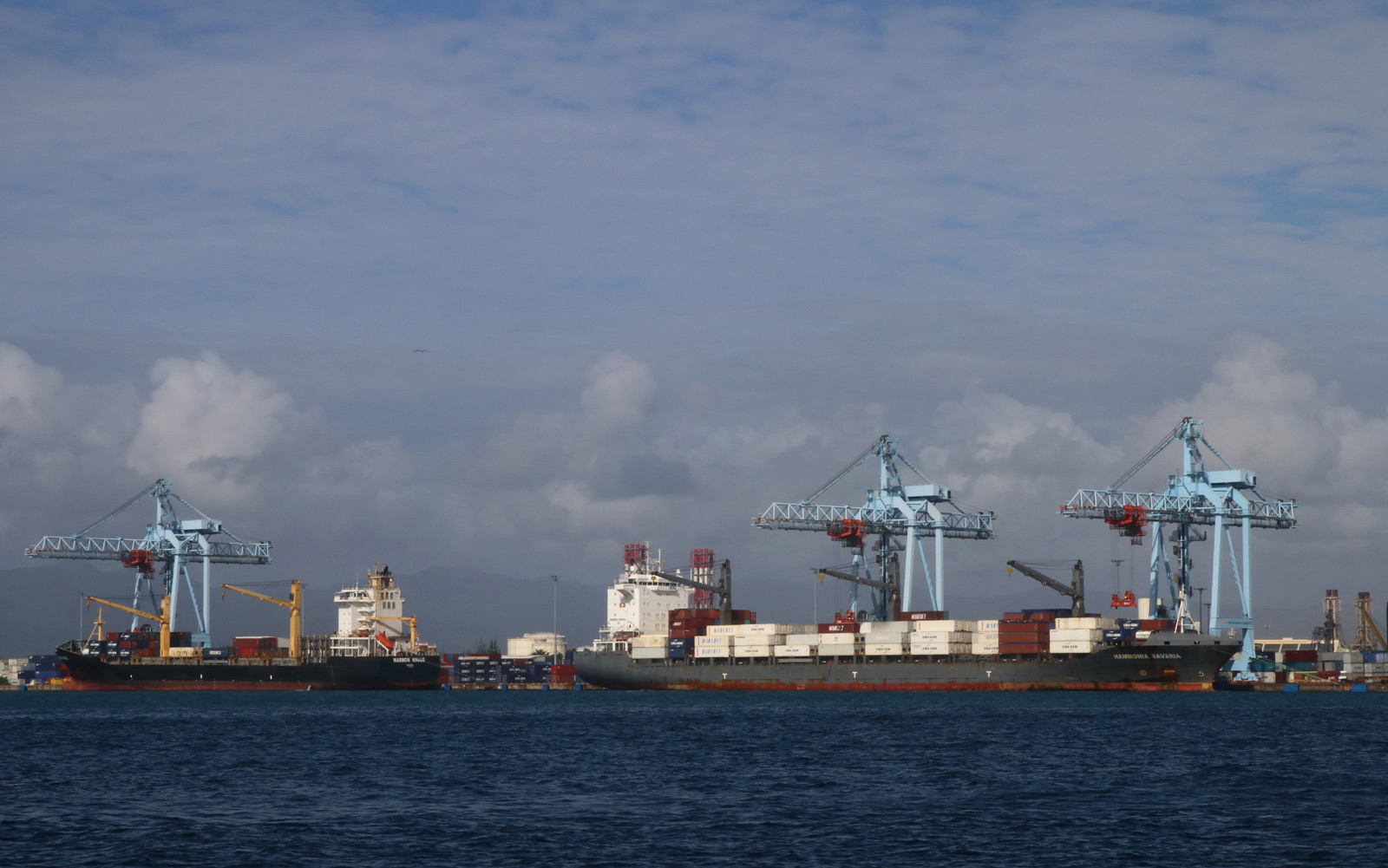
Photo: Port of Jarry container terminal, Guadeloupe. Rémi Jouan, CC BY-SA 4.0, via Wikimedia Commons.
Ready to ship your freight?
