
On this page13
Ship to Martinique and Guadeloupe by LCL, FCL or air from Miami into Fort-de-France or Jarry (about 5 days by sea, IWF estimate), clear French Customs (DGDDI) under EU rules with an EORI number, and pay EU customs duty, octroi de mer and 8.5% TVA. Both islands are French overseas departments and regions (DROM) and EU outermost regions, which makes them unlike any other Caribbean destination: cargo arriving from Miami or Shanghai enters the EU customs territory. That means the EU Union Customs Code, the EU Common Customs Tariff, an EORI number for the importer, CE marking and EU sanitary rules, all applied by French Customs. On top of EU customs duty, both islands levy their own octroi de mer and octroi de mer régional, set locally by product, and a reduced French VAT (TVA) of 8.5% standard and 2.1% reduced. Prices are in euros, the commercial language is French, and most supply historically comes from mainland France, so a US or Asian supplier competes on landed cost against goods that already meet EU rules. French Guiana, the third French DROM in the region, borders Suriname, a non-EU market covered in our guide to shipping to Suriname.
Martinique and Guadeloupe Shipping at a Glance: Transit Times and Options
Martinique and Guadeloupe are about 5 days from Miami by LCL, 1 to 3 days by air, and 30 to 45 days from China via transshipment.
| Route & mode | Indicative cost | Transit | Best for |
|---|---|---|---|
| Miami to Fort-de-France (Martinique), Ocean LCL | about $1,225 for 5 CBM / 1,500 kg (IWF published LCL rate, September 2026; excludes destination duties, taxes and local charges) | about 5 days port to port (estimated) | food, retail and building supply under ~15 CBM |
| Miami to Pointe-à-Pitre (Guadeloupe), Ocean LCL | about $1,225 for 5 CBM / 1,500 kg (IWF published LCL rate, September 2026; excludes destination duties, taxes and local charges) | about 5 days port to port (estimated) | food, retail and building supply under ~15 CBM |
| USA to Martinique or Guadeloupe, Ocean FCL | quote on request | 1 to 2 weeks depending on routing | full loads of food, beverages, materials |
| Miami to FDF or PTP, Air freight | quote on request | 1 to 3 days | spare parts, pharma, urgent and high-value cargo |
| China to Martinique or Guadeloupe, Ocean FCL/LCL | quote on request | 30 to 45 days via transshipment, longer for LCL | consumer goods, furniture, equipment |
| Mainland France / North Europe to the French Antilles, Ocean | quote on request | 2 to 3 weeks | EU-origin food and consumer goods |
The Miami LCL rate covers FCA Miami CFS to the destination port. Duty, octroi de mer, TVA and destination handling are billed separately. The process below applies to each island separately.
How to Ship to Martinique and Guadeloupe: Step by Step
Shipping to Martinique or Guadeloupe follows eight steps under EU procedure, with one bill of lading and one declaration per island.
- Classify and check EU compliance. Assign the CN code (it sets EU duty and the octroi de mer rate) and confirm CE marking, French labeling and EU sanitary eligibility.
- Register an EORI and choose the Incoterm. The importer needs an EORI number, and the buyer and seller agree who pays freight, EU duty, octroi de mer and TVA.
- Book from Miami or origin. Deliver US cargo to a Miami container freight station for LCL, or book FCL or air; Asian cargo moves via a hub or via Miami.
- Prepare the documents. Issue an EU-compliant invoice, a packing list, a transport document per island and any sanitary certificate or proof of origin.
- File the US export data and the ENS. Submit Electronic Export Information (EEI) in AES when a Schedule B line is valued over $2,500 or a licence is required; the carrier lodges the Entry Summary Declaration in ICS2 before arrival.
- Transit and temporary storage. On arrival the goods are presented to customs and held in temporary storage until a procedure is assigned.
- Declare with French Customs. The carrier, forwarder or a registered customs representative files the electronic declaration (moving to DELTA I/E), with veterinary or phytosanitary checks at a border control post where they apply.
- Pay and take delivery. Pay EU duty, octroi de mer, octroi de mer régional, TVA and any excise, then release the cargo from Pointe des Grives or Jarry for final delivery.
For US suppliers, steps 3 to 5 start in Miami.
Shipping From the USA to Martinique and Guadeloupe
Miami is the natural US consolidation point for the French Antilles. IWF's published LCL service from Miami runs to both Fort-de-France and Pointe-à-Pitre, with an estimated port-to-port transit of about five days and a published rate of about $1,225 for a 5 CBM / 1,500 kg shipment to either island. Because each island is a separate destination with its own octroi de mer rates, every shipment needs its own bill of lading and consignee; cargo cleared in Martinique is not automatically free to move to Guadeloupe without formalities. Neighbours differ: Dominica sits between the two islands and St Lucia lies just south of Martinique, but both apply CARICOM rules rather than EU customs, as our guides to shipping to Dominica and shipping to St Lucia explain.
Most US cargo to the islands moves as LCL consolidation: goods are received in Miami, palletized and loaded with other shippers' freight, and you pay per cubic meter or weight ton. Pricing depends on volume, density and destination charges, as explained in what drives LCL shipping costs. When orders reach 15 CBM, a dedicated 20ft container is more economical, and full loads move under Caribbean container shipping.
Air freight lands at Martinique Aimé Césaire International (FDF) and Guadeloupe Pôle Caraïbes (PTP). Air fits pharmaceuticals, electronics, spare parts and urgent retail replenishment; see air freight to the Caribbean. The key rule for the US lane: confirm EU compliance (CE marking, labeling in French, sanitary eligibility) before booking, because non-compliant goods are a customs problem, not a freight problem.
Shipping From China, Asia and Europe to Martinique and Guadeloupe
Asian cargo reaches the French Antilles through transshipment: containers relay at a hub in the Caribbean basin or via Europe before the final leg to Fort-de-France or Jarry, with transit of 30 to 45 days for a full container and longer for LCL. Martinique's port is investing to become a regional hub, but most Asian cargo still connects through larger terminals, compared in Caribbean transshipment hubs.
Asian goods entering the islands face the same EU rules as any non-EU import: the EU Common Customs Tariff, CE marking where applicable, and EU product safety and labeling. Smaller Asian orders can be routed through Miami and consolidated with US cargo, which gives one weekly arrival per island and one set of import documents.
Shipping From Europe to Martinique and Guadeloupe
Mainland France and North Europe remain the dominant supply source. Direct services link North European and Mediterranean ports with Fort-de-France and Pointe-à-Pitre, with transit of two to three weeks. Goods with EU (Union) status are not charged customs duty, but a customs declaration is still required for every import into an overseas department, including shipments from mainland France or another EU state (trade within the Antilles single market is the exception). Union status must be proven, with a T2LF document as the standard proof, and octroi de mer and TVA still apply. For a US or Asian supplier, this is the benchmark: European goods arrive duty-free but still pay octroi de mer, so the competitive gap is the EU customs duty plus any compliance cost.
Which Ports and Airports Handle Cargo in Martinique and Guadeloupe?
Each island has one main container port and one cargo airport: Pointe des Grives and FDF in Martinique, Jarry and PTP in Guadeloupe.
- Grand Port Maritime de la Martinique, Fort-de-France (UN/LOCODE MQFDF): the island's commercial port. The Pointe des Grives terminal is dedicated to containers and handles more than 150,000 TEU a year on a 450 m quay with 14 m of depth, a 16-hectare yard and post-panamax gantry cranes. Under the Hub Antilles project, two large new gantry cranes arrived in May 2025 to lift capacity toward 300,000 TEU a year; one collapsed during commissioning in September 2025, and container operations resumed within days. The Hydrobase handles bulk and RoRo.
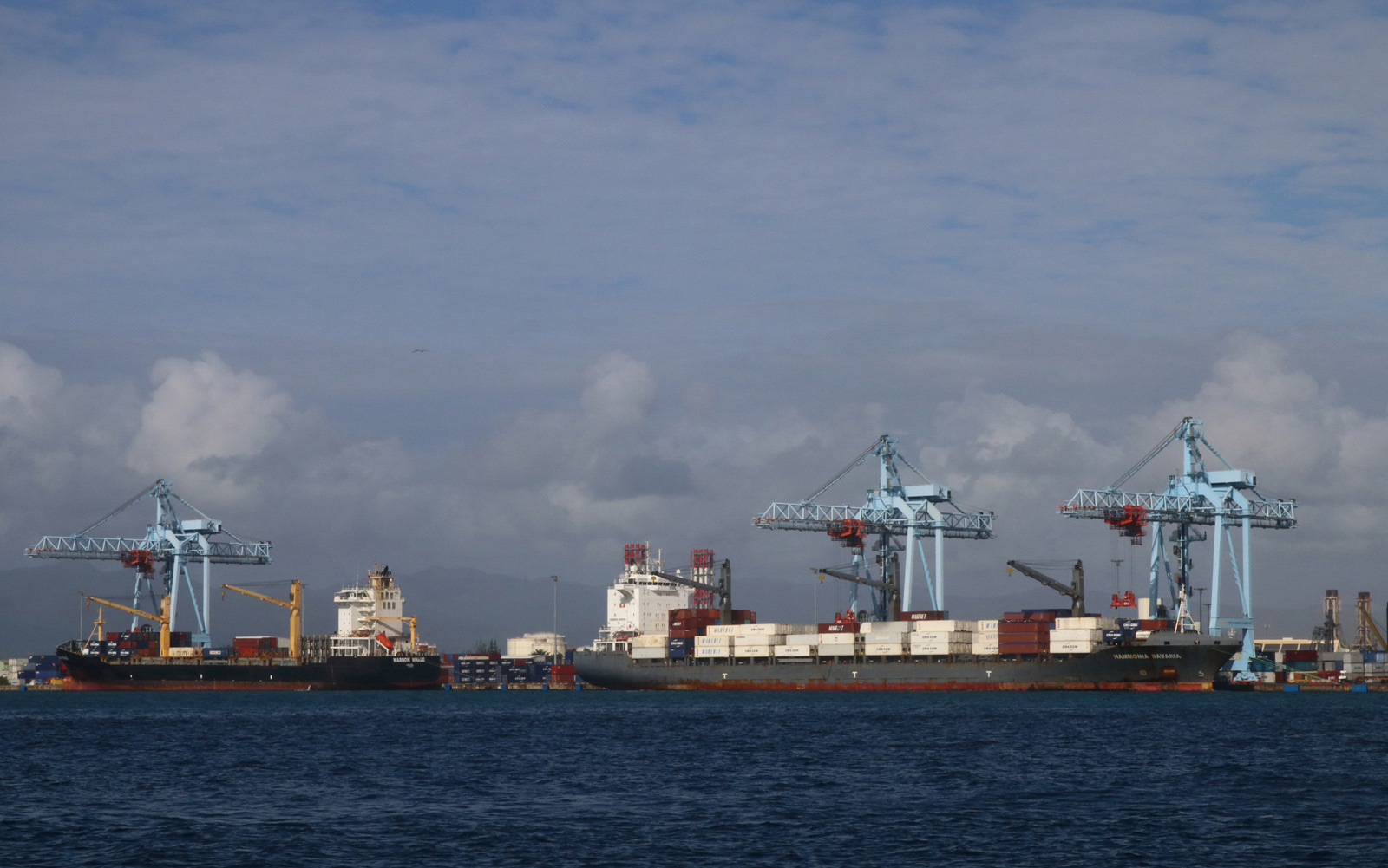
- Guadeloupe Port Caraïbes, Jarry terminal (Baie-Mahault, near Pointe-à-Pitre, UN/LOCODE GPPTP): Guadeloupe's freight port, carrying about 97% of Guadeloupe Port Caraïbes' cargo traffic. Quays 12 and 13 were optimized for fully laden ships of 3,000 TEU, and the channel was dredged to 15.5 m, giving about 14 m of draft.
- Martinique Aimé Césaire International Airport (FDF): Martinique's air cargo gateway, at Le Lamentin.
- Guadeloupe Pôle Caraïbes Airport (PTP): Guadeloupe's air cargo gateway, at Les Abymes.
Every one of these gateways applies the same EU customs procedure.
How Does Customs Clearance Work in Martinique and Guadeloupe?
Imports into Martinique and Guadeloupe clear through French Customs (Direction générale des douanes et droits indirects, DGDDI) under the EU Union Customs Code, and every import needs a customs declaration, even from mainland France. The process is the EU procedure, run locally:
- EORI number: mandatory for every import and export operation, including trade with mainland France, another overseas department or another EU state (except trade within the Antilles single market between Martinique and Guadeloupe), and valid across the EU, according to French Customs.
- Entry Summary Declaration (ENS): safety and security data for non-EU goods must be lodged at the first point of entry into the EU, before arrival, through the EU's ICS2 system.
- Temporary storage: on arrival, goods are presented to customs and placed in temporary storage until a customs procedure is assigned.
- Customs declaration: filed electronically. French Customs is moving import and export declarations to DELTA I/E, its new online clearance service built for the Union Customs Code, which replaces DELTA G, as explained in the French Customs import-export overhaul file.
- Classification and valuation: HS/CN classification determines customs duty, octroi de mer rates and applicable standards. Duty and octroi de mer are calculated on the value of goods plus transport and insurance to entry into the department.
- Controls and release: documentary and physical checks, veterinary and phytosanitary controls where applicable, then payment and release.
In most cases the carrier, forwarder or a registered customs representative handles clearance and advances duties and taxes, then invoices them to the consignee with a service fee. An importer with an EORI number and access to French Customs' online services can also lodge its own declarations.
What Are the Import Duties and Taxes in Martinique and Guadeloupe?
A non-EU import into Martinique or Guadeloupe pays up to four layers: EU customs duty, octroi de mer plus octroi de mer régional, TVA, and excise where it applies.
- EU customs duty: the EU Common Customs Tariff applies to non-EU goods (including US and Chinese origin). Rates depend on the CN code and origin; goods qualifying under an EU free trade agreement can receive a reduced or zero rate with valid proof of origin.
- Octroi de mer and octroi de mer régional: taxes specific to the overseas departments, charged on imports, including goods from mainland France. Rates are set by deliberation of each territory's local assembly and vary by product (tariff line), and the tax base is the customs value, according to French Customs. EU law authorizes the current regime, including the differential in favor of local production, until 31 December 2027; in September 2026 the European Commission proposed extending it to 31 December 2030 and updating its product codes, subject to Council approval.
- TVA (VAT): Martinique and Guadeloupe apply 8.5% as the normal rate and 2.1% as the reduced rate (which covers products taxed at 5.5% or 10% in mainland France), with special rates of 1.75% and 1.05% for narrow categories, according to the French tax authority. Import TVA is calculated on the customs value plus transport and insurance to the final delivery point, plus customs duty.
- Octroi de mer is not in the TVA base: under Article 45 of Law 2004-639, octroi de mer and octroi de mer régional are excluded from the TVA base at import, as the ministry confirmed in its answer to written question 14492. Calculate TVA on value plus duty, not on value plus duty plus octroi.
- Excise: alcohol, tobacco and energy products carry additional excise duties.
Because octroi de mer rates are set per product and per island, the same container can carry a different tax bill in Fort-de-France and in Pointe-à-Pitre. Confirm the CN code and the local octroi rate before quoting a landed price, and support both with the documents below.
What Documents Are Required to Ship to Martinique and Guadeloupe?
A French Antilles import needs EU-grade paperwork: invoice, packing list, transport document, the importer's EORI, and origin, sanitary or conformity documents where they apply.
- Commercial invoice in a format accepted by EU customs, with CN/HS codes, values, currency and Incoterm
- Packing list with gross and net weights per line
- Bill of lading or air waybill per island (see bill of lading types)
- Importer's EORI number
- Proof of preferential origin where a reduced EU duty is claimed; T2LF for Union-status goods
- Health certificates and pre-notification for products of animal origin; phytosanitary certificates for plants and plant products
- Declarations of conformity and technical files for CE-marked products
The sanitary and conformity lines govern the restricted categories.
Restricted Goods and Import Permits in Martinique and Guadeloupe
Martinique and Guadeloupe apply EU restrictions, so the tightest controls fall on food of animal origin, plants, non-compliant products without CE marking, and excise goods.
- Products of animal origin: meat, dairy, fish and other animal products from third countries are subject to EU veterinary controls. In Martinique and Guadeloupe these checks take place at authorized entry points, and goods cleared there are for local use only (Commission Implementing Decision 2012/44/EU). Consignments move with EU-format health certificates, pre-notified in the EU's TRACES system, and enter through a border control post.
- Plants and plant products: EU phytosanitary rules apply, with phytosanitary certificates and inspection at entry.
- CE marking and product safety: machinery, electrical equipment, toys, construction products and many other categories must meet EU requirements and carry CE marking before being placed on the market.
- Excise goods: alcohol, tobacco and energy products are subject to excise duties and controls.
- Dangerous goods: hazmat ships under IMDG and IATA DGR rules; check LCL acceptance per class.
Compliant cargo then moves by the mode its volume justifies.
LCL, FCL or Air Freight to Martinique and Guadeloupe: Which to Choose?
Volume decides the mode for Martinique and Guadeloupe: LCL from Miami below 15 CBM, a 20ft container above it, air for urgent cargo.
- Under 15 CBM: LCL from Miami, one shipment per island. The published IWF rate for 5 CBM / 1,500 kg gives a reference point for planning.
- 15 CBM and above: a 20ft FCL lowers cost per unit and reduces handling.
- Above 30 CBM: 40ft or 40ft high cube for food, beverages and retail stock.
- Reefer: chilled and frozen products in reefer containers, with veterinary certificates prepared before sailing.
- Air: for pharma, spare parts and urgent high-value retail stock where days matter more than freight cost.
Key Industries Shipping Freight to Martinique and Guadeloupe
Retail and food distribution account for a large share of import volume into Martinique and Guadeloupe. Hypermarkets, wholesalers and food distributors supply the population of both islands with dry, chilled and frozen goods, beverages, household products and consumer electronics, most of it historically sourced from mainland France and increasingly complemented by US and Caribbean suppliers that can meet EU rules. Construction, healthcare and the energy transition pull in building materials, medical supplies and electrical equipment.
On the export side, bananas, rum and sugar products leave for Europe, which is one reason European lines connect the islands well. US and Asian suppliers who want to sell into French Caribbean supermarkets and wholesalers face specific requirements on labeling, cold chain and sanitary documents, which we cover in Supplying Retail and Food Distributors in the French Caribbean.
Choosing a Freight Forwarder for Martinique and Guadeloupe
For the French Antilles, a forwarder has to bring EU customs discipline to a Caribbean routing: EORI and ENS data in order, CN classification that holds up for both customs duty and octroi de mer, sanitary documents ready before sailing, and separate documents per island. Interworld Freight has operated from Miami since 1992, with a Miami warehouse that receives and consolidates US, Asian and European cargo, and handles ocean FCL and LCL, air freight and customs coordination with the destination customs representative, with coverage on every major trade lane. See Miami freight forwarding to the Caribbean for South Florida routings. Quotes are answered within one business day.
Frequently Asked Questions
Are Martinique and Guadeloupe part of the EU for customs?
Yes. As French overseas departments and EU outermost regions, both islands are inside the EU customs territory. Imports follow the Union Customs Code and the EU Common Customs Tariff, applied by French Customs, and the importer needs an EORI number.
What is the octroi de mer?
It is a tax specific to the French overseas departments, charged on imported goods, including goods from mainland France. Rates are set locally by product, so they differ between Martinique and Guadeloupe. It is calculated on the customs value, and the current regime runs to the end of 2027, with a Commission proposal to extend it to 2030.
What VAT applies to imports into Martinique and Guadeloupe?
The normal TVA rate is 8.5% and the reduced rate is 2.1%, compared with 20% in mainland France. Import TVA is calculated on the value including transport, insurance and customs duty; octroi de mer is not part of the TVA base.
How long does shipping from Miami to Martinique or Guadeloupe take?
IWF's published LCL service from Miami has an estimated transit of about 5 days port to port to Fort-de-France or Pointe-à-Pitre. Air freight takes 1 to 3 days, and cargo from China takes 30 to 45 days via transshipment.
How much does it cost to ship LCL from Miami to the French Antilles?
IWF's published LCL rate is about $1,225 for 5 CBM / 1,500 kg from Miami to either Fort-de-France or Pointe-à-Pitre (September 2026). That figure excludes customs duty, octroi de mer, TVA and destination local charges.
Can US food products be shipped to Martinique and Guadeloupe?
Yes, if they meet EU rules. Products of animal origin need EU-format health certificates and pass veterinary checks at authorized entry points, and labeling and additives must comply with EU food law. Shelf-stable goods are simpler than meat and dairy.
Do I need a customs declaration for goods from mainland France?
Yes. A customs declaration is required for every import into an overseas department, even from mainland France or another EU state. Union-status goods pay no customs duty but remain subject to octroi de mer and TVA.
Can I clear customs myself in Martinique or Guadeloupe?
Yes, an importer with an EORI number can lodge its own declaration with French Customs, but most shipments are cleared by the carrier, forwarder or a registered customs representative. The representative charges a service fee on top of the duty, octroi de mer and TVA it advances, so ask for that fee in the quote.
Photo: Port of Jarry container terminal, Guadeloupe. Rémi Jouan, CC BY-SA 4.0, via Wikimedia Commons.
Ready to ship your freight?
