
On this page11
Customs clearance in Trinidad and Tobago is handled by the Customs and Excise Division of the Ministry of Finance, which processes electronic declarations in ASYCUDA World, with permits and agency approvals routed through the TTBizLink portal. Duty follows the CARICOM Common External Tariff, with rates up to 20% on most goods, and 12.5% VAT is charged on the aggregate import value. Commercial goods must be cleared by a customs broker.
Cargo from Florida to Port of Spain or Point Lisas needs its declaration ready before the vessel arrives. Interworld Freight ships containers and LCL from Miami on its container shipping service to Trinidad and Tobago; this guide picks up at the customs desk, where the freight leg ends.
Trinidad and Tobago Customs at a Glance
| Item | Trinidad and Tobago |
|---|---|
| Customs authority | Customs and Excise Division, Ministry of Finance |
| Electronic system | ASYCUDA World (Customs Border Control System), with agency permits routed through TTBizLink |
| Tariff framework | CARICOM Common External Tariff (CET), up to 20% on most goods |
| Trade agreements with the US | No reciprocal free trade agreement; CBERA preferences apply to exports to the US |
| Duty valuation basis | Fair market value of the goods when landed (ITA); Customs builds the customs value from the invoice plus insurance and freight (CIF) |
| VAT rate | 12.5%, levied on the aggregate import value |
| Other import levies | High excise taxes on spirits, wine, tobacco and motor vehicles; 7% tax on online purchases |
| Importer ID required | Registration with the authorities; VAT registration above TT$600,000 in gross supplies |
| Broker requirement | Customs broker required for commercial goods |
| De minimis | Not stated in the official sources reviewed |
How Does Customs Clearance Work in Trinidad and Tobago?
The sequence below follows the U.S. International Trade Administration's description of the import process and the TTBizLink e-services model.
- Check licensing first. Most items import freely, but products on the negative list need an import licence from the Ministry of Trade and Industry. Ask whether a licence is required before the cargo ships.
- Appoint a licensed broker. A customs broker is required for commercial imports.
- Send documents early. Shipping documents can go to Customs on the date the goods are shipped, which saves days on sea freight.
- File the declaration. The broker prepares the electronic declaration in ASYCUDA World and submits it to Customs and any other border agency involved. Customs and Excise Division notices call it the e-C82, self-assessed by the declarant in the Customs Border Control System, while the Country Commercial Guide still names a C75 or C76 declaration signed by the importer. Your broker knows which form reference your entry carries.
- Assessment. Customs reviews the declared classification and value against the documents.
- Pay duties and taxes. Documents go to Customs on arrival and duties are paid before clearance.
- Release and delivery. Once Customs releases the goods, the broker arranges collection from the terminal.
The ITA trade-barriers page flags local customs clearance as the most frequently reported problem for US exporters, with delays that can take weeks. It also notes that electronic payments are not accepted and that not every ministry involved uses the portal. Build a buffer into the delivery date. The filing role is defined in the glossary entry on customs broker.
Documents Required for Trinidad and Tobago Customs
The Country Commercial Guide lists seven documents for importing goods:
- CARICOM area invoice provided by the supplier
- Supplier's invoice
- Copy of the bill of lading or air waybill
- Declaration on the C75 or C76 form signed by the importer
- Certificate of origin provided by the supplier
- Health or sanitary certificate, if required
- Import licence, if required
The Country Commercial Guide points importers to TTBizLink for online processing of these documents. Before the supplier issues the invoice, have the broker confirm which declaration form and which agency permits your commodity needs.
Trinidad and Tobago Import Duty Rates by Product Category
Trinidad and Tobago applies the CARICOM CET to goods from outside the region. The Country Commercial Guide on the import tariff states import tariffs up to 20% and gives these examples. The HS code sets the rate for each shipment; check it in the tariff look-up on the Customs ASYCUDA portal or with your broker.
| Category | Duty indicated | Source note |
|---|---|---|
| Books, CDs, computer hardware and software, scanners | Tariff-free | Examples named by the U.S. International Trade Administration |
| Most other goods from outside CARICOM | Up to 20% under the CET | U.S. International Trade Administration |
| Auto parts, DVD players, jewelry | 30% | U.S. International Trade Administration |
| Spirits, wine, tobacco, motor vehicles | Customs duty plus high excise tax | U.S. International Trade Administration |
| Certain food items | Zero-rated for VAT | Inland Revenue Division and U.S. International Trade Administration |
The guide was last published in March 2024. Check the live tariff before you commit to a landed price, especially after a budget announcement.
How to Calculate Import Duty and Taxes in Trinidad and Tobago
The U.S. International Trade Administration states that customs duty is assessed on the fair market value of imported goods when they land, and that VAT is levied on the aggregate import value, which in the entry is built from the CIF value plus duty. The order is therefore CIF value, then duty, then excise where it applies, then VAT on the total.
Illustrative example (round numbers, not a quote): machinery parts with a CIF value of TT$100,000 and an HS line at 20% duty.
- CIF value: TT$100,000
- Duty at 20%: TT$20,000
- Aggregate import value (CIF plus duty): TT$120,000
- VAT at 12.5%: TT$15,000
- Duty and VAT payable: TT$35,000
Excise goods such as vehicles and spirits add an excise charge before VAT. Get the assessed figure from the broker before the vessel sails.
Importer Registration and Customs Brokers in Trinidad and Tobago
Commercial importers register with the revenue authorities, and a business whose gross commercial supplies exceed TT$600,000 in any twelve-month period must register for VAT, according to the Inland Revenue Division (threshold as of January 1, 2023). The VAT rate stated on that page is 12.5%.
For clearance, the Country Commercial Guide states that a customs broker is required when importing and exporting commercial goods. Choose a broker who handles your commodity week in, week out: the broker's classification choices become your tax liability. Interworld Freight coordinates with licensed brokers at destination and does not clear cargo in Trinidad and Tobago itself.
Exemptions, Free Zones and Special Regimes in Trinidad and Tobago
CARICOM trade arrangements give preferential access to goods originating in member states, supported by the CARICOM area invoice and certificate of origin. Trinidad and Tobago has no reciprocal free trade agreement with the United States. The Country Commercial Guide on trade agreements describes its US preferences as CBERA arrangements that favor exports to the US, so US-origin goods enter at the CET rate for their HS code.
For goods that come in temporarily and leave again, the guide on temporary entry sets these rules:
- Temporary entry of goods to be re-exported needs advance arrangement with Customs.
- Each item needs an identifying mark such as a serial code or part number.
- A deposit or bond covering the duty liability must be posted before entry.
- Upon re-export, 10% of the duty liability becomes due for every three months the item has remained in the country.
The sources reviewed do not describe free zone regimes, so ask the broker before you count on one.
Import Permits and Licensing Agencies in Trinidad and Tobago
The Ministry of Trade and Industry issues import licences for items on the negative list and some of those products are also subject to import surcharges. Health-related goods need further approval: the ITA notes that all drugs must be assessed, registered and certified by the Trinidad and Tobago Food and Drug Administration.
The Customs Act, Chapter 78:01, is the governing statute. For day-to-day work, use the prohibited and restricted imports guidance and your broker.
Common Customs Delays in Trinidad and Tobago and How to Avoid Them
The Country Commercial Guide on trade barriers reports that clearing goods through local customs is the most frequently cited problem, with delays that can take weeks. The causes and fixes:
- Licence not obtained. The cargo lands before the Ministry of Trade and Industry has issued the licence. Fix: check the negative list and apply before booking.
- Documents sent late. Documents reach Customs only after the vessel arrives. Fix: send them on the shipping date, as the Country Commercial Guide recommends.
- Incomplete document set. A missing CARICOM invoice, certificate of origin or signed declaration stops the entry. Fix: use the seven-item list above as a checklist.
- Payment friction. Electronic payments are not accepted, so the broker needs funds and instructions in place. Fix: agree the payment route with the broker in advance.
- Several agencies involved. Not every ministry uses the portal. Fix: ask the broker to confirm which agencies review the commodity.
Storage and demurrage accrue while the entry is open, so each of these costs money as well as time.
Clearing Cargo to Trinidad and Tobago With Interworld Freight
Interworld Freight was founded in Miami in 1992 and operates ocean FCL and LCL, air freight, Miami warehousing and customs coordination with licensed brokers at destination. Routing, ports and transit are in our guide to shipping to Trinidad and Tobago, and Asian origins in shipping from China to Trinidad and Tobago. Duties and consumption taxes across the region are compared in Caribbean import duties and taxes. Send the commodity, HS code and value, and a quote comes back within one business day.
Frequently Asked Questions
What is the import duty in Trinidad and Tobago?
It follows the CARICOM Common External Tariff, with rates up to 20% on most goods, according to the U.S. International Trade Administration. Some lines are tariff-free, such as books and computer hardware, and others are higher, such as 30% on auto parts and jewelry.
What is the VAT rate on imports in Trinidad and Tobago?
12.5%. It is levied on the aggregate import value, which includes cost, insurance, freight and duty. Certain food items are zero-rated.
Do I need a customs broker in Trinidad and Tobago?
Yes for commercial goods. The Country Commercial Guide states that a customs broker is required when importing commercial goods, and the broker files the electronic declaration.
Which documents are needed to clear goods in Trinidad and Tobago?
A CARICOM area invoice, the supplier's invoice, the bill of lading or air waybill, a C75 or C76 declaration signed by the importer and a certificate of origin. A health certificate and an import licence are added where the product requires them.
How do I calculate import duty in Trinidad and Tobago?
Apply the HS-code duty rate to the landed value, add any excise, then charge 12.5% VAT on the aggregate value (CIF plus duty). Your broker's ASYCUDA assessment gives the final figure.
Are US goods duty-free in Trinidad and Tobago?
No. There is no reciprocal free trade agreement with the United States, so US-origin goods pay the CET rate for their HS code. CBERA preferences favor Trinidad and Tobago exports to the US.
Can I bring goods in temporarily?
Yes, with advance arrangement with Customs. A deposit or bond covering the duty liability must be posted first, and 10% of the duty becomes due for every three months an item stays in the country.
Who issues import licences in Trinidad and Tobago?
The Ministry of Trade and Industry issues licences for items on the negative list. Drugs also need assessment and registration by the Trinidad and Tobago Food and Drug Administration.
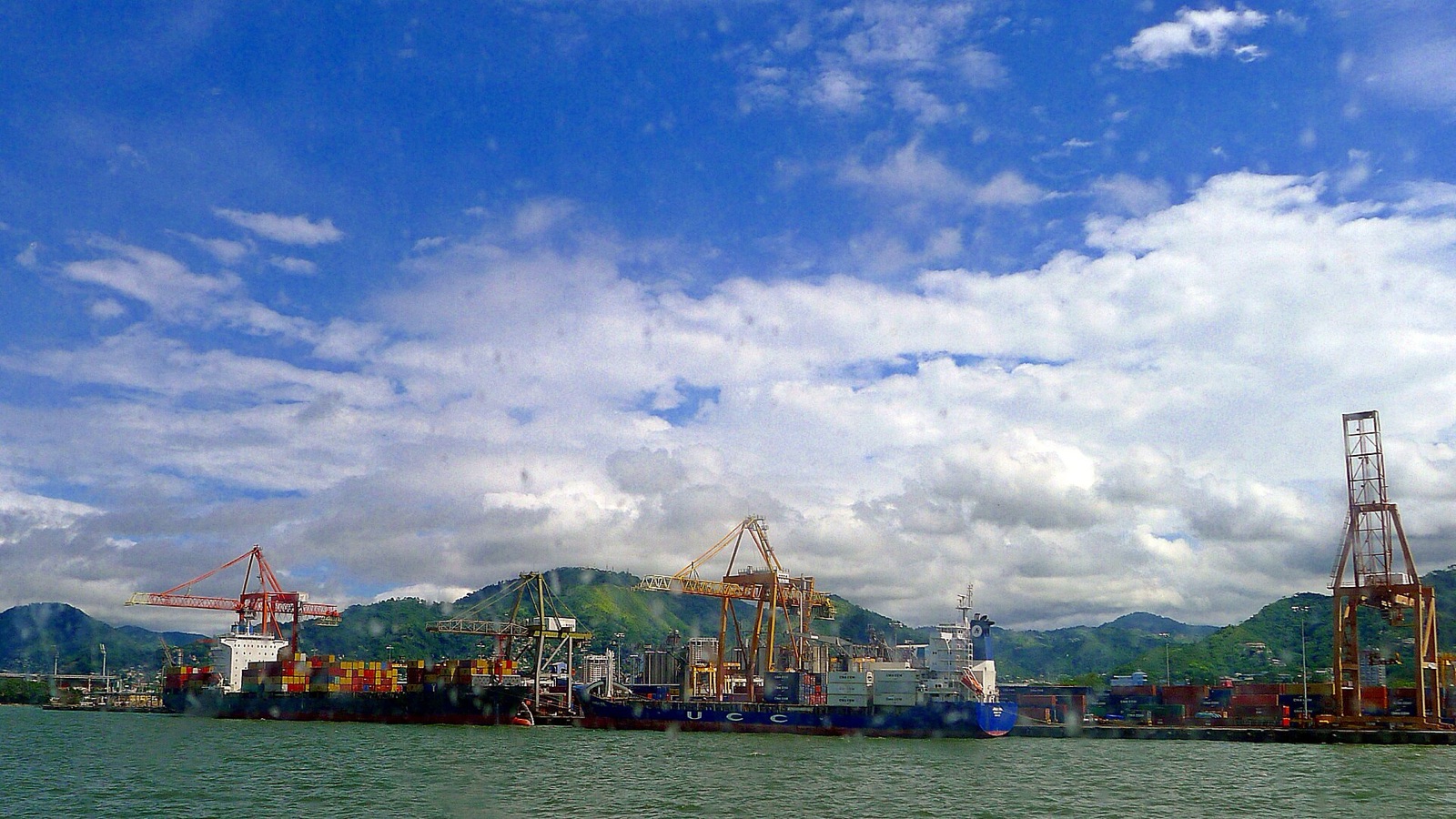
Photo: Container ships under gantry cranes at a terminal in Trinidad. Kalamazadkhan, CC BY-SA 4.0, via Wikimedia Commons.
Ready to ship your freight?
