
On this page14
You ship to Peru by ocean FCL or LCL into Callao or Chancay, or by air into Lima (LIM), with 9 to 12 days of ocean transit from Miami, a DAM declaration filed with SUNAT by a licensed customs agent, and 0% to 11% duty plus 18% IGV and IPM. The tariff is low (four bands: 0%, 4%, 6% or 11%), the U.S.-Peru Trade Promotion Agreement removed duties on almost all US consumer and industrial goods, and Peru's FTA network covers China, the EU and its Pacific Alliance partners. What catches shippers out is the tax and procedure mechanics: an IGV perception advance of up to 10%, a mandatory customs agent above US$2,000 FOB, and anticipated filing of the declaration as the default. The port map has also changed, with Chancay in full commercial operation since June 2025 as a deep-water option north of Lima, and Peru's reefer exports set equipment and space availability by fruit season.
Peru Shipping at a Glance: Transit Times and Options
Ocean freight from Miami to Callao takes 9 to 12 days, air freight to Lima 1 to 3 days, and ocean freight from China 25 to 40 days.
| Route & mode | Transit | Best for |
|---|---|---|
| Miami to Callao, ocean FCL | 9 to 12 days | full loads, machinery, retail stock |
| Miami to Callao, ocean LCL | 10 to 16 days (port to port) | shipments under 15 CBM |
| Miami (MIA) to Lima (LIM), air | 1 to 3 days | urgent parts, electronics, pharma |
| China to Callao or Chancay, ocean FCL | 25 to 40 days | full containers from Asia |
| China to Peru, ocean LCL | 30 to 45 days | small Asian orders |
| North Europe or Spain to Callao, ocean FCL | 22 to 35 days | EU equipment and ingredients |
The low end of each range applies to direct sailings and the high end to transshipped rotations; confirm the sailing with your forwarder before you commit a delivery date. Behind every one of these lanes sits the same import sequence.
How to Ship to Peru: Step by Step
Shipping to Peru follows eight steps, from HS classification to release at Callao, Chancay or Lima airport.
- Classify the goods and check permits. Assign the 10-digit national subheading in Peru's Arancel de Aduanas and check whether the product needs a VUCE authorization from SENASA, DIGESA or DIGEMID.
- Confirm the importer's status. The Peruvian buyer needs an active RUC in "habido" status with SUNAT; a first-time importer pays the 10% IGV perception on the first entry.
- Choose the mode and Incoterm. Pick air under 2 CBM, LCL from 2 to 15 CBM and FCL above that, and fix the Incoterm in writing, because Peruvian customs value is calculated on a CIF basis.
- Book from Miami or origin. Consolidate US suppliers in Miami into one container and one declaration, or book Asian cargo direct into Callao or Chancay.
- Prepare the documents and origin proof. Issue the commercial invoice, packing list, bill of lading or air waybill, insurance letter and a certificate of origin to claim PTPA, China FTA or EU preferences.
- File the US export record. For US cargo, the exporter or forwarder files Electronic Export Information (EEI) in AES when any Schedule B line exceeds $2,500 or the goods need an export license.
- Declare in advance through a customs agent. The licensed agent files the DAM in anticipated dispatch before the vessel or aircraft arrives, and SUNAT assigns a green, orange or red channel.
- Pay duties and taxes, then take delivery. The importer pays duty, IGV, IPM and any perception in soles, and the cargo leaves the terminal for final delivery.
Step 4 sets most of the landed cost, and the US lane is the shortest of the three.
Shipping From the USA to Peru
Miami is the shortest US gateway to Peru: ocean services run south through the Panama Canal and down the Pacific coast to Callao in 9 to 12 days, and air freight reaches Lima in 1 to 3 days. US suppliers in the Southeast and Midwest truck to Miami, where Interworld Freight consolidates cargo from several vendors into one container and one customs declaration.
The U.S.-Peru Trade Promotion Agreement (PTPA), in force since February 1, 2009, eliminated tariffs on most goods, according to the U.S. International Trade Administration. Almost all US consumer and industrial goods enter duty-free, and the remaining agricultural tariffs were scheduled to phase out by 2026. That makes origin documentation worth the effort: with a valid origin claim, most US shipments pay zero duty and only the import taxes.
For full loads, container shipping to Peru on 20ft or 40ft equipment is the efficient choice once volume passes 15 CBM. Smaller shipments move as LCL consolidation, billed by cubic meter or weight, whichever is greater. Air freight from MIA to Jorge Chávez International (LIM) suits spare parts for mining and agro-industry, electronics and pharmaceuticals. Agree the Incoterm with your supplier before booking: on FOB or FCA terms the buyer controls the main freight and insurance, which matters because Peruvian customs value includes freight and insurance (CIF basis).
Asian cargo now has a second Peruvian gateway to choose from.
Shipping From China and Asia to Peru
Asian cargo reaches Peru in 25 to 40 days through two routing options. Liner services call Callao directly or via transshipment hubs such as Balboa (Panama) or Manzanillo (Mexico). Chancay, the deep-water multipurpose port developed by COSCO Shipping Ports with Peruvian miner Volcan about 80 km north of Lima, was inaugurated on November 14, 2024 and began full commercial operations on June 1, 2025 under its National Port Authority (APN) license. It receives direct transpacific services, which shortens the Asia leg for cargo that can be cleared there.
The China-Peru FTA gives preferential tariffs on qualifying Chinese goods with a certificate of origin. LCL from Asia takes longer than FCL because of consolidation at origin and deconsolidation in Lima, so book well ahead of peak season. Importers buying from both the US and Asia sometimes route Asian LCL into Miami and ship one consolidated container to Callao, which keeps one customs agent and one set of import taxes for the whole order.
Shipping From Europe to Peru
European cargo enters Peru with preferential tariffs under the EU trade agreement (in force for Peru since 2013) when the goods qualify as EU origin and carry proof of origin, and Peru also has an FTA with the United Kingdom. The same EU agreement covers Colombia and Ecuador, so the origin workflow carries over to shipping to Ecuador. Direct and transshipment services from North Europe and the Mediterranean reach Callao in 22 to 35 days. Machinery, vehicle parts, chemicals and food ingredients dominate the flow. On the return leg, Peruvian fruit and vegetables move to Rotterdam and other North European ports in reefers, from a port network that now spans six gateways.
Which Ports and Airports Handle Cargo in Peru?
Peru's main maritime gateway is Callao, with Chancay as the new deep-water alternative for Asia, three regional ports for agro-exports and mining, and Jorge Chávez (LIM) for air cargo. Ports are regulated by the National Port Authority (Autoridad Portuaria Nacional, APN).
- Port of Callao (PECLL), Lima region: Peru's main container gateway, with two concessioned container terminals (North Pier and South Pier) and the bulk of import volume.
- Port of Chancay (PECHY), Huaral province, about 80 km north of Lima: deep-water terminal operated by COSCO Shipping Ports Chancay Perú, focused on direct transpacific services.
- Paita (PEPAI), Piura: northern port, key for agro-exports such as mangoes, grapes and avocados from Piura and Lambayeque.
- Matarani (PEMRI), Arequipa: southern port for mining concentrates and mining inputs.
- Ilo (PEILQ), Moquegua: southern port serving mining and also used for Bolivian transit cargo, the Peruvian alternative to Arica covered in our guide to shipping to Bolivia.
- Jorge Chávez International (LIM), Callao: the country's air cargo hub for imports and for blueberry, asparagus and other perishable exports.
How Does Customs Clearance Work in Peru?
Imports into Peru clear through SUNAT (Superintendencia Nacional de Aduanas y de Administración Tributaria), the combined tax and customs authority, with a licensed customs agent filing the declaration electronically. Permits from sector regulators run through VUCE (Ventanilla Única de Comercio Exterior), the foreign trade single window.
- Registration: the importer holds an active RUC (tax number) with SUNAT, in "habido" status (confirmed tax address).
- Classification: goods are classified under the 10-digit national subheading of Peru's Customs Tariff (Arancel de Aduanas), built on the Andean Community NANDINA nomenclature and the HS code.
- Permits first: regulated goods need their VUCE authorization (for example SENASA for plant and animal products, DIGESA for food safety, DIGEMID for medicines and medical devices) before shipment or before filing.
- Customs agent: the import-for-consumption procedure covers goods with an FOB value above US$2,000, and the importer files it through a licensed customs agent appointed by electronic mandate, according to the Peruvian government's SUNAT procedure page. Smaller consignments use the simplified declaration (DSI).
- Declaration and dispatch mode: the agent files the DAM (Declaración Aduanera de Mercancías). Anticipated dispatch, filed before the vessel or aircraft arrives, is mandatory except in listed cases; deferred dispatch must be filed within 15 calendar days of discharge, and urgent dispatch covers specific goods.
- Valuation: customs value follows the WTO Customs Valuation Agreement and Andean Community rules, so the invoice, freight and insurance figures must reconcile.
- Control channel: SUNAT assigns a green, orange or red channel; orange means document review, red means physical inspection.
- Payment and release: duties, IGV, IPM and any IGV perception are paid, and the cargo leaves the terminal or temporary warehouse.
Importers with a strong compliance record can apply to SUNAT's Authorized Economic Operator (OEA) program for faster controls. Step 8 is where the tax structure below turns into cash.
What Are the Import Duties and Taxes in Peru?
Peru charges an ad valorem duty of 0%, 4%, 6% or 11% by national subheading, plus 16% IGV and 2% IPM, according to SUNAT's schedule of import taxes. The full list:
- Ad valorem duty: 0%, 4%, 6% or 11% depending on the national tariff subheading, assessed on customs value (CIF). The 4% band covers a group of industrial capital goods. Under the PTPA, almost all US consumer and industrial goods enter at 0%.
- IGV (general sales tax): 16%, on customs value plus duties.
- IPM (municipal promotion tax): 2%. IGV plus IPM give the familiar 18% combined rate.
- ISC (selective consumption tax): applies to specific goods such as tobacco, alcohol and fuels.
- Price band system (Sistema de Franja de Precios): variable specific duties on rice, yellow corn, milk and sugar and linked products.
- Antidumping and countervailing duties: apply to listed products and origins, published through ALADI.
- IGV perception: an advance collected at import. The rate is 10% when the importer is importing for the first time, has a deregistered or suspended RUC, an unconfirmed tax address or is not registered for IGV; 5% when the goods are used; and 3.5% in all other cases. It is creditable against later IGV, but it ties up cash.
Duties and taxes are expressed in US dollars and paid in soles at the exchange rate published by the banking regulator (SBS) on the payment date. Peru belongs to the Pacific Alliance and the Andean Community and has 22 free trade agreements, including with the US, Canada, China, the EU, Japan, Mexico and the UK; its Pacific Alliance partner to the south follows a similar low-tariff model, explained in our guide to shipping to Chile. The practical rule: with a valid origin claim the duty drops to zero for most US goods, so the real landed cost driver is the 18% IGV and IPM plus any perception. First-time importers budget for the 10% perception on their first entry, and every claim rests on the document set.
What Documents Are Required to Ship to Peru?
SUNAT requires a customs declaration (DAM), commercial invoice, transport document, packing list and insurance letter for imports, according to the U.S. International Trade Administration. The full set:
- Commercial invoice with value, Incoterm and full description
- Packing list with weights and dimensions per package
- Bill of lading or air waybill
- Insurance policy or insurance letter
- Importer RUC
- Certificate of origin when claiming PTPA, China FTA, EU or other preferences (US goods need one to avoid duties)
- VUCE permits for regulated goods (SENASA, DIGESA, DIGEMID and others)
- For processed food: DIGESA sanitary registration, supported by a Certificate of Free Sale from the origin country's health authority
- Technical documentation for machinery and equipment classification
Restricted Goods and Import Permits in Peru
Peru prohibits imports of used cars more than five years old and used buses and trucks more than two years old, according to the U.S. International Trade Administration's list of prohibited and restricted imports. Any vehicle, new or used, clears under the full import-for-consumption procedure regardless of value. Used medical equipment is allowed only when individual physicians procure it for their own practice. Used goods in general attract the 5% IGV perception rate and more scrutiny on valuation.
Plant and animal products need a SENASA phytosanitary or zoosanitary permit, processed food needs DIGESA sanitary registration, and medicines and medical devices need DIGEMID registration. Fresh foods in their natural state (grains, fruit, vegetables, meat, eggs) do not need sanitary registration but still pass SENASA controls. Wood packaging must comply with ISPM 15 wood packaging rules. Hazardous cargo moves under IMDG or IATA DGR with full declarations, and controlled chemicals used in mining need prior authorization from the relevant regulator.
LCL, FCL or Air Freight to Peru: Which to Choose?
For Peru, choose air under 2 CBM or when time is critical, LCL from 2 to 15 CBM, and FCL above 15 CBM.
- Under 2 CBM or urgent: air freight to LIM, especially for mining and agro-industry spare parts.
- 2 to 15 CBM: LCL consolidated through Miami. One declaration, one customs agent fee.
- Above 15 CBM: a 20ft FCL costs less per unit; above 30 CBM, quote a 40ft or 40ft high cube.
- Shipments above US$2,000 FOB: budget for the customs agent regardless of mode, which favors consolidating several small orders into one shipment.
- Cash flow: duties and taxes are paid before release, and the perception adds to the upfront outlay, so plan working capital per shipment, not per order.
Key Industries Shipping Freight to Peru
Peru imports machinery and equipment for mining and agro-industry, vehicles and parts, chemicals, fuels, steel and consumer goods, and exports copper, gold, zinc and fresh fruit. Copper, gold and zinc mining in the south drives demand for heavy equipment, wear parts and reagents through Callao and Matarani, while the coastal agro-export belt imports irrigation equipment, packaging and cold chain machinery.
On the export side, Peru's agricultural exports reached USD 15,013 million in 2025, a record, with the United States as the first destination market, according to the Ministry of Agrarian Development and Irrigation (MIDAGRI). Fresh blueberries led at USD 2,457 million, followed by fresh grapes at USD 1,960 million and avocados at USD 1,363 million. That fruit moves in reefers under strict phytosanitary protocols, which is the subject of our follow-up guide on shipping Peruvian blueberries and avocados to the US.
Choosing a Freight Forwarder for Peru
The right forwarder for Peru consolidates US cargo so you pay one customs agent fee instead of several, gets PTPA origin documents right so the duty is zero, and chooses between Callao and Chancay based on the full routing rather than the port name. Interworld Freight was founded in Miami in 1992 and runs ocean FCL and LCL, air freight and customs coordination from its Miami hub with warehousing, with coverage on every major trade lane. For perishables, see our cold chain solutions, and for regional context read shipping from Miami to Latin America. Quote requests are answered within one business day.
Frequently Asked Questions
How long does shipping from Miami to Peru take?
Ocean freight from Miami to Callao takes 9 to 12 days port to port for FCL and 10 to 16 days for LCL. Air freight from Miami to Lima arrives in 1 to 3 days.
What is the cheapest way to ship freight from the USA to Peru?
LCL consolidation through Miami is the cheapest option from 2 to 15 CBM, because you pay only for the space you use and file one declaration. Above 15 CBM a full container becomes cheaper per unit, and air only pays off for small, urgent or high-value cargo.
What import taxes apply in Peru?
SUNAT applies an ad valorem duty of 0%, 4%, 6% or 11% by tariff subheading, 16% IGV and 2% IPM (18% combined), plus ISC on specific goods. An IGV perception of 3.5%, 5% or 10%, depending on the importer's status and whether the goods are used, is also collected at import as a creditable advance.
Do US products pay import duty in Peru?
Most do not. Under the U.S.-Peru Trade Promotion Agreement, almost all US consumer and industrial goods enter duty-free with a valid certificate of origin. IGV and IPM still apply.
Is a customs agent required in Peru?
Yes for imports for consumption above US$2,000 FOB, which are filed through a licensed customs agent. Smaller shipments can use the simplified declaration.
What can't you ship to Peru?
Used cars over five years old, used buses and trucks over two years old and used medical equipment (except for a physician's own practice) are prohibited. Food, plant and animal products, medicines, chemicals and hazardous goods are restricted and need permits from regulators such as SENASA, DIGESA or DIGEMID before shipping.
How strict is Peruvian customs?
Strict on documents and valuation. Declarations are filed in advance, SUNAT assigns a green, orange or red control channel, and mismatches between invoice, packing list and declared value trigger review or physical inspection.
What is the difference between Callao and Chancay?
Callao is Peru's established main port with two container terminals and most liner services. Chancay, about 80 km north of Lima, is a newer deep-water port in full commercial operation since June 2025 with direct transpacific services, mainly relevant for Asia cargo.
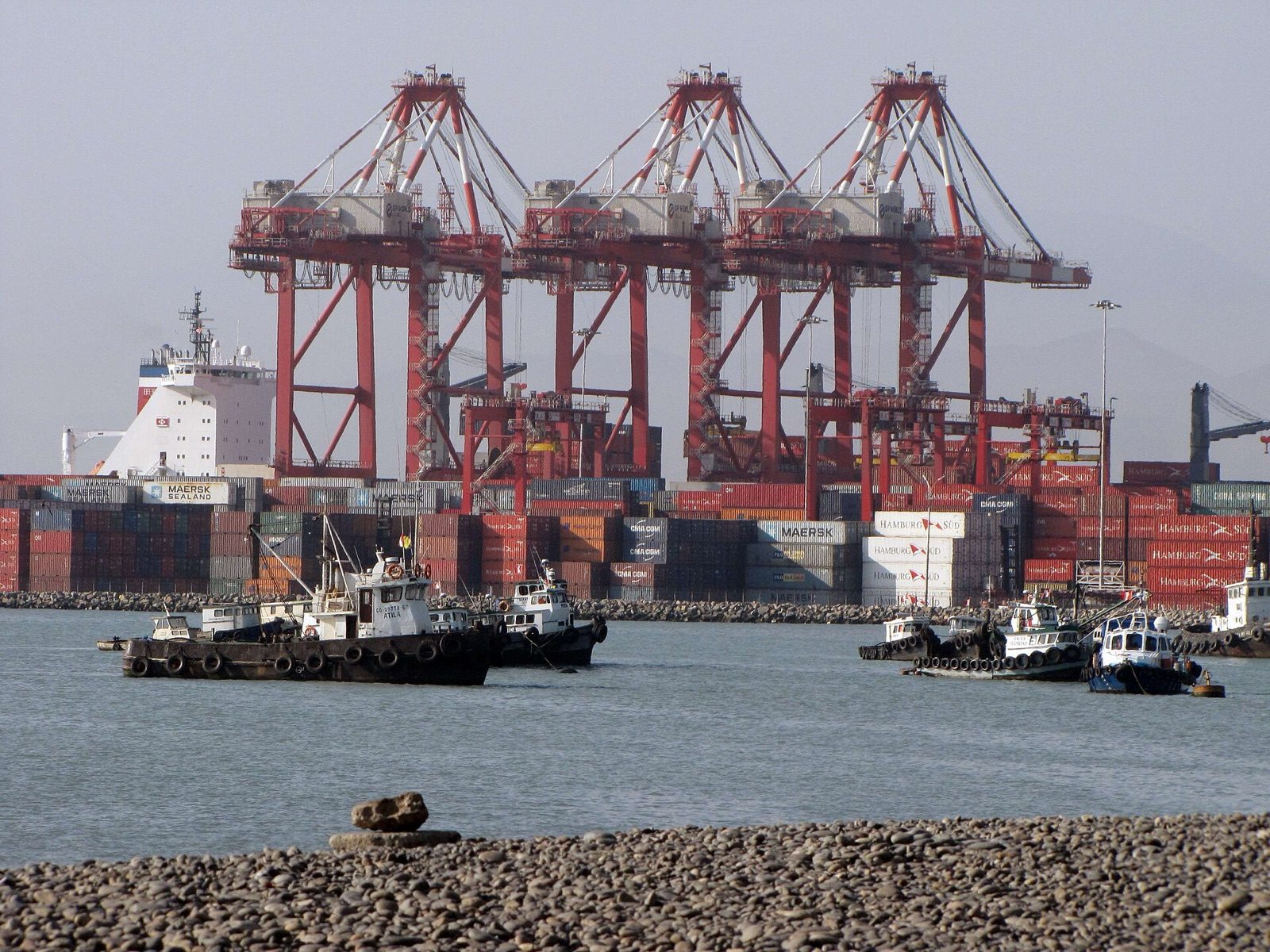
Photo: Container terminal, Port of Callao, Peru. sergejf, CC BY-SA 2.0, via Wikimedia Commons.
Ready to ship your freight?
