
On this page13
Ship to Panama by ocean FCL or LCL into the Colón terminals or Balboa, or by air into Tocumen (PTY): 3 to 7 days by sea from Miami, 1 to 2 days by air, ANA clearance on SIGA via a broker, 7% ITBMS, duty-free TPA entry for most US goods.
Access is not the shipper's problem in Panama. The Panama Canal, container terminals on both oceans and Tocumen's air cargo hub put Panama on more direct services than any other country in Central America, so transit is short from almost every origin. What makes Panama different is that much of the cargo arriving there is not destined for Panama at all: it transships to other ports or enters the Colón Free Zone for re-export. A shipper importing for the domestic market has to make sure the cargo is booked, documented and cleared as a Panamanian import, not lost in a transshipment flow. The customs side is comparatively simple: no import license, a 7% ITBMS, a maximum tariff of 15% on most goods and duty-free entry for most US products under the US-Panama Trade Promotion Agreement.
Panama Shipping at a Glance: Transit Times and Options
Ocean freight from Miami reaches Panama's Atlantic terminals in 3 to 7 days port to port, air freight to Tocumen takes 1 to 2 days, and direct transpacific services from China take 25 to 35 days.
| Route & mode | Transit | Best for |
|---|---|---|
| Miami to Manzanillo / Colón, ocean LCL | 7-14 days, including consolidation | retail and distributor restocks under 15 CBM |
| Miami / US East Coast to Manzanillo / Colón, ocean FCL | 3-7 days port to port | full loads, building materials, consumer goods |
| Miami to Panama City (PTY), air freight | 1-2 days | urgent parts, electronics, pharma |
| China / Asia to Balboa, ocean FCL | 25-35 days on direct transpacific services | factory orders, machinery, steel |
| Europe to Manzanillo / Colón, ocean FCL | 14-22 days | industrial inputs, food and beverages, equipment |
Transit times are indicative and depend on carrier schedules. Panama is not part of the IWF published LCL rate table, so request a quote for current pricing. Short transits only pay off when the shipment is set up as a Panamanian import from the first step.
How to Ship to Panama: Step by Step
Shipping to Panama follows eight steps, and the critical one is booking the cargo with Panama as the final destination rather than as transshipment.
- Classify the goods and check permits. Assign the HS code and confirm whether the product needs APA sanitary clearance, pharmaceutical registration or a special permit (firearms, ammunition, fertilizers).
- Confirm the importer. The consignee needs a commercial or industrial license; no separate import license exists.
- Choose mode and Incoterm. Pick LCL, FCL or air, and the terminal: Manzanillo, Colón or Cristóbal for Atlantic services, Balboa or Rodman for Pacific services.
- Book from Miami or origin with Panama as final destination. The bill of lading and booking must show a Panamanian import, not transit or a free zone entry.
- Prepare the document set. Original commercial invoice, bill of lading or air waybill, packing list, TPA origin certification and sanitary or free sale certificates where required.
- File the US export. Shipments over $2,500 per Schedule B line, or any licensed cargo, need EEI filed in AES before departure.
- Clear customs on SIGA. A licensed agente corredor de aduana files the entry with the ANA, and SIGA risk selection decides on direct release, review or inspection.
- Pay duty and ITBMS, then deliver. Duty and 7% ITBMS are paid before release, and the container moves 80 km by highway to Panama City or to the final site.
Shipping From the USA to Panama
US cargo for Panama moves on frequent services from Miami and the US East and Gulf coasts into the Atlantic-side terminals near Colón: Manzanillo International Terminal, Colón Container Terminal and Cristóbal. Port-to-port transit from Miami is three to seven days, and Panama City is about 80 km away by highway, so a container reaches a Panama City warehouse within days of discharge. Pacific-side terminals at Balboa and Rodman matter more for Asian and west coast cargo.
Because services are frequent, the decision between LCL and FCL on this lane is driven by cost and handling rather than schedule. Smaller shippers consolidate through Miami and pay by the cubic meter; our explainer on how LCL container shipping works covers the CFS cut-offs and deconsolidation step. Once volume fills a box, container shipping to Panama in 20ft or 40ft equipment is the efficient route.
Air freight from Miami International (MIA) into Tocumen International (PTY) takes one to two days. Tocumen is a major passenger and cargo hub, with plentiful belly and freighter capacity, which keeps air freight to Panama a practical option for spare parts, electronics and time-sensitive project materials. Distributors covering western Panama and Costa Rica from one stock point can compare this lane with shipping to Costa Rica, linked by road through the Paso Canoas border crossing.
Shipping From China, Asia and Europe to Panama
Asian cargo arrives in Panama on a direct call at Balboa or another Pacific terminal, without an intermediate transshipment, because Panama sits on the main transpacific services that use the Canal. Transit from Shanghai or Shenzhen is 25 to 35 days for a full container. That makes Panama one of the best-connected destinations in Latin America for Asian goods, and also a transshipment hub for cargo going on to Colombia, Ecuador, Central America and the Caribbean; relays through Panama to Cartagena are a standard routing for shipping to Colombia. Our guide to shipping from China to Panama covers origin ports, LCL from Asia and booking lead times.
For goods destined for the Colón Free Zone rather than the domestic market, the documentation and customs treatment differ, and the Colón Free Zone re-export guide explains how that regime works. This guide focuses on cargo cleared for use in Panama.
European cargo reaches the Atlantic terminals at Manzanillo, Colón and Cristóbal on direct or relayed services in 14 to 22 days. Many Europe to west coast South America services pass through the Canal and call Panama on the way, which gives European shippers more sailing options than most regional destinations. For mixed-origin buyers, combining European and US goods through a Miami consolidation remains a simple way to reduce the number of separate customs entries. All of these services converge on five Panamanian gateways.
Which Ports and Airports Handle Cargo in Panama?
Panama's import cargo enters through the Atlantic terminals at Colón (Manzanillo, Colón Container Terminal, Cristóbal), the Pacific terminals at Balboa and Rodman, and Tocumen International (PTY) for air.
- Manzanillo International Terminal (PAMIT), Colón, Atlantic side: a major container terminal handling imports, exports and a large volume of transshipment.
- Colón Container Terminal and Port of Cristóbal, Colón, Atlantic side: container and general cargo terminals next to the Colón Free Zone.
- Port of Balboa (PABLB), Panama City, Pacific side: the main Pacific container terminal, served by transpacific and west coast services.
- PSA Panama International Terminal (Rodman), Panama City, Pacific side: a container terminal at the Pacific entrance of the Canal.
- Tocumen International Airport (PTY), Panama City: the main air cargo gateway and a regional connecting hub.
How Does Customs Clearance Work in Panama?
Panamanian imports clear through the Autoridad Nacional de Aduanas (ANA), with a licensed customs broker filing the commercial declaration on SIGA (Sistema Integrado de Gestión Aduanera), ANA's electronic customs platform. SIGA is also integrated with the Colón Free Zone's electronic movement system (DMCE), which tracks goods moving between the free zone and the domestic market.
- Who can import: no import license is required, and any company holding a commercial or industrial license can import goods, according to the Panama import requirements and documentation guide.
- Broker requirement: under Article 42 of Decree Law No. 1 of 2008, Panama's customs law, the intervention of a licensed customs broker (agente corredor de aduana) is required for imports, both temporary and definitive. Article 43 lists narrow exceptions, such as direct imports by the State and personal and household goods imported by individuals up to B/.4,000 CIF; broker use is optional for exports and re-exports. The broker handles classification, valuation and the SIGA entry.
- Classification and valuation: Panama uses the Harmonized System and assesses duties ad valorem on the declared CIF value, under the WTO Customs Valuation Agreement.
- Inspection and release: SIGA applies risk selection; selected shipments are reviewed or inspected before release, and duties and ITBMS are paid before goods leave customs control.
- Transit versus import: cargo moving through Panama to another country, or into a free zone, follows a different customs regime. The bill of lading and booking must show Panama as the final destination when the goods are for domestic use.
Once the entry is filed correctly, the remaining variable is the tax bill.
What Are the Import Duties and Taxes in Panama?
Most US goods enter Panama duty free under the Trade Promotion Agreement, and almost every import pays the 7% ITBMS on the CIF value plus duty.
- Import duty: Panama's tariffs have a maximum of 15% except for a few agricultural products, and the overall average is about 12%, the lowest in the region. Duties are ad valorem on the CIF value.
- US-Panama Trade Promotion Agreement (TPA): in force since October 2012. It reduced duties to zero for 87% of the products in the tariff schedule, with agricultural duties phasing out over 15 years, according to the Panama import tariffs chapter of the Country Commercial Guide. A certificate or certification of origin supports the preference, and blanket certifications covering up to 12 months are allowed.
- ITBMS: 7% on the CIF value plus import duty and other handling charges. Higher rates apply to alcoholic beverages (10%) and tobacco products (15%). Medicines, foods and school supplies are exempt.
- Selective consumption tax (ISC): applies to non-essential items such as sugary drinks, jewelry, luxury vehicles, firearms, alcohol and tobacco, with rates from 5% on soft drinks up to 100% on tobacco.
For non-TPA origins such as China, the full tariff applies, so classification and correct valuation are what drive landed cost. Claiming the TPA rate depends on the documents.
What Documents Are Required to Ship to Panama?
Panama's core import documents are the original commercial invoice and the bill of lading or air waybill, plus a certificate of origin to claim the TPA and sanitary or free sale certificates for regulated goods.
- Commercial invoice (original)
- Bill of lading (ocean) or air waybill (air)
- Packing list
- Certificate or certification of origin to claim TPA preferential duty
- Sanitary or phytosanitary certificates for food and agricultural products
- Certificates of free sale for pharmaceuticals
- Importer's commercial or industrial license details
Panama's documentation list is short, which is why consistency matters: a mismatch between the invoice and the bill of lading is the most common cause of delay. A few product groups need more than this base set.
Restricted Goods and Import Permits in Panama
Panama requires special import permits for firearms, ammunition and fertilizers, and sanitary documentation for food, agricultural and pharmaceutical products; other commercial goods need no prior permit.
- Firearms, ammunition and fertilizers: require special permits before import.
- Food and agricultural products: require sanitary or phytosanitary certification. Imported food for human consumption falls under the Autoridad Panameña de Seguridad de Alimentos (APA), which publishes the sanitary import requirements by product and handles importer registration.
- Pharmaceuticals: require certificates of free sale and product registration.
- Oversized and heavy cargo: construction equipment, steel structures, rail components and similar project cargo that exceed container dimensions need flat racks, open tops or breakbulk handling, plus port and road permits for the inland move. Our comparison of breakbulk vs container shipping explains when each makes sense.
LCL, FCL or Air Freight to Panama: Which to Choose?
Panama's short transits make LCL the default for 2 to 15 CBM, FCL the better buy above 15 CBM, and air a realistic option for small, high-value shipments.
- Under 2 CBM: air freight is viable given the short distance and capacity at Tocumen, especially for high-value goods.
- 2 to 15 CBM: LCL consolidation from Miami. Frequent sailings keep consolidation transit short.
- 15 CBM and up: price a 20ft FCL. From 15 to 18 CBM, a dedicated container costs less per unit and avoids deconsolidation handling.
- Project and heavy cargo: 40ft, 40ft high cube, flat rack or breakbulk depending on dimensions and weight.
The project cargo option matters more in Panama than in most markets, because of what the country is building.
Key Industries Shipping Freight to Panama
Panama's economy runs on logistics, construction and services. Public infrastructure is a major source of import demand: Panama Metro Line 3, a monorail connecting Panamá Oeste with Panama City, was reported at 77% overall progress in June 2026 and entered monorail testing, and the fourth bridge over the Canal is designed to carry both road lanes and the Line 3 tracks. The Panama Canal Authority is also preparing the Río Indio reservoir to secure water for Canal operations. These projects pull in steel, cement additives, electrical and rail systems, heavy equipment and spare parts.
Retail, food and beverage distribution, pharmaceuticals and the Colón Free Zone trade account for most of the remaining import volume, and Panama is also an export origin for products moving north; shippers sending cargo the other way can see our page on shipping containers from Panama to the USA. The construction side has its own planning issues on heavy equipment, delivery sequencing and site logistics, which we cover in our guide to infrastructure and construction cargo for Panama's Metro and Canal projects.
Choosing a Freight Forwarder for Panama
Panama has plenty of capacity; what shippers need is a forwarder who books the cargo as a Panamanian import, consolidates smaller orders efficiently and coordinates clearance on SIGA with a licensed broker. Interworld Freight has operated from Miami since 1992, with a Miami warehouse for receiving and consolidation, ocean FCL and LCL, air freight and customs coordination, and coverage on every major trade lane into Panama. Quotes are answered within one business day.
Frequently Asked Questions
How long does shipping to Panama take?
Ocean freight from Miami to the Colón area terminals takes three to seven days port to port, with LCL adding consolidation time (7 to 14 days in total). Air freight into Tocumen (PTY) takes one to two days. From China, allow 25 to 35 days on direct transpacific services.
What is the ITBMS on imports into Panama?
ITBMS is Panama's value added tax. The general rate is 7%, charged on the CIF value plus duty and handling charges, with 10% on alcoholic beverages and 15% on tobacco. Foods, pharmaceuticals and school supplies are exempt.
Do US goods enter Panama duty free?
Most do: under the US-Panama Trade Promotion Agreement, in force since October 2012, 87% of US products entered duty free, with remaining agricultural duties phasing out. Origin must be certified to claim the preference.
Do I need a customs broker in Panama?
Yes, for commercial imports. Panama's customs law (Decree Law No. 1 of 2008) requires a licensed customs broker to process imports on SIGA, the ANA's electronic customs system; exceptions are narrow, such as personal and household goods up to B/.4,000 CIF imported by individuals.
What can you not bring into Panama?
Illegal drugs and counterfeit goods are prohibited, while most other commercial goods face permits rather than bans: firearms, ammunition and fertilizers need special import permits, food needs APA sanitary clearance and pharmaceuticals need product registration and certificates of free sale. No general import license is required.
How long does it take to clear customs in Panama?
Clearance time depends on whether SIGA's risk selection releases the declaration directly or sends it to document review or physical inspection. A complete document set filed by the broker before arrival is the fastest route, and mismatches between the invoice and the bill of lading are the main source of delay.
Is the Colón Free Zone the same as importing into Panama?
No. Goods entering the Colón Free Zone are held under a special regime, mostly for re-export, and do not pay Panamanian import duty or ITBMS unless they are later imported into the domestic market.
How much does it cost to ship to Panama?
The freight cost depends on volume, equipment and season, so request a current quote: LCL is priced per cubic meter, FCL per container and air per chargeable kilogram. Landed cost adds 7% ITBMS, duty on non-TPA goods, broker fees and local delivery.
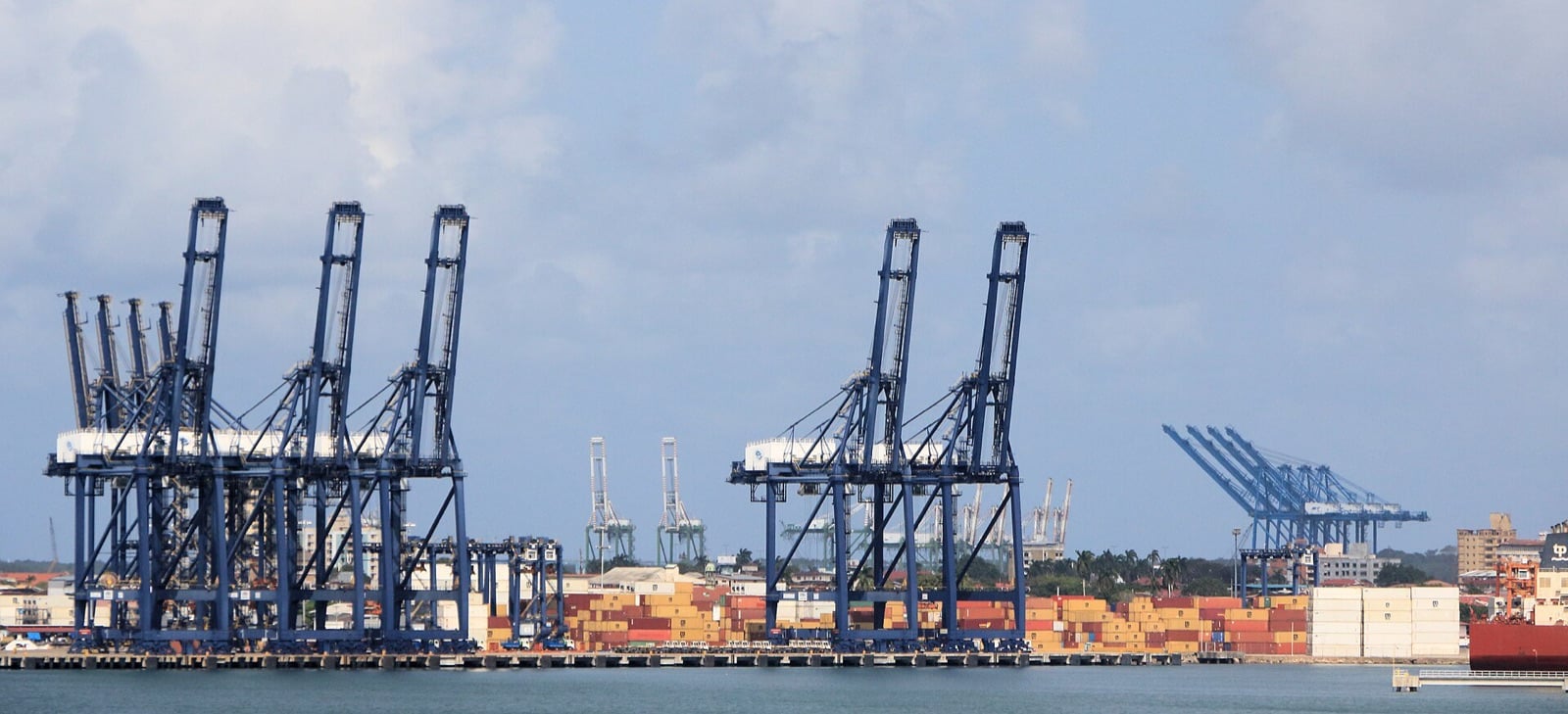
Photo: Container port, Colón, Panama. ImagePerson, CC BY-SA 4.0, via Wikimedia Commons.
Ready to ship your freight?
