
On this page12
How shipping from China to Dominica works
There is no direct sailing from China, and Dominica receives no mainline call of any kind. Cargo leaves a Chinese port on a mainline transpacific vessel, relays at a hub, and arrives on a feeder.
The relay points are Kingston and Caucedo, both on the Windward Passage routing close to the mainline Asia-to-US-East-Coast route, with some cargo routing via Cartagena. Dominica sits between the French territories of Guadeloupe and Martinique, which run on entirely separate networks, so the feeder options serving it are fewer than the geography suggests. See Caribbean transshipment hubs.
How long it takes, leg by leg
What sets the range. The range comes from the Chinese port of loading, not from the island: in Interworld Freight's LCL tariff of July 21, 2026, Shanghai reaches Miami in 18 days, Qingdao and Shenzhen in 35 and Ningbo in 37, and the Miami to Dominica leg adds 4 days. The totals are port-to-port sailing days. They exclude the cargo cut-off at the origin warehouse, the wait in Miami for the next sailing and customs clearance on arrival.
The Interworld Freight schedule (rates refreshed 2026-07-21) consolidates China cargo in Miami and connects it to Dominica in 4 days, with arrivals on Monday. The China-to-Miami leg is set by the origin port:
| Origin port | China to Miami | Total to Dominica |
|---|---|---|
| Shanghai | 18 days | 22 days |
| Shenzhen | 35 days | 39 days |
| Qingdao | 35 days | 39 days |
| Ningbo | 37 days | 41 days |
Consolidated shipments add origin consolidation at the China CFS and deconsolidation at destination. Full containers skip both. On relay routings through Kingston, Caucedo or Cartagena, the dwell at the hub is set by the next connecting feeder, and Dominica has the thinnest feeder frequency in the region. Plan to the upper figure in the table. Regional comparisons are in China to Caribbean transit times.
What it costs and what drives the number
| Component | Basis | Notes |
|---|---|---|
| Ocean freight | Per CBM (LCL) or per container (FCL) | Eastern-arc feeder, thin frequency |
| Origin and destination CFS | Per shipment or per CBM | LCL only |
| Terminal handling, both ends | Flat | n/a |
| Customs brokerage | Per entry | n/a |
| Import duty | CARICOM CET, 0 to 20% by HS code, on CIF value | Finished consumer goods at 15 to 20% |
| VAT 15% | On customs value plus duty | n/a |
| Customs Service Charge 4% | 4% of CIF value on imports | Not a duty; omitted from most tariff comparisons |
The cost driver specific to Dominica is schedule, not tariff: thin feeder frequency makes missed connections more frequent and more expensive, and the cost of being late on a construction or resilience project is not a freight cost at all. Build the buffer in and book early. The regional table is in Caribbean import duties and taxes, and the cost stack in China to Caribbean shipping cost.
LCL, FCL or air: choosing for Dominica
Container freight station capacity is limited and feeder frequency is the thinnest in the region, which pushes the breakeven early and makes schedule reliability the dominant consideration.
- Under 12 CBM: consolidated shipping wins on cost.
- 12 to 18 CBM: price both ways, weighting the container side heavily for schedule reliability.
- Above 18 CBM: a full container wins.
A sealed container is not reworked at the relay and presents a simpler entry at destination, and on the region's least predictable lane that is worth more than the cost difference.
Interworld Freight runs the consolidated option from origin CFS in China through local clearance: LCL shipping from China to Dominica. For full containers, container shipping to Dominica. The mode analysis is in LCL vs FCL for Caribbean imports.
Published LCL rates to Dominica
The Interworld Freight LCL schedule for 5 CBM and 1,500 kg quotes FCA at the origin CFS, before destination duties, taxes and local charges:
| Origin | Total transit to Dominica | Total for 5 CBM / 1,500 kg |
|---|---|---|
| Miami | 4 days | $1,220 |
| Shanghai | 22 days | $2,795 |
| Shenzhen | 39 days | $2,830 |
The two China quotes differ by $35 and by 17 days, so the origin port is a schedule decision on this lane before it is a price decision.
Air freight and project cargo
When a part blocks a resilience project, air freight to the Caribbean removes the feeder interval from the schedule, and the critical item flies while the bulk follows by sea. Oversized or heavy structural items fall under project cargo, which plans the road route from Woodbridge Bay to the site before the booking is confirmed, because the island's winding coastal roads set the weight and dimension limits.
A booking checklist for Dominica
- Classify each product under the CARICOM CET and confirm the duty band with the broker.
- Add the 4% Customs Service Charge and 15% VAT on CIF value to the landed cost model.
- Choose the origin port by the days in the table above, and book before the LCL cutoff.
- Name the port of discharge: Woodbridge Bay for most consignees, and Portsmouth for consignees in the north.
- Prepare the commercial invoice, packing list and bill of lading so the broker files in ASYCUDA World on arrival.
- Plan the road delivery from the port to the site, and the days of free time at destination.
Ports of entry in Dominica
Woodbridge Bay, just north of Roseau, is the island's principal deep-water cargo port and handles containerized imports.
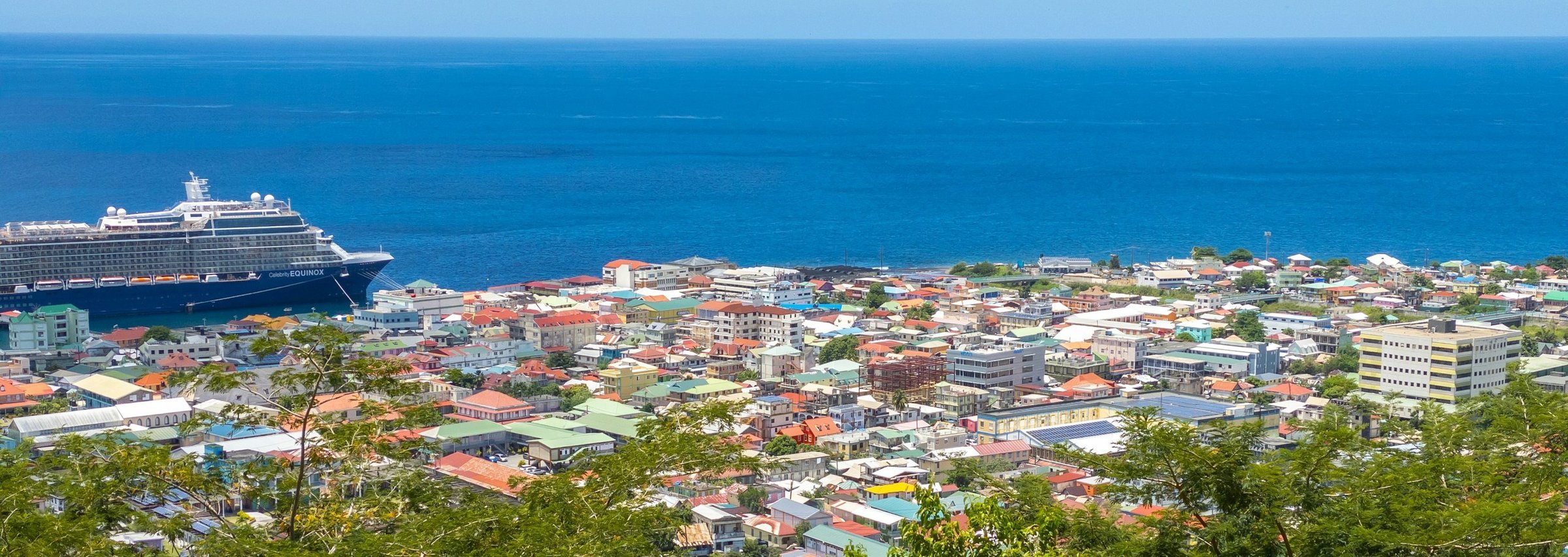
Roseau itself handles cruise traffic and smaller vessels. Portsmouth in the north serves that region, and for consignees there it avoids a road movement down a mountainous island with limited road infrastructure.
Confirm the port of discharge at booking. Dominica's terrain makes inland movement slower and costlier than distance alone, so landing at the wrong end of the island is a larger error here than in flatter territories.
Customs clearance in Dominica
Imports are administered by the Customs and Excise Division.
- The importer registers with the Customs and Excise Division through a licensed local broker, who files for commercial cargo.
- Entry is filed through the ASYCUDA World system.
- Duty is assessed under the CARICOM Common External Tariff by HS code.
- VAT at 15% is charged on imported goods.
- A Customs Service Charge of 4% of CIF value applies to imports, per Invest Dominica Authority.
CARICOM duty-free entry applies to goods of CARICOM origin only. Chinese-origin cargo pays the full CET rate. Goods sourced from neighboring Guadeloupe or Martinique are not CARICOM-origin either, since those are French territories.
What importers actually bring in from China
Dominica's import demand is shaped by a national rebuilding and climate-resilience program following major hurricane damage, alongside an agricultural sector, eco-tourism and a resident population: construction and finishing materials, roofing and structural products, generators and electrical equipment, water and sanitation infrastructure components, agricultural equipment and inputs, consumer electronics and appliances, and general retail.
Construction and resilience materials are the volume category, and they are also the category where classification pays: structural and capital goods carry lower CET rates than finished consumer products, which carry 15% to 20%. On projects with public funding or donor timelines, the schedule risk described above is the binding constraint, not the cost.
Where these shipments fail
- Planning to the optimistic end of the range. This is the region's thinnest feeder lane. Plan to 41 days from Ningbo, not 22 days from Shanghai.
- Forgetting the Customs Service Charge. At 4% of CIF value it is missing from standard tariff tables.
- Landing northern cargo at Woodbridge Bay. Dominica's terrain makes inland movement expensive, so confirm whether Portsmouth is the better discharge point.
- Assuming Guadeloupe or Martinique proximity helps. They are French territories on separate networks and are not CARICOM origin.
- Booking at the LCL cutoff rather than before it. With the thinnest feeder frequency in the region, a missed sailing costs a full feeder interval.
Interworld Freight is a global freight forwarder headquartered in Miami, running transpacific consolidation from China alongside its transatlantic, Middle East and Oceania trades. The wider lane is in shipping from China to the Caribbean, and the neighboring markets in shipping from China to Saint Lucia and shipping from China to Antigua and Barbuda.
Frequently Asked Questions
How long does shipping from China to Dominica take?
In the Interworld Freight schedule, 22 days from Shanghai, 39 days from Shenzhen or Qingdao and 41 days from Ningbo, including the 4 day Miami-to-Dominica leg. Dominica receives no mainline call and has the thinnest feeder frequency in the region, so plan to the upper figure.
What duty and VAT does Dominica charge on imports?
Duty under the CARICOM Common External Tariff at 0% to 20% by HS code, VAT at 15%, and a Customs Service Charge of 4% of CIF value. Most Chinese-sourced consumer goods fall in the 15% to 20% duty band, so duty, the 4% service charge and 15% VAT on customs value plus duty add 36% to 42% of CIF on a finished product.
Which port do shipments from China arrive at in Dominica?
Woodbridge Bay, just north of Roseau, is the principal deep-water cargo port and handles containerized imports. Roseau handles cruise traffic and smaller vessels, and Portsmouth in the north serves northern consignees. Confirm the port at booking, because Dominica's terrain makes inland movement slower and costlier than distance suggests.
Why is this lane slower than other Caribbean destinations?
Because Dominica receives no mainline service of any kind and its feeder frequency is the thinnest in the region. Every shipment relays at Kingston or Caucedo, and with fewer connecting sailings a missed connection costs a full feeder interval. The island also sits between Guadeloupe and Martinique, French territories running on separate networks, so the feeder options are fewer than the geography implies.
Do Chinese goods get CARICOM duty relief in Dominica?
No. CARICOM duty-free entry applies to goods certified as being of CARICOM origin. Chinese-manufactured goods pay the full Common External Tariff rate, plus VAT at 15% and the 4% Customs Service Charge. Goods from neighboring Guadeloupe and Martinique are not CARICOM origin either, since those are French territories.
How much does LCL to Dominica cost?
The Interworld Freight published rate for 5 CBM and 1,500 kg is $1,220 from Miami, $2,795 from Shanghai and $2,830 from Shenzhen, before destination duties, taxes and local charges.
How should I ship construction and resilience materials to Dominica?
In sealed containers wherever the volume supports it, booked well ahead of the required date. On projects with fixed public or donor timelines the binding constraint is schedule rather than cost, and a sealed container is not reworked at the relay and presents a simpler entry at destination. Classify carefully as well, since structural and capital goods carry lower CET rates than finished consumer products.
Ready to ship your freight?
