
On this page14
You ship to Ecuador by ocean FCL or LCL into Guayaquil or Posorja, or by air into Guayaquil (GYE) and Quito (UIO), with 5 to 10 days of ocean transit from Miami, clearance by SENAE on ECUAPASS, and ad valorem duty plus 0.5% FODINFA and 15% IVA. Ecuador is a dollarized economy where the export side weighs as much as the import side: containers arrive full of machinery, vehicle parts, chemicals and consumer goods and leave full of shrimp, bananas and cut flowers, so reefer availability shapes the lane. The tariff sits inside the Andean Community framework, and the payment to your supplier carries the currency outflow tax (ISD). Shippers who budget for all four charges and register in ECUAPASS before the cargo sails clear in days; the rest pay storage in Guayaquil.
Ecuador Shipping at a Glance: Transit Times and Options
Ocean freight from Miami to Guayaquil takes 5 to 10 days, air freight 1 to 3 days, and ocean freight from China 30 to 45 days.
| Route & mode | Transit | Best for |
|---|---|---|
| Miami to Guayaquil, ocean FCL | 5 to 10 days | full loads, machinery, retail replenishment |
| Miami to Guayaquil, ocean LCL | 8 to 14 days (port to port) | shipments under 15 CBM |
| Miami (MIA) to Guayaquil (GYE) or Quito (UIO), air | 1 to 3 days | urgent parts, electronics, pharma |
| China to Guayaquil or Posorja, ocean FCL | 30 to 45 days | full containers from Asia |
| China to Ecuador, ocean LCL | 35 to 50 days | small Asian orders |
| North Europe or Spain to Guayaquil, ocean FCL | 20 to 30 days | EU machinery, food ingredients |
The low end of each range applies to direct sailings and the high end to transshipped rotations; confirm the sailing with your forwarder before you commit a delivery date. The process behind these transit times follows the same eight steps on every lane.
How to Ship to Ecuador: Step by Step
Shipping to Ecuador follows eight steps, from HS classification to release in Guayaquil.
- Classify the goods and check permits. Assign the HS code under Ecuador's NANDINA-based national tariff and check whether the product needs an INEN conformity certificate, an ARCSA health registration or an Agrocalidad permit.
- Register the importer. The Ecuadorian buyer obtains a RUC from the SRI and registers in ECUAPASS with an electronic signature token before the cargo sails.
- Choose the mode and Incoterm. Pick air under 2 CBM, LCL from 2 to 15 CBM and FCL above that, and fix the Incoterm in writing, because it decides who controls the freight and what enters the customs value.
- Book from Miami or origin. Consolidate US suppliers at a Miami warehouse into one booking and one bill of lading, or book direct from Asia or Europe into Guayaquil or Posorja.
- Prepare the documents. Issue the commercial invoice, packing list, bill of lading or air waybill, insurance policy and, to claim a China FTA or EU preference, the certificate of origin.
- File the US export record. For US cargo, the exporter or forwarder files Electronic Export Information (EEI) in AES when any Schedule B line exceeds $2,500 or the goods need an export license.
- Declare in ECUAPASS. A licensed customs agent files the import declaration (DAI) in ECUAPASS, and SENAE assigns a control channel that decides documentary or physical inspection.
- Pay duties and taxes, then take delivery. The importer pays duty, FODINFA and IVA, SENAE releases the cargo from the terminal, and it moves by truck to the final warehouse.
Step 4 is where most of the cost difference between origins appears, starting with the US lane.
Shipping From the USA to Ecuador
US cargo ships to Ecuador through Miami, the natural gateway, on weekly services that reach Guayaquil through the Panama Canal corridor. Most US suppliers in the Southeast, Midwest and Northeast already truck to Miami for export. Consolidation in Miami lets an Ecuadorian buyer combine purchases from several US vendors into one booking, one bill of lading and one ECUAPASS entry, which cuts the per-shipment customs cost as much as the freight.
For full loads, on 20ft and 40ft equipment is the efficient choice once volume passes 15 CBM. Below that, LCL consolidation charges by cubic meter or weight, whichever is higher, and Interworld Freight consolidates LCL weekly from its Miami hub. Air freight from MIA reaches Guayaquil (GYE) and Quito (UIO) in 1 to 3 days and suits spare parts that stop a production line, electronics and pharmaceuticals.
Three practical points on this lane. First, US-origin goods pay Ecuador's applied MFN tariff today. The United States and Ecuador signed an Agreement on Reciprocal Trade on March 13, 2026, under which Ecuador commits to cut tariffs on US agricultural goods, machinery, chemicals and medical products, as published by the Office of the U.S. Trade Representative; the preferences apply only once the agreement completes Ecuador's domestic approval and enters into force, so check its status before pricing a deal on it. Second, the Ecuadorian importer must hold a RUC (tax number) and an ECUAPASS registration with electronic signature before arrival; cargo that lands for an unregistered consignee sits in the terminal. Third, agree the Incoterm in writing: under FOB or FCA the buyer controls the main freight, while under CIF the seller's freight and insurance become part of the customs value on which every Ecuadorian tax is calculated.
Asian cargo follows a different logic, built on direct Pacific services and free trade preferences.
Shipping From China and Asia to Ecuador
Asian cargo reaches Ecuador in 30 to 45 days for a full container, either on west coast South America services that call Guayaquil or Posorja directly, or with transshipment in a hub such as Panama (Balboa), Callao or Manzanillo (Mexico). Callao is the same hub that serves Ecuador's southern neighbour, which our guide to shipping to Peru covers in detail. LCL takes longer than FCL because it waits for consolidation at origin and deconsolidation at destination.
The China-Ecuador Free Trade Agreement entered into force on May 1, 2024. Under it, both sides eliminate tariffs on about 90% of products, about 60% immediately and the rest over phase-out schedules. Claiming the preference requires a valid certificate of origin issued under the agreement, so ask your supplier for it before the cargo ships; a missing or defective certificate means the full MFN rate at entry. For mixed Asian and US purchasing, some importers route Asian LCL into Miami, consolidate it with US cargo and ship one container to Guayaquil.
Shipping From Europe to Ecuador
European cargo enters Ecuador with preferential tariffs under the EU trade agreement with Colombia, Peru and Ecuador, which Ecuador joined in 2017, provided the goods qualify as EU origin and carry valid proof of origin. The same agreement applies to shipping to Colombia, so importers buying for both markets use one origin workflow. Direct and transshipment services from North Europe and the Mediterranean reach Guayaquil in 20 to 30 days. European machinery, food ingredients, pharmaceuticals and wine are the main flows. As with China, the preference applies only when the origin documentation is correct at the time of entry, and that entry happens at one of a handful of gateways.
Which Ports and Airports Handle Cargo in Ecuador?
Guayaquil is Ecuador's main container gateway, with Posorja as the deep-water alternative for larger ships and Quito (UIO) as the main air cargo hub for the highlands.
- Port of Guayaquil (ECGYE), Guayas: the main container gateway, with several private terminals on the Guayas River estuary; handles the bulk of imports and the reefer exports of shrimp and bananas. River draft (about 9.75 m) limits vessel size.
- Posorja (DP World Posorja, ECPSJ), Guayas, about 85 km southwest of Guayaquil: Ecuador's first deep-water container port, developed by DP World under a 50-year concession and designed for a draft of about 15 m. Larger container ships call here.
- Puerto Bolívar (ECPBO), Machala, El Oro: banana and general cargo exports.
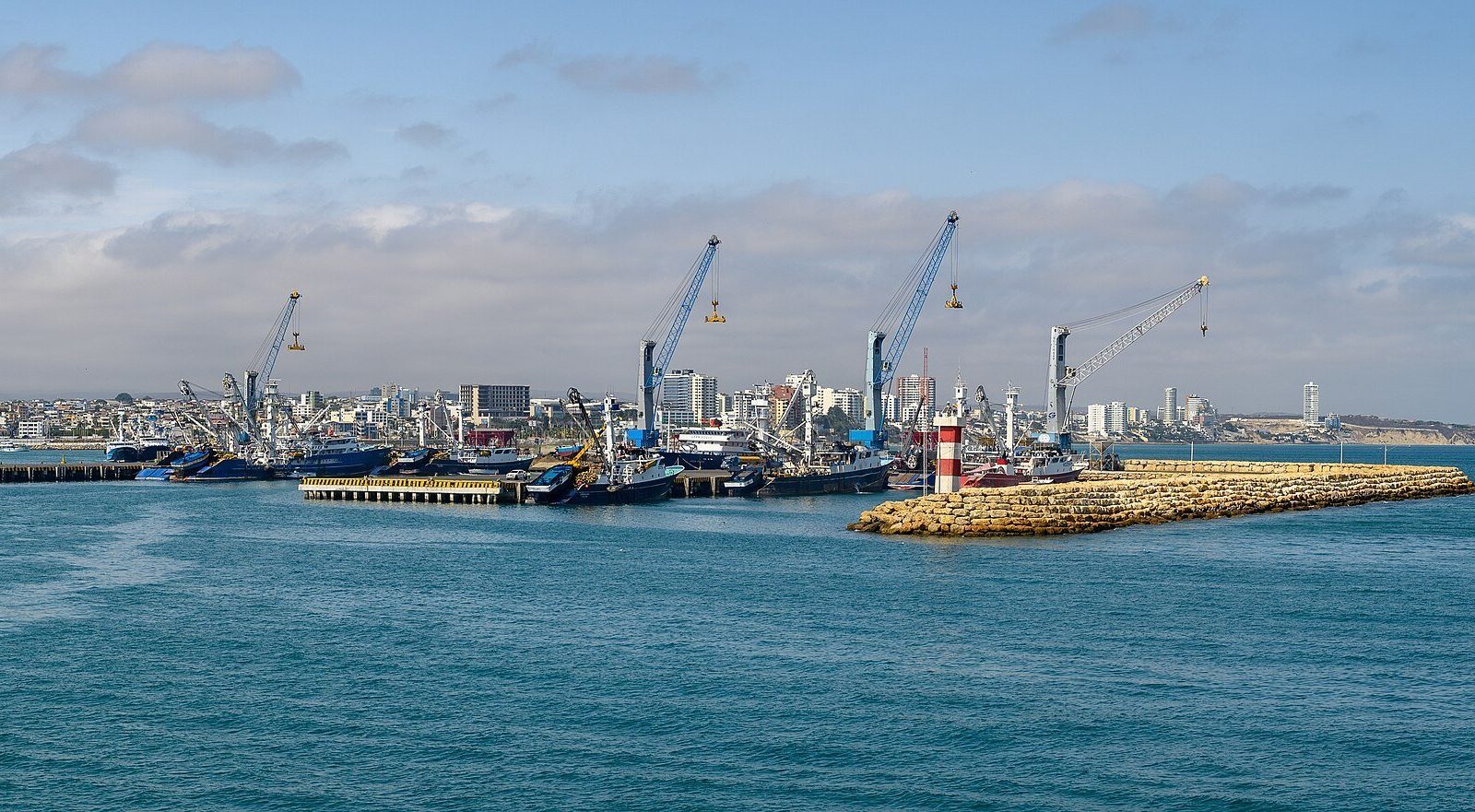
- Manta (ECMEC), Manabí: fishing, tuna and general cargo.
- Esmeraldas (ECESM): northern port, general cargo.
- José Joaquín de Olmedo International (GYE), Guayaquil: air cargo for the coast, seafood and perishables.
- Mariscal Sucre International (UIO), Quito (Tababela): the main air cargo hub for the highlands and for cut flower exports.
Whichever gateway the cargo uses, clearance runs through the same national system.
How Does Customs Clearance Work in Ecuador?
Imports into Ecuador clear through the Servicio Nacional de Aduana del Ecuador (SENAE) on ECUAPASS, the electronic customs and single window system, and every importer must first register with SENAE and hold a RUC issued by the Servicio de Rentas Internas (SRI), as the ITA Country Commercial Guide on Ecuador customs sets out.
- Registration: the importer obtains a RUC from the SRI, registers in ECUAPASS and obtains an electronic signature token required for submissions.
- Permits first: where the product needs a control document (conformity with an RTE INEN technical regulation, an ARCSA health registration, an Agrocalidad phytosanitary or zoosanitary permit), it is processed through the Ventanilla Única Ecuatoriana (VUE) inside ECUAPASS before shipment or before filing.
- Declaration: the import declaration (Declaración Aduanera de Importación, DAI) is filed in ECUAPASS with the commercial invoice, transport document, insurance and origin certificate where a preference applies. Each item is classified under Ecuador's national tariff, built on the Andean NANDINA nomenclature and the HS code. SENAE publishes a list of authorized customs agents, and commercial cargo is filed by a licensed local agent.
- Risk channel and inspection: SENAE assigns a control channel; physical or documentary inspection follows for selected shipments.
- Payment and release: duties and taxes are paid, and the cargo is released from the terminal or temporary warehouse.
Classification and valuation errors are the main cause of delays, followed by missing control documents, and both feed directly into the tax bill.
What Are the Import Duties and Taxes in Ecuador?
Imports into Ecuador pay the ad valorem tariff for the HS code, a 0.5% FODINFA levy and 15% IVA, with ICE on specific goods and ISD on the payment abroad. SENAE lists FODINFA at 0.5% and IVA at 15% in its official breakdown of import tax categories.
- Ad valorem tariff: set by HS code under Ecuador's national tariff. The 2023 simple average MFN applied rate was 11.2%, with 17.4% for agricultural and 10.2% for non-agricultural products, according to the ITA guide to Ecuador import tariffs. As an Andean Community (CAN) member, Ecuador applies the Andean Price Band System to 189 agricultural products, about 2.5% of its tariff schedule.
- FODINFA: a 0.5% levy on the CIF (customs) value.
- IVA (VAT): 15%, charged on the CIF value plus duties and other import charges. The rate rose from 12% to 15% on April 1, 2024.
- ICE (special consumption tax): applies to specific goods such as alcohol, tobacco, perfumes, sugary drinks, firearms and others, at specific or ad valorem rates.
- ISD (currency outflow tax): charged by the SRI on payments sent abroad, including payments to foreign suppliers. The general rate is 5% in 2026, with a differentiated 2.5% rate for designated productive sector subheadings and 0% for fuel imports and designated pharmaceutical subheadings.
Preferential tariffs apply under the China FTA, the EU agreement and CAN membership when origin is proven. Because the stack is cumulative, model IVA on the duty-inclusive base and add ISD to the payment side of your cost sheet. A simple check: on $40,000 CIF of goods at a 10% duty, the duty is $4,000, FODINFA is $200, and IVA at 15% on the duty-inclusive base adds $6,630 more before any ICE. Proving origin and value for that calculation depends on the document set.
What Documents Are Required to Ship to Ecuador?
Shipping to Ecuador requires a commercial invoice, packing list, transport document, insurance policy, the importer's RUC and ECUAPASS registration, and the DAI, plus origin and control documents where they apply.
- Commercial invoice with value, Incoterm and full description (commercial invoice requirements are stricter than many exporters expect)
- Packing list with gross and net weight per product
- Bill of lading or air waybill
- Insurance policy
- Importer RUC and ECUAPASS registration
- Import declaration (DAI) filed in ECUAPASS
- Certificate of origin when claiming a preferential rate
- Certificate of conformity when the product falls under an RTE INEN technical regulation
- Spanish labeling where required
- Sanitary, phytosanitary or other control documents for regulated goods (ARCSA, Agrocalidad)
Restricted Goods and Import Permits in Ecuador
Ecuador bans a defined list of used and hazardous goods and requires prior control documents for food, health, plant and animal products. Under COMEX Resolution 009-2022, summarized in the ITA list of Ecuador's prohibited and restricted imports, Ecuador prohibits imports of used clothing, footwear and tires, used vehicle spare parts, used vehicles and motorcycles, hazardous waste, ozone-depleting substances, single-use plastic straws, baby bottles containing BPA, equipment using certain banned refrigerants and several other items. Used special-purpose vehicles such as ambulances and fire trucks are allowed only as tax-exempt donations. Antiques, firearms, live animals, precious gems and original artwork need ministry authorization.
Food, plant and animal products need phytosanitary or zoosanitary clearance from Agrocalidad, and processed foods, cosmetics and medicines need ARCSA health registration before import. Products under an INEN technical regulation need a conformity certificate. Wood packaging must meet ISPM 15. Hazmat moves under IMDG (ocean) or IATA DGR (air) with correct declarations.
Courier shipments follow a separate regime. SENAE's Category B (4x4) covers personal packages up to 4 kg and USD 400 FOB, with a USD 1,600 annual cap per person and, since June 16, 2025, a fixed USD 20 tariff plus FODINFA under COMEX Resolution 006-2025. Commercial stock does not belong in that category; it moves as freight with a full import declaration, which brings the choice of mode into play.
LCL, FCL or Air Freight to Ecuador: Which to Choose?
For Ecuador, choose air under 2 CBM or for urgent goods, LCL from 2 to 15 CBM, and FCL above 15 CBM.
- Under 2 CBM or urgent: air freight into GYE or UIO, especially for parts, electronics and medical goods.
- 2 to 15 CBM: LCL consolidated through Miami. You pay by the cubic meter and file one ECUAPASS entry.
- Above 15 CBM: a 20ft FCL costs less per unit than LCL; above 30 CBM, quote a 40ft or 40ft high cube.
- Heavy, dense cargo: a 20ft fills by weight before volume, so check payload limits before booking.
Because ECUAPASS fees and broker costs are per declaration, consolidating several suppliers into one shipment cuts the customs cost per unit as well as the freight, and that saving decides more Ecuador lanes than the freight difference between modes.
Key Industries Shipping Freight to Ecuador
Ecuador imports machinery and equipment, vehicle parts, chemicals, pharmaceuticals, plastics and consumer goods, and exports shrimp, bananas, cut flowers, cocoa and tuna. Aquaculture and agriculture pull in feed, packaging, aerators and processing equipment, while construction and energy projects import heavy equipment and spares. Retail and distribution rely on frequent consolidated shipments from the US and Asia.
On the export side, shrimp is Ecuador's largest export product. According to the Banco Central del Ecuador, shrimp exports reached a record USD 8,401.3 million and 1,398,500 metric tons in 2025, and in the fourth quarter shrimp outsold crude oil and oil products combined, with China and the United States as the key buyers. Bananas and plantains added a record USD 4,262.4 million, and cut flowers via Quito, cocoa and tuna complete the picture, all needing reefer or temperature-controlled capacity. Our follow-up guide covers how Ecuadorian shrimp moves to US buyers in reefers through Miami.
Choosing a Freight Forwarder for Ecuador
The right forwarder for Ecuador consolidates US and Asian cargo so you file fewer ECUAPASS entries, gets classification and origin documents right so preferences apply, and secures reefer space in peak export season. Interworld Freight was founded in Miami in 1992 and runs ocean FCL and LCL, air freight and customs coordination from its Miami hub with warehousing, with coverage on every major trade lane. For temperature-sensitive cargo, see our temperature-controlled shipping options. Explore container shipping to Ecuador or read our overview of shipping from Miami to Latin America. Quote requests are answered within one business day.
Frequently Asked Questions
How long does shipping from Miami to Ecuador take?
Ocean freight from Miami to Guayaquil takes 5 to 10 days port to port for FCL, and 8 to 14 days for LCL because of consolidation. Air freight from Miami to Guayaquil or Quito lands in 1 to 3 days.
How much does it cost to ship freight to Ecuador?
The cost depends on mode, volume, weight and origin: LCL is priced per cubic meter or per ton, whichever is higher, FCL per container, and air per chargeable kilogram. On top of the freight, budget for Ecuadorian duty, 0.5% FODINFA, 15% IVA and the 5% ISD on the supplier payment. Request a quote with dimensions, weight and HS code to get a landed-cost estimate.
What taxes do I pay when importing into Ecuador?
You pay the ad valorem tariff for your HS code, a 0.5% FODINFA levy on CIF value and 15% IVA on the duty-inclusive value. ICE applies to specific goods, and ISD (5% general rate in 2026) applies to payments sent abroad to your supplier.
Can I use FedEx, DHL or Amazon to ship goods to Ecuador?
Couriers deliver small parcels to Ecuador, but SENAE's 4x4 courier category is limited to personal packages up to 4 kg and USD 400 FOB, with a USD 1,600 yearly cap and a fixed USD 20 tariff. Commercial quantities must enter as freight with a full import declaration in ECUAPASS, which is where consolidated LCL or air cargo is the cheaper route.
What is ECUAPASS?
ECUAPASS is SENAE's electronic customs system and single window. Importers must register in it, with a RUC and an electronic signature token, before filing an import declaration.
Do I need a customs broker in Ecuador?
Yes for commercial imports: SENAE maintains a list of authorized customs agents, and commercial declarations are filed by a licensed agent. A broker also manages control documents such as INEN conformity certificates and sanitary permits.
Can I import used vehicles or used machinery parts into Ecuador?
No for vehicles and parts: used vehicles, motorcycles, used vehicle spare parts, used tires and used clothing are prohibited under COMEX Resolution 009-2022. Check the current COMEX list before buying any used goods for Ecuador.
Does Ecuador have a free trade agreement with the United States?
Ecuador and the United States signed an Agreement on Reciprocal Trade on March 13, 2026, which cuts Ecuadorian tariffs on many US goods once it enters into force. Until then, US-origin cargo pays the applied MFN tariff, while Chinese and EU goods can already claim preferences with a valid certificate of origin.
Photo: Port of Manta, Ecuador. Gordon Leggett, CC BY-SA 4.0, via Wikimedia Commons.
Ready to ship your freight?
