
On this page11
Customs clearance in Ecuador runs through the Servicio Nacional de Aduana del Ecuador (SENAE) on the ECUAPASS system, where an import declaration (DAI) is filed on a CIF value. Goods then pay an ad valorem duty set by tariff subheading, FODINFA at 0.5%, and 15% IVA, with ICE added on selected products. Importers moving full loads can start from our container shipping to Ecuador service.
The money does not stop at the border. Ecuador also taxes the payment you send abroad: the currency outflow tax (ISD) is 5% in its general schedule. An importer with a RUC, an ECUAPASS registration and a correct classification in hand before the vessel arrives clears cargo without storage charges. One who fixes the paperwork after arrival pays terminal fees while doing it.
Ecuador Customs at a Glance
| Item | Ecuador |
|---|---|
| Customs authority | Servicio Nacional de Aduana del Ecuador (SENAE) |
| Electronic system | ECUAPASS, with the Ventanilla Única (single window) |
| Tariff framework | Ecuadorian national tariff under the Andean Community; Andean Price Band System on 189 agricultural products |
| Trade agreement with the US | No free trade agreement. A US-Ecuador Agreement on Reciprocal Trade was signed on March 13, 2026; no official notice of entry into force found as of this post |
| Duty valuation basis | CIF (cost, insurance and freight) |
| Main import taxes | Ad valorem duty; FODINFA 0.5%; IVA 15%; ICE on selected goods |
| Other levy | ISD 5% (general schedule) on the payment abroad |
| Importer ID | RUC from the SRI, registration with SENAE and in ECUAPASS |
| Broker requirement | The importer or a SENAE-accredited customs agent files the declaration; using a broker is standard practice |
| De minimis | Not covered here (courier and postal regimes follow separate SENAE rules) |
How Does Customs Clearance Work in Ecuador?
Clearance follows seven steps, and four of them happen before the cargo arrives.
- Obtain a RUC. The importer registers with the Servicio de Rentas Internas (SRI) as a taxpayer.
- Get an electronic signature. ECUAPASS requires a digital certificate or token for signing, obtained through the Central Bank of Ecuador (BCE).
- Register in ECUAPASS. The importer creates a user, accepts the usage policies and registers the electronic signature.
- Check the product and classify it. Confirm that the goods are not prohibited or restricted by the Foreign Trade Committee (COMEX) and find the subheading in the national tariff.
- Transmit the DAI. The declaration is filed in ECUAPASS in a window that opens 15 days before the vessel arrives and closes 30 days after arrival, according to SENAE.
- Receive the channel. The system assigns the DAI number and an inspection channel (aforo): automatic, documentary, physical, or non-intrusive physical (scanner). Selection follows risk profiling, and perishable goods and live animals get priority for physical inspection.
- Pay and release. The importer or customs agent pays the liquidated duties and taxes, and the goods leave the terminal.
Pre-shipment documents come first for regulated goods. SENAE separates accompanying documents (approved before shipment) from supporting documents (kept by the declarant). Ask your supplier for the information those documents need before the booking is confirmed, not after.
Documents Required for Ecuador Customs
The declarant must hold a set of supporting documents, in paper or electronic form.
- Commercial invoice or proof of the commercial transaction. See the commercial invoice glossary entry for the fields customs expects.
- Transport document: bill of lading for ocean or air waybill for air.
- Insurance policy, since the tax base includes insurance.
- RUC of the importer.
- Certificate of origin, when a tariff preference applies.
- INEN-1 certificate of conformity with technical standards, for goods under mandatory standards.
- Weights and labeling: individual gross and net weight per product, and special labeling, often in Spanish.
- Any other document SENAE or COMEX requires for the specific goods.
Ecuador Import Duty Rates by Product Category
Ecuador publishes the ad valorem rate per subheading in its national tariff, so the HS code decides the percentage. The U.S. International Trade Administration reports a 2023 simple average MFN tariff of 11.2%, with applied rates running from low single digits up to a maximum band that varies by product group, according to its Ecuador tariff summary.
| Category | What the official summary says |
|---|---|
| Clothing | Rates capped at 30% |
| Cotton, petroleum products | Maximum applied rate of 10% |
| Live animals and meat | Highest bands, up to 86% |
| 189 agricultural products | Andean Price Band System adds a variable levy to the basic duty |
| Cigarettes, alcohol, perfumes, firearms | ICE on top of duty (for example 30% on firearms and ammunition; spirits at USD 10.41 per liter of pure alcohol in 2026, plus 75% ad valorem) |
| Most machinery, inputs and consumer goods | Look up the subheading; no single band applies |
The SRI resets the specific ICE amounts every year (Resolution NAC-DGERCGC25-00000040 sets the 2026 figures), while ad valorem ICE rates are fixed by law. Never budget a shipment from an average. Classify first, then read the rate.
How to Calculate Import Duty and Taxes in Ecuador
The cascade runs in this order: CIF value, ad valorem duty, FODINFA, ICE, then IVA on the sum.
- Tax base = cost + insurance + freight (the CIF value).
- Ad valorem = base x tariff rate.
- FODINFA = 0.5% of the base.
- ICE, when the product is subject to it.
- IVA = 15% x (base + ad valorem + FODINFA + ICE).
Illustrative example (round numbers, not a quote): a pallet of industrial parts with a CIF value of USD 10,000 and a 10% tariff rate.
- Ad valorem: 10,000 x 10% = USD 1,000
- FODINFA: 10,000 x 0.5% = USD 50
- IVA base: 10,000 + 1,000 + 50 = USD 11,050
- IVA: 11,050 x 15% = USD 1,657.50
- Duties and taxes at customs: USD 2,707.50
The ISD sits outside this cascade. The SRI treats payments to suppliers abroad as a taxable event, with the customs value in the declaration as the base for goods. At the general 5% rate, the same shipment adds USD 500 when the supplier is paid. Fuel and pharmaceutical imports carry 0%, and listed productive-sector subheadings carry 2.5%.
Importer Registration and Customs Brokers in Ecuador
Every importer needs a RUC from the SRI, registration with SENAE, and an active ECUAPASS user with an electronic signature. The ECUAPASS signature must be in hand before the first declaration, so request it through the BCE before you book.
Ecuadorian law lets the importer file directly or through an accredited customs agent. Most commercial importers hire one. SENAE publishes the list of authorized agents and their auxiliaries on its website, so you can verify a broker's accreditation before signing a power of attorney. For background on the role, see the customs broker glossary entry.
Exemptions, Free Zones and Special Regimes in Ecuador
SENAE's customs regimes page lists the regimes importers use most.
- Importación para el consumo (Regime 10): definitive entry; once the obligation is paid, goods circulate freely.
- Admisión temporal para reexportación en el mismo estado (Regime 20): suspends duties and taxes in whole or in part. Goods must be identifiable and inspected. The general term is one year, or the length of the contract for public works, leased capital goods and similar cases.
- Admisión temporal para perfeccionamiento activo (Regime 21): for processing, assembly, repair or authorized maquila. The term is one year, extendable once for an equal period.
- Depósito aduanero (Regime 70): storage without paying duties; up to one year, extendable by six months.
On trade preferences: Ecuador has no free trade agreement with the United States. A 1990 Trade and Investment Council Agreement was updated by a Protocol on Trade Rules and Transparency, in force since August 2021. On March 13, 2026, the two countries signed an Agreement on Reciprocal Trade, as USTR announced. The USTR release announces the signing and does not announce entry into force, and we found no official notice of it when we checked for this post. Until one is published, budget US-origin goods at the normal tariff rate and confirm any preference with your broker before relying on it.
Import Permits and Licensing Agencies in Ecuador
Permits depend on the product. Official sources confirm these agencies and permits.
- COMEX sets the list of prohibited imports (Resolution 009-2022 and its reforms).
- ARCOTEL issues the non-automatic import license for satellite decoders and receivers under subheading 8528.71.00.21.
- INEN standards: the INEN-1 certificate applies to goods under mandatory technical regulations.
- Ministries authorize imports of antiques, precious gems, original artwork, firearms and live animals.
Other goods need approvals that depend on the subheading. Ask your Ecuadorian broker for the exact agency and registration before you buy. The U.S. Commercial Service guide recommends using a specialized customs agent for this reason.
Common Customs Delays in Ecuador and How to Avoid Them
Delays cluster in five places.
- No ECUAPASS signature. A first-time importer without a token cannot file. Start with the BCE process weeks ahead.
- Wrong subheading. A misclassified HS code changes the duty and the declared goods may not match the cargo at inspection. Fix the classification with the broker before shipping.
- Missing pre-shipment documents. Goods under accompanying-document control cannot ship until approved.
- Value disputes. The tax base is CIF, so freight and insurance must appear on the documents. Keep the commercial invoice consistent with the bill of lading.
- Declaring too late. The DAI window closes 30 days after arrival, and port storage accrues in the meantime.
Clearing Cargo to Ecuador With Interworld Freight
Interworld Freight has operated from Miami since 1992. Our Miami hub consolidates US suppliers into one booking for ocean FCL, LCL or air, and we coordinate customs clearance with licensed brokers at destination. For routing, ports and transit, read our shipping to Ecuador guide, or go straight to container shipping to Ecuador. Send the commercial invoice and HS code, and we answer with a quote within one business day. The customs clearance glossary entry defines each step of the process.
Frequently Asked Questions
What is the import duty in Ecuador?
The duty is ad valorem, set by tariff subheading and applied to the CIF value. The U.S. International Trade Administration reports a 2023 simple average MFN tariff of 11.2%, and clothing is capped at 30%. Your HS code decides the actual rate.
What taxes do I pay on imports to Ecuador?
Besides duty, you pay FODINFA at 0.5%, IVA at 15% on the sum of CIF, duty, FODINFA and ICE, and ICE on selected goods. The ISD of 5% applies to the payment sent abroad.
Does Ecuador have a free trade agreement with the United States?
No. The two countries signed an Agreement on Reciprocal Trade on March 13, 2026, but no official notice of entry into force has been published. Confirm its status with your broker before claiming any preference.
Do I need a customs broker to import into Ecuador?
The importer can file directly or through an accredited agent. SENAE publishes the authorized agents, and the Commercial Service advises using one.
What is ECUAPASS?
ECUAPASS is SENAE's electronic customs system, required to clear all shipments entering Ecuador. Users need an electronic signature to transmit declarations.
When must the import declaration be filed?
The DAI can be transmitted from 15 days before the vessel arrives until 30 days after arrival, according to SENAE.
What is the ISD on imports?
The ISD is Ecuador's currency outflow tax. Its general rate is 5%, with 0% for fuel and pharmaceutical imports and 2.5% for listed productive-sector subheadings, according to the SRI.
Can I bring goods in temporarily?
Yes. Regime 20 allows temporary admission for re-export in the same state, for one year, with duties and taxes suspended in whole or in part.
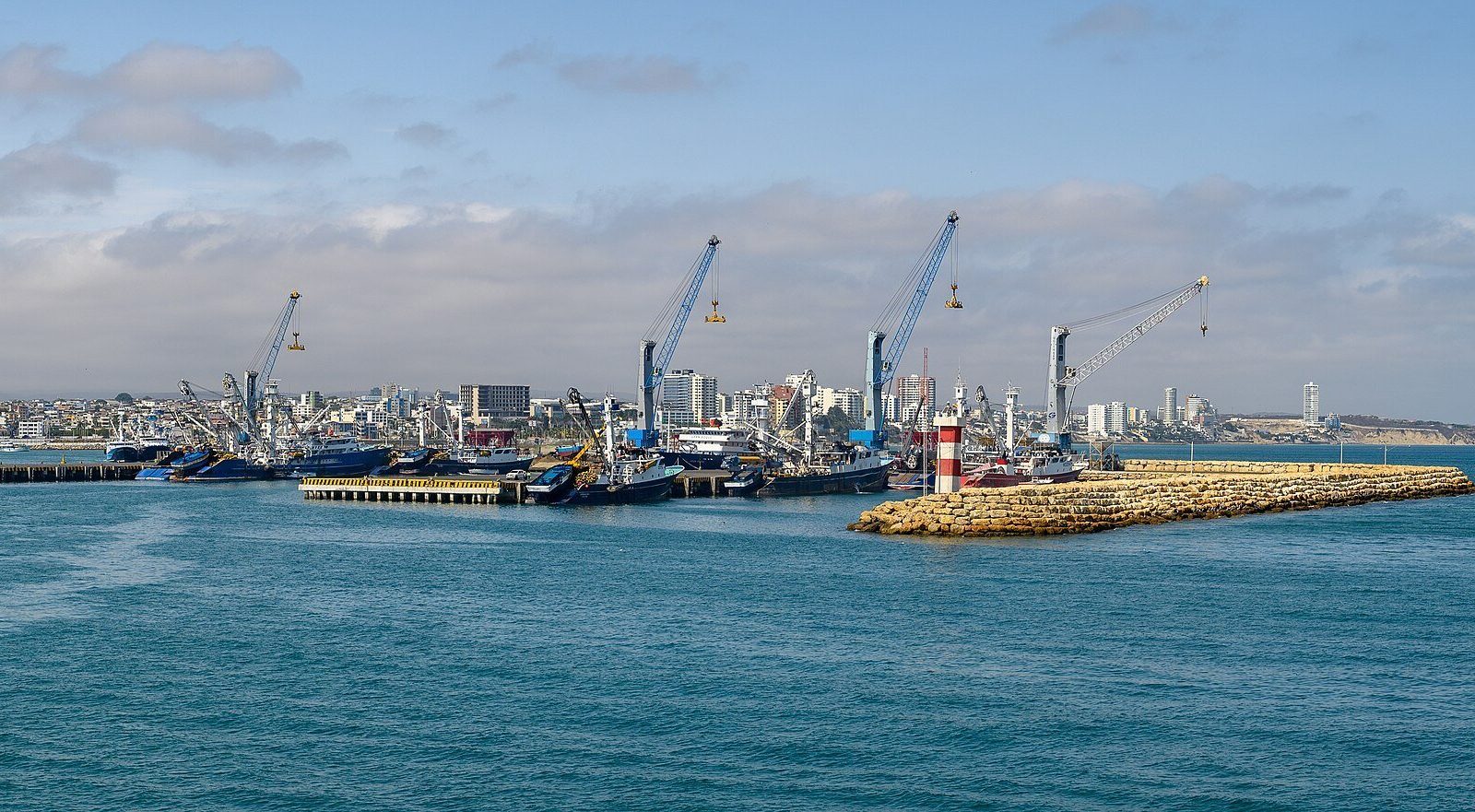
Photo: Port of Manta, Ecuador. Gordon Leggett, CC BY-SA 4.0, via Wikimedia Commons.
Ready to ship your freight?
