
On this page11
Colombian imports clear through the Dirección de Impuestos y Aduanas Nacionales (DIAN) under Decree 1165 of 2019, and the importer must file an advance declaration at least 48 hours before the cargo arrives. Duties run from 0% to 20%, VAT is 19%, and most US-origin goods enter duty free under the US-Colombia Trade Promotion Agreement (CTPA).
Late paperwork is what hurts in Colombia. The 48-hour deadline runs ahead of the vessel, so the document set has to be final before the cargo reaches the port. Interworld Freight moves full containers from Miami under its container shipping to Colombia service, and the customs steps below apply to that cargo. The penalty regime changed in June 2026, and the last section before the FAQ covers it.
Colombia Customs at a Glance
The table covers a commercial import from the United States. Rates depend on the 10-digit tariff code, so classify first.
| Item | Colombia |
|---|---|
| Customs authority | DIAN (Dirección de Impuestos y Aduanas Nacionales) |
| Electronic system | DIAN electronic services (servicios informáticos electrónicos), accessed with a digital signature |
| Legal framework | Decree 1165 of 2019, as amended, including Decree 659 of 2024 |
| Trade agreement with the US | US-Colombia Trade Promotion Agreement (CTPA), in force since May 15, 2012 |
| Duty range | 0% to 20% (MFN), by 10-digit tariff code |
| Valuation basis | Customs value in US dollars under WTO valuation rules; Andean Customs Value Declaration at USD 5,000 FOB or more |
| VAT | 19% general rate, with 5% and 0% for listed goods |
| Importer ID | NIT and RUT with DIAN, VUCE registration, digital signature accredited by ONAC |
| Broker requirement | A customs agency should file when the import value is USD 1,000 or more |
| Advance declaration | At least 48 hours before arrival, for nearly all merchandise |
How Does Customs Clearance Work in Colombia?
DIAN requires the advance import declaration (declaración anticipada de importación) for almost all import shipments under Decree 659 of 2024, which amended Decree 1165 of 2019. Article 175 of Decree 1165, as modified, requires it to be filed and accepted at least 48 hours before the merchandise reaches Colombian customs territory.
- Classify and check approvals. Assign the 10-digit tariff code and confirm whether the product needs an import registration, license or sanitary approval.
- Confirm the importer's registrations. NIT, RUT, VUCE and the digital signature must be active.
- Collect the document set. Invoice, packing list, transport document, origin certificate and any permits.
- File the advance declaration. The customs agency submits it through DIAN's electronic services at least 48 hours before arrival.
- Present the import declaration. After arrival, the import declaration is filed, and the Andean Customs Value Declaration accompanies it at USD 5,000 FOB or more.
- Pay duties and VAT. Payment goes through authorized financial entities.
- Inspection or release. DIAN verifies description and classification on selected shipments, then authorizes release (levante).
The advance declaration has a short exception list. Decree 659 does not require it for goods coming from free trade zones, postal traffic and traveler goods, direct transshipments to the arrival warehouse, and temporary imports of tourist vehicles, among others. Every other commercial import needs it. Our glossary entry on customs clearance shows how this filing fits the wider process.
Documents Required for Colombia Customs
The import requirements chapter of the Country Commercial Guide lists the set, and importers must keep the documents for at least five years.
- Commercial invoice. Our note on commercial invoice requirements lists the data customs authorities check.
- Packing list.
- Bill of lading (ocean) or air waybill (air).
- Advance import declaration, filed at least 48 hours before arrival.
- Import declaration.
- Andean Customs Value Declaration for shipments of USD 5,000 FOB or more.
- Import registration or import license through VUCE, when the product requires one.
- Certificate of origin, depending on the product and the preference claimed.
- INVIMA, ICA or other agency approvals for regulated goods.
Colombia Import Duty Rates by Product Category
Duties fall into three bands, according to the Colombia import tariffs chapter: 0% to 5% on capital goods, industrial goods and raw materials not produced locally, 10% on most manufactured goods, and 15% to 20% on consumer and sensitive goods. The 2025 simple average MFN rate was 6.8%, and about 51% of tariff lines are duty free.
| Product category | MFN duty | US origin under the CTPA |
|---|---|---|
| Capital goods, industrial inputs, raw materials not produced in Colombia | 0% to 5% | 0% |
| Most manufactured goods | 10% (some exceptions) | 0% |
| Consumer and sensitive goods | 15% to 20% | 0% for most |
| Agricultural products | Set by tariff code | Per the CTPA schedule for the line |
The CTPA took effect on May 15, 2012. About 80% of US consumer and industrial exports gained immediate duty-free entry, according to the Country Commercial Guide. Check the CTPA schedule for your tariff line, especially on agricultural goods. Origin must be documented to claim the preference.
How to Calculate Import Duty and Taxes in Colombia
Duty comes first, on the customs value, and VAT is then charged on the customs value plus the duty. The Estatuto Tributario sets the VAT base on imports as the base used for customs duties plus the duty itself, and Decree 1165 sets customs value in US dollars, with foreign-currency amounts converted at the rate of the last business day of the week before the declaration is filed.
- Customs value: transaction value under the WTO rules, in US dollars, including transport costs, handling and insurance up to the port or place of import.
- Duty: customs value x tariff rate.
- VAT: (customs value + duty) x 19%.
- Other taxes where they apply: excise and consumption taxes on listed goods.
Illustrative example (round numbers, not a quote). A non-preferential shipment with a customs value of USD 10,000 and a 10% duty:
- Duty: 10,000 x 10% = USD 1,000
- VAT base: 10,000 + 1,000 = USD 11,000
- VAT: 11,000 x 19% = USD 2,090
- Total taxes: USD 3,090
With US origin documented under the CTPA, the duty is 0% and the VAT is 10,000 x 19% = USD 1,900. The difference is USD 1,190 on a USD 10,000 shipment. Decree 1165 requires transport, handling and insurance costs up to the port of import to be taken into the customs value and documented, so an FOB invoice needs those costs added before it is declared.
Importer Registration and Customs Brokers in Colombia
An importer needs a NIT and an RUT registration with DIAN, registration on VUCE, the single window for foreign trade run by the Ministry of Commerce, Industry and Tourism, and a digital signature certified by ONAC. Importers who act directly before DIAN use its electronic services, under Decree 1165.
For imports of USD 1,000 or more, the customs agency (agencia de aduanas) should handle the paperwork and clearance. Under Decree 1165, the importer answers for the authenticity of the supporting documents, even when it acts through an agency, so a weak file cannot be repaired by the agency afterward. Our glossary entry on the customs broker explains the role.
Exemptions, Free Zones and Special Regimes in Colombia
Colombia offers several regimes that defer or remove taxes. Ordinary import pays duty and VAT. Temporary import for short or long terms suspends duty while the goods stay in the country for a defined purpose. The special import-export systems (Sistemas Especiales de Importación-Exportación) permit duty-free import of inputs, capital goods and parts used to make goods for export. Free zones (zonas francas) let goods enter without payment under an entry declaration, and goods leaving a free zone into the national territory are imported under a special import declaration.
For preferences, Colombia has 17 trade agreements in force. Besides the CTPA, they include the Andean Community, the Pacific Alliance, the European Union, Canada, Chile, South Korea, Costa Rica, Israel, EFTA, and El Salvador, Guatemala and Honduras, according to the trade agreements chapter. If you buy in several markets, check which origin earns the lowest rate before you pick the supplier.
Import Permits and Licensing Agencies in Colombia
Permits are processed through VUCE, and the agency depends on the product.
- INVIMA: registrations and approvals for health-related products such as food, beverages, medicines, cosmetics and medical devices.
- ICA: sanitary and phytosanitary approvals for agricultural goods, plants and animal products.
- Ministry of Commerce, Industry and Tourism (MinCIT): approves the import registration or license for goods under special controls.
Many unrestricted goods skip the licensing step and go directly to the import declaration. For food and feed, the Country Commercial Guide warns that details such as the exporting facility cannot be changed after the shipment leaves port, so verify the permit data before departure.
Common Customs Delays in Colombia and How to Avoid Them
- Late advance declaration. The 48-hour deadline is fixed. Consolidated and multi-supplier cargo needs the final documents early.
- Invoice and value mismatches. The invoice, the Andean Customs Value Declaration and the import declaration must agree.
- Wrong tariff code. The 10-digit code determines duty, taxes and regulations, and DIAN inspects selected shipments to check description against classification.
- Missing approvals. INVIMA or ICA approvals must precede the declaration for regulated goods.
Law 2586 of 2026
Law 2586 of 2026, published on June 19, 2026 in Diario Oficial 53.527, sets Colombia's customs sanctions and forfeiture regime. It classifies infractions as minor (leves), serious (graves) and most serious (gravísimas), regulates DIAN's seizure procedure and creates a Comité de Revisión de Aprehensiones. A user who corrects a first minor infraction, or one with no other infraction in the previous three years, avoids a monetary penalty. For importers, that makes an accurate declaration and a prompt correction worth money.
Clearing Cargo to Colombia With Interworld Freight
Interworld Freight has operated from Miami since 1992. The Miami hub and warehouse receive and consolidate US cargo for ocean FCL and LCL and for air freight, and we coordinate customs with licensed brokers at destination. Our guide to shipping to Colombia covers the freight side. We answer quotes within one business day.
Frequently Asked Questions
What is the import duty in Colombia?
Duties range from 0% to 20%, depending on the 10-digit tariff code. Capital goods and raw materials pay 0% to 5%, most manufactured goods 10%, and consumer and sensitive goods 15% to 20%.
What is the VAT on imports in Colombia?
The general rate is 19%, calculated on the customs value plus the duty. Listed goods pay 5% or 0%.
What is the advance import declaration?
It is a declaration that must be filed and accepted at least 48 hours before the cargo arrives in Colombia, under Decree 659 of 2024. It applies to nearly all merchandise, with a defined list of exceptions.
Do I need a customs broker in Colombia?
For imports of USD 1,000 or more, the customs agency should handle the paperwork and clearance. The importer remains responsible for the authenticity of the supporting documents.
Does Colombia have a free trade agreement with the United States?
Yes. The CTPA took effect on May 15, 2012. About 80% of US consumer and industrial exports became duty free at entry into force.
What is the Andean Customs Value Declaration?
It is a value declaration required for imports of USD 5,000 FOB or more, filed with the import declaration.
What is VUCE?
VUCE is Colombia's single window for foreign trade, run by the Ministry of Commerce, Industry and Tourism. Importers register there and process licenses, registrations and agency approvals.
What happens if the advance declaration is late?
Decree 659 requires it 48 hours before arrival. Law 2586 of 2026 classifies customs infractions as minor, serious and most serious, and a first minor infraction that is corrected carries no monetary penalty. Ask your customs agency how late filing is classified.
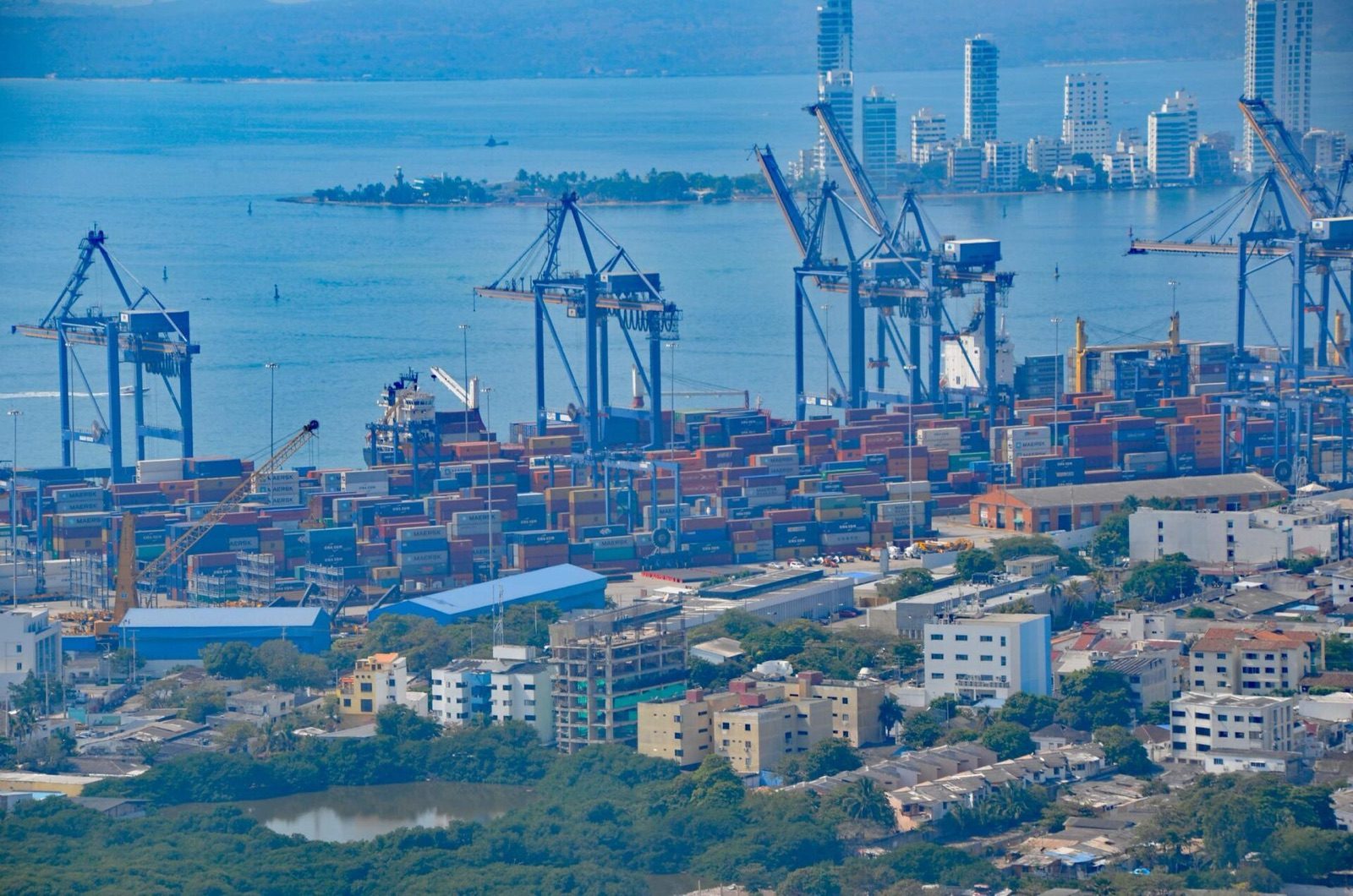
Photo: Container port, Cartagena, Colombia. Joe Ross from Lansing, Michigan, CC BY-SA 2.0, via Wikimedia Commons.
Ready to ship your freight?
