
On this page11
Customs clearance in Argentina is handled by ARCA (formerly AFIP) through its customs bureau, the Dirección General de Aduanas, and an import destination is registered in the Sistema Informático Malvina (SIM). Duty is ad valorem on the CIF value, with a 3% statistics fee and 21% IVA on top. IVA and income tax perceptions are also collected at import. For full containers, start with our container shipping to Argentina service.
The regime has changed heavily since 2023. The SIRA and SEDI import licensing systems are gone, the PAIS tax ended in December 2024, and the statistics fee was extended to the end of 2027. Argentina has no free trade agreement with the United States, so US-origin goods pay the same tariff as other non-Mercosur origins.
Argentina Customs at a Glance
| Item | Argentina |
|---|---|
| Customs authority | Agencia de Recaudación y Control Aduanero (ARCA), Dirección General de Aduanas |
| Electronic system | Sistema Informático Malvina (SIM) |
| Tariff framework | Nomenclatura Común del Mercosur (NCM); Mercosur common external tariff with national exceptions |
| Trade agreement with the US | No FTA. A US-Argentina Agreement on Reciprocal Trade and Investment was signed on February 5, 2026; no official notice of entry into force found as of this post |
| Duty valuation basis | CIF at the Argentine port or airport of entry |
| VAT | IVA 21% general rate |
| Other import levies | Statistics fee 3% (capped by decree); IVA perception up to 20%; income tax perception 6%; fines for late filing |
| Importer ID | CUIT with clave fiscal level 2 or higher, and access to the SIM |
| Broker requirement | The importer or a customs broker (despachante de aduana) acting in representation; a broker is recommended |
| De minimis | Not applicable to commercial cargo; courier regimes are separate |
How Does Customs Clearance Work in Argentina?
Clearance for definitive import has seven steps.
- Classify the goods. Argentina uses the NCM, consistent with the Harmonized System, so the HS code from your supplier is the starting point.
- Check restrictions. Used capital goods, for example, must not appear on the list of prohibited tariff positions in Annex II of Resolution 909/1994, as updated by Decree 273/2025, according to Argentina.gob.ar.
- Confirm access. The importer needs a CUIT and a clave fiscal level 2 or higher in ARCA, and operates in the SIM, directly or through a despachante.
- Prepare the documents. The invoice, transport document and packing list must support the declared value and goods.
- Request the import destination on time. Under Article 217 of the Customs Code, the importer must file in advance, up to the arrival of the transport, or within 15 days counted from arrival. Article 218 sets an automatic fine of 1% of the customs value if no destination is requested in that window, according to the Código Aduanero.
- Receive the selectivity channel. The declaration is assigned to the green, orange or red channel under Dirección General de Aduanas Resolution 44/1998: green releases the goods right after the declaration is registered, orange adds documentary review, and red adds physical verification. In April 2024, Ministry of Economy Resolution 154/2024 ended the mandatory "normative red channel" for the goods in its annex, so those goods now follow the general selectivity criteria like the rest.
- Pay and take delivery. Duties, fee and taxes are paid, and the goods are released from the terminal. The importer or despachante must attend the verification if the goods are inspected; if they do not attend, they lose the right to contest the result.
Documents Required for Argentina Customs
The U.S. International Trade Administration lists these for ocean and air cargo.
- Commercial invoice, original plus three copies, in Spanish, marked "Original Invoice" and signed in ink, with a sworn declaration in Spanish. See the commercial invoice glossary entry.
- Bill of lading for ocean cargo (at least one copy) or air waybill for air. The bill of lading is the transport and title document.
- Packing list, not generally needed for bulk goods.
- Insurance certificate, if the exporter buys the coverage.
- Certificate of origin for certain goods: textiles, footwear and apparel, goods under antidumping, countervailing or safeguard duties, and goods from non-MFN countries. The guide says it is valid for six months.
Confirm the current form of each document with your broker before the supplier issues it, because the guide was last updated in August 2025 and the rules have kept moving in 2026.
Argentina Import Duty Rates by Product Category
Argentina sets the import duty (Derecho de Importación Extrazona) by NCM position. Ad valorem duties apply to CIF value. Specific duties (a monetary amount per unit) and mixed duties that combine both apply to some products, according to the trade.gov guide. Argentina does not publish a single tariff band on the official pages reviewed here, so the table shows only categories with confirmed rates.
| Category | Duty |
|---|---|
| Smartphones and portable cell phones | 0% from January 15, 2026 (Decree 333/2025; 8% before) |
| Video game consoles and machines | 20%, reduced from 35% to align with the common external tariff (Decree 333/2025) |
| Goods of Mercosur origin | Excepted from the statistics fee under preferential-agreement rules |
| Everything else | Rate depends on the NCM position; look it up before quoting |
How to Calculate Import Duty and Taxes in Argentina
The cascade runs from CIF to duty, statistics fee, IVA and the perceptions.
- CIF value.
- Import duty = CIF x NCM rate.
- Statistics fee = 3% of the customs value, within the per-operation maximum amounts that Decree 1140/2024 sets (check the cap for your invoice value; it does not bind in the example below).
- IVA = 21% on the customs value plus all import taxes, per Article 25 of the consolidated VAT law text. Article 28 lets the executive set reduced rates down to half of the general rate (10.5%) for listed goods, so confirm the rate for your NCM position.
- Perceptions: IVA and income tax advances on top, described below.
Illustrative example (round numbers, not a quote): CIF USD 20,000 and a 10% duty rate.
- Import duty: 20,000 x 10% = USD 2,000
- Statistics fee: 20,000 x 3% = USD 600
- IVA base: 20,000 + 2,000 + 600 = USD 22,600
- IVA 21%: USD 4,746
- Duty, fee and IVA: USD 7,346
On top come the perceptions. ARCA describes them as an IVA perception of up to 20% and an income tax perception of 6%, applied to definitive imports. Both are advances against your own tax position. Importers that generate a permanent credit balance can apply for an exclusion certificate, which ARCA reinstated in 2025. Temporary exceptions from both perceptions for listed essential goods and for inputs bought by MiPyMEs holding a valid MiPyME certificate run through December 31, 2026, under General Resolution 5868/2026. Unless ARCA extends them again, the general perceptions apply from January 1, 2027, so check whether an exception covers your goods.
The statistics fee runs at 3% until December 31, 2027 under Decree 1140/2024, with exceptions preserved for preferential-agreement origin such as Mercosur.
Importer Registration and Customs Brokers in Argentina
To operate in the SIM, an importer needs a CUIT and a clave fiscal level 2 or higher. Under Article 37 of the Customs Code, importers may clear goods themselves or through an authorized person, so a despachante de aduana is not mandatory; the importer or the despachante acting in representation must attend verification. The U.S. Commercial Service advises using a customs broker or freight forwarder. The customs broker glossary entry describes how the role works.
Exemptions, Free Zones and Special Regimes in Argentina
On preferences: Argentina has no free trade agreement with the United States. USTR announced the signing of the Agreement on Reciprocal Trade and Investment on February 5, 2026. The release does not announce entry into force, and we checked for an official notice of it when writing this post and found none. Budget US-origin goods at the normal tariff. Argentina belongs to Mercosur, whose members are Brazil, Paraguay and Uruguay, and its agreements run through that bloc.
The Temporary Admission Regime lets goods enter duty-free for a specific purpose and leave within a set time. The terms reported by the U.S. International Trade Administration are:
- 240 days for samples, packaging, pallets, containers, machines and testing devices that enter unchanged.
- 360 days for finished goods, extendable by another 360 days if the request is filed at least one month before the deadline.
- Up to 1,080 days for capital goods in long-term projects.
- A bond covering the import charges, refunded on re-export.
Import Permits and Licensing Agencies in Argentina
General import licensing is gone. The U.S. International Trade Administration reports that SIRA was replaced by SEDI in December 2023, that General Resolution 5651/2025 eliminated SEDI effective February 26, 2025, and that import licensing was fully eliminated by April 2025. Sector regulators still control specific goods.
- ANMAT (Ministry of Health): pharmaceuticals and cosmetics.
- INAL, inside ANMAT: consumer-ready foods, supplements and beverages other than wine.
- SENASA: animal and plant products, human food safety and animal feed.
- INV: wine and wine products.
Used goods carry the heaviest limits. The U.S. International Trade Administration lists used automobiles, motorcycles, clothing and tires as restricted or prohibited.
Common Customs Delays in Argentina and How to Avoid Them
- Late filing. The 15-day window runs from arrival and the 1% fine is automatic.
- Perception surprise. The IVA perception (up to 20%) and income tax perception (6%) are advance payments, so budget the cash before release.
- Invoice defects. The invoice must be in Spanish with the sworn declaration and ink signature.
- Used goods. A used machine on the prohibited positions list is stopped. Check Resolution 909/1994 first.
- Red channel. Goods that go to physical verification need the importer or despachante present.
- Rule drift. Argentina changed its regime several times in 2024 to 2026. Re-check your assumptions per shipment.
Clearing Cargo to Argentina With Interworld Freight
Interworld Freight has operated from Miami since 1992. Our Miami hub consolidates US suppliers into one booking, ocean FCL, LCL or air, and we coordinate customs clearance with licensed brokers at destination. For ports, routing and transit, read our shipping to Argentina guide. Send the commercial invoice and HS code and we quote within one business day. The customs clearance glossary entry defines the term.
Frequently Asked Questions
What is the import duty in Argentina?
It is ad valorem on the CIF value and depends on the NCM position. Some products carry specific or mixed duties. Smartphones have paid 0% since January 15, 2026.
What taxes do I pay on imports to Argentina?
You pay duty, a 3% statistics fee and 21% IVA on the customs value plus import taxes. IVA and income tax perceptions are collected in advance.
Does Argentina have a free trade agreement with the United States?
No. A reciprocal trade and investment agreement was signed on February 5, 2026, but no official notice of entry into force has been published. Check its status before claiming any preference.
Do I need an import license in Argentina?
No. SIRA and SEDI were eliminated, and import licensing was fully eliminated by April 2025. Sector regulators such as ANMAT and SENASA still control some goods.
What is the SIM?
The Sistema Informático Malvina is ARCA's customs system, where the import destination is registered. You need a CUIT and clave fiscal level 2 or higher.
What is the deadline to file an import declaration?
File in advance, up to the arrival of the transport, or within 15 days of arrival. A late filing carries an automatic fine of 1% of the customs value.
How long can I keep goods in Argentina under temporary admission?
Samples and machines entering unchanged get 240 days, finished goods 360 days (extendable once by 360), and capital goods for long projects up to 1,080 days. A bond is required.
Can I import used goods into Argentina?
Only if they are not on the prohibited positions list in Resolution 909/1994, as updated by Decree 273/2025. Used cars, motorcycles, clothing and tires are restricted or prohibited.
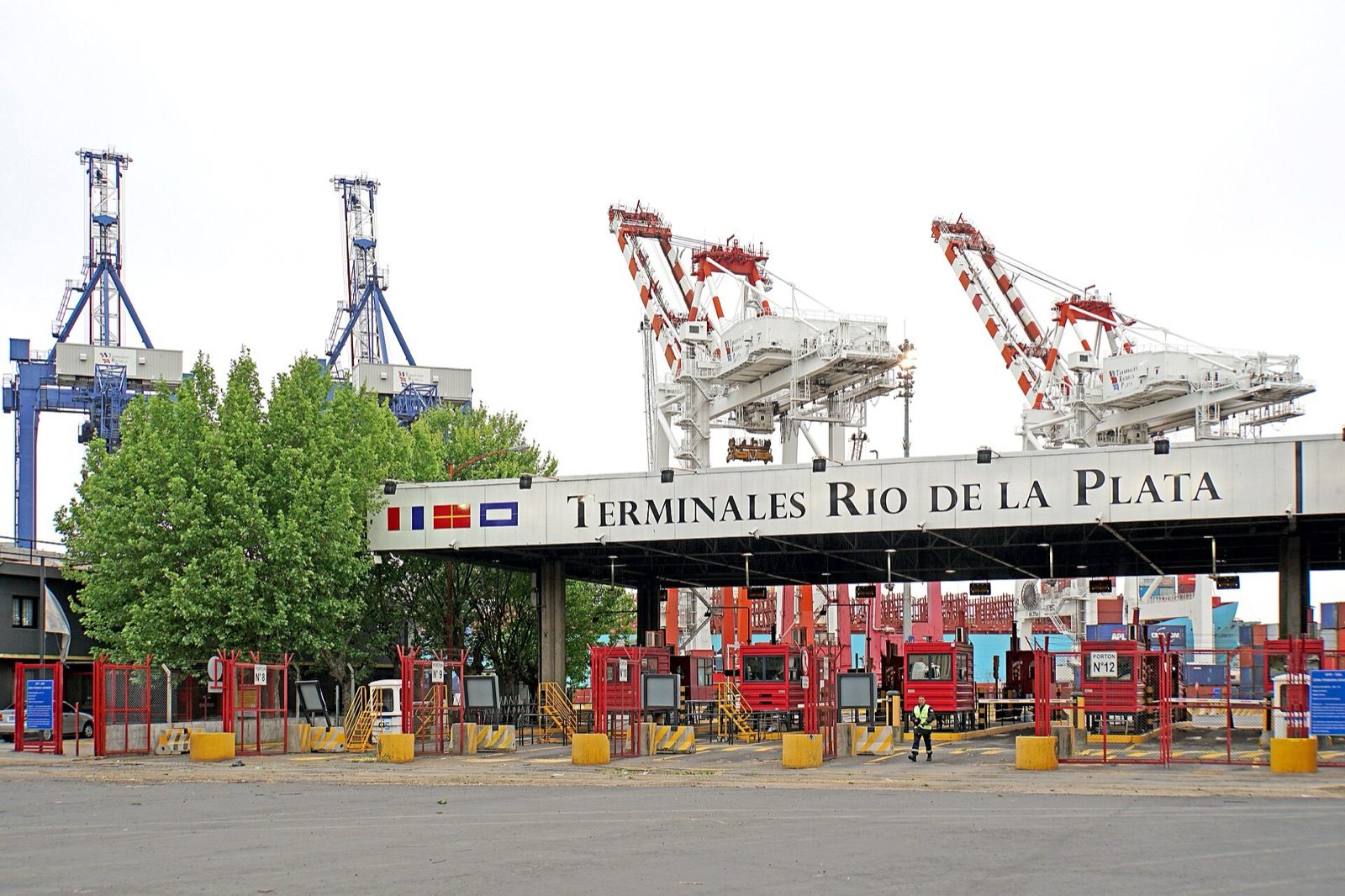
Photo: Terminales Río de la Plata, Port of Buenos Aires, Argentina. Dennis G. Jarvis, CC BY-SA 2.0, via Wikimedia Commons.
Ready to ship your freight?
