
On this page14
You ship to Brazil by ocean FCL or LCL into Santos, Paranaguá or Itajaí, or by air into São Paulo (GRU or VCP), with 14 to 25 days of ocean transit from Miami, a DUIMP filed in Siscomex by a RADAR-enabled importer, and Mercosur duty plus IPI, PIS/COFINS and ICMS. Brazil is the largest market in South America and the most complex to import into, for two reasons. First, the importer must be enabled in Siscomex through the RADAR registration before it can import at all, and its RADAR modality caps how much it can bring in. Second, the tax load is heavy and cascading: import duty under the Mercosur Common External Tariff, IPI, PIS and COFINS, the state ICMS and, on ocean cargo, the AFRMM surcharge on freight, each calculated on a base that can include the others. A shipment that is cheap to move can still be expensive to land. Two changes matter in 2026: the DUIMP is replacing the old import declaration, and the EU-Mercosur interim trade agreement now cuts duties on many European goods.
Brazil Shipping at a Glance: Transit Times and Options
Ocean freight from Miami to Santos takes 14 to 25 days, air freight to São Paulo 1 to 3 days, and ocean freight from China 35 to 45 days.
| Route & mode | Transit | Best for |
|---|---|---|
| Miami to Santos, ocean FCL | 14 to 25 days | full loads, machinery, industrial inputs |
| Miami to Brazil, ocean LCL | 18 to 30 days (port to port) | shipments under 15 CBM |
| Miami to Paranaguá or Itajaí, ocean FCL | 15 to 28 days | agribusiness and southern states |
| Miami (MIA) to São Paulo (GRU or VCP), air | 1 to 3 days | urgent parts, electronics, pharma |
| China to Santos, ocean FCL | 35 to 45 days | full containers from Asia |
| North Europe or Spain to Santos, ocean FCL | 18 to 30 days | EU machinery and chemicals |
The low end of each range applies to direct sailings and the high end to transshipped rotations; confirm the sailing with your forwarder before you commit a delivery date. In Brazil the paperwork sequence matters more than the sailing, so it comes next.
How to Ship to Brazil: Step by Step
Shipping to Brazil follows eight steps, and the first three happen before any cargo moves.
- Confirm RADAR enablement. Check that the Brazilian importer holds an active RADAR in Siscomex with enough capacity for the shipment value, and that its CNPJ will appear on the bill of lading.
- Classify the goods and secure licenses. Assign the 8-digit Mercosur NCM code and obtain any LPCO license from MAPA, ANVISA or INMETRO before shipment where the product requires it.
- Choose the mode, port and Incoterm. Pick air under 2 CBM, LCL from 2 to 15 CBM and FCL above that, choose the port closest to the final destination, and fix the Incoterm, because it sets the freight value on which AFRMM is charged.
- Book from Miami or origin. Consolidate US suppliers in Miami into one container and one declaration, or book direct from Asia or Europe into Santos, Paranaguá or Itajaí.
- Prepare matching documents. Issue a commercial invoice with NCM-level descriptions, a packing list and a bill of lading that match exactly, plus proof of origin for EU-Mercosur preferences.
- File the US export record. For US cargo, the exporter or forwarder files Electronic Export Information (EEI) in AES when any Schedule B line exceeds $2,500 or the goods need an export license.
- File the DUIMP. A despachante aduaneiro files the DUIMP on the Portal Único, and Receita Federal assigns a risk channel from automatic release to physical inspection.
- Pay taxes, clear AFRMM and take delivery. Federal taxes are debited, ICMS is settled with the state, AFRMM is cleared in the Sistema Mercante, and the cargo leaves the terminal for final delivery.
Step 4 is where Miami consolidation saves fixed per-declaration costs, starting with the US lane.
Shipping From the USA to Brazil
US cargo ships to Brazil best through Miami, which connects to Santos and the southern ports on regular ocean services and to São Paulo on daily air capacity. Interworld Freight consolidates purchases from several US suppliers at its Miami hub: one container means one import declaration, one set of licenses and one tax calculation, which matters more in Brazil than in most markets because each declaration carries fixed costs.
For full loads, on 20ft and 40ft equipment is the efficient option above 15 CBM, and FCL ocean freight keeps cargo sealed from origin to the Brazilian terminal. Smaller volumes move as LCL; see what drives LCL shipping costs for how destination charges add up. Time-critical spares and high-value goods move by air freight to Brazil into Guarulhos (GRU) or Viracopos (VCP).
Brazil has no free trade agreement with the United States, so US goods pay the Mercosur tariff for their NCM code. Before the first shipment, confirm that the consignee holds an active RADAR with enough capacity, that its CNPJ (company tax ID) appears on the bill of lading, and that any import license (LPCO) the product needs is approved; goods shipped before a required license is granted can face penalties. Agree the Incoterm early: on FOB or FCA terms the Brazilian buyer controls the ocean leg, which also sets the freight value on which AFRMM is charged. Asian cargo pays the same full tariff, on a much longer and deeper lane.
Shipping From China and Asia to Brazil
Shipping from China to Brazil takes 35 to 45 days for a full container on direct Asia to east coast South America services to Santos, Paranaguá, Itajaí, Navegantes, Itapoá and Rio Grande. China is Brazil's largest trading partner, so capacity is deep. LCL takes longer because of consolidation at origin and deconsolidation in Brazil. With no Mercosur trade agreement with China, Chinese goods pay the full CET rate unless they qualify for a reduction such as an ex-tarifário for capital goods, the same baseline that applies when shipping to Argentina. European cargo is the exception to that rule since 2026.
Shipping From Europe to Brazil
Shipping from Europe to Brazil now carries a tariff advantage: the EU-Mercosur interim trade agreement, signed on January 17, 2026, has applied since May 1, 2026, and EU-origin goods can claim phased duty reductions on the Brazilian side. To claim the preference, the importer files the DUIMP with the agreement code and backs it with proof of origin, either a statement on origin written by the EU exporter on the invoice or a certificate of origin, according to the Siscomex guidance on the agreement's entry into force. Reductions follow a schedule per product, so many lines still pay part of the CET for years; check the NCM before quoting a landed cost.
The lane itself is short and frequent: North Europe and Mediterranean ports reach Santos in 18 to 30 days. Machinery, chemicals, pharmaceuticals and vehicle parts dominate, and they land at a port network that spans the whole coastline.
Which Ports and Airports Handle Cargo in Brazil?
Santos handles the largest share of Brazil's container imports, with the southern ports and the northern grain corridor covering the rest, and Guarulhos (GRU) and Viracopos (VCP) handling air cargo.
- Santos (BRSSZ), São Paulo: Latin America's largest container port and Brazil's main gateway for imports to the São Paulo industrial region; also a major port for sugar, soybeans and coffee exports.
- Paranaguá (BRPNG), Paraná: major agribusiness port for grains, fertilizers, frozen meat and containers.
- Itajaí (BRITJ), Navegantes (BRNVT) and Itapoá, Santa Catarina: container ports serving the south, with strong reefer and manufacturing flows.
- Rio Grande (BRRIG), Rio Grande do Sul: southernmost container port, agribusiness and industry.
- Rio de Janeiro (BRRIO) and Itaguaí: southeast gateway, including steel and offshore energy cargo.
- Suape (BRSUA), Pernambuco, and Pecém, Ceará: northeastern ports.
- Arco Norte ports (Itaqui in São Luís, Vila do Conde in Barcarena, Santarém and Itacoatiara): the northern corridor that has become the main export route for soybeans and corn and an entry point for fertilizers.
- Manaus (BRMAO), Amazonas: river port serving the Manaus Free Trade Zone.
- São Paulo Guarulhos International (GRU) and Viracopos International (VCP), Campinas: the main air cargo hubs.
How Does Customs Clearance Work in Brazil?
Imports into Brazil clear through the Receita Federal do Brasil (RFB) on Siscomex and the Portal Único de Comércio Exterior, with a licensed customs broker (despachante aduaneiro) filing on behalf of most importers. The DUIMP (Declaração Única de Importação) is replacing the legacy import declaration (DI), with licenses, permits and certificates (LPCO) handled in the same environment; the Siscomex DI decommissioning schedule switches off the DI in stages by mode and operation type, with the last groups of operations scheduled for December 2026.
- RADAR enablement: the importer must be enabled in Siscomex. The Receita Federal Habilita system offers an express modality (listed companies and state-owned firms), a limited modality with a cap of US$50,000 or US$150,000 per six-month period, and an unlimited modality, assigned according to the company's calculated financial capacity.
- Licenses (LPCO): products controlled by MAPA (agriculture), ANVISA (health), INMETRO (conformity) or other agencies need their license before shipment or before clearance, depending on the product.
- Declaration: the broker files the DUIMP with the commercial invoice, packing list, bill of lading and certificates, classifying each item under the Mercosur NCM (an 8-digit code built on the HS).
- Risk channel: the declaration is assigned a channel, from automatic release to documentary or physical inspection, and customs value is subject to review.
- Taxes and release: federal taxes are debited, ICMS is settled with the state, AFRMM is cleared in the Sistema Mercante for ocean cargo, and the cargo is released from the terminal.
Brazilian Customs regularly holds or penalizes shipments with inaccurate or incomplete documents, so the invoice, packing list and bill of lading must match exactly. Once the declaration clears, the tax stack decides the landed cost.
What Are the Import Duties and Taxes in Brazil?
Imports into Brazil pay the Mercosur import duty plus four federal and state taxes that cascade on each other, and ocean cargo adds AFRMM on the freight.
- Import duty (II): set by the Mercosur Common External Tariff (TEC) for each NCM code, assessed on CIF value. Brazil keeps national exception lists to the CET.
- IPI (tax on industrialized products): charged at clearance by product under the TIPI table; the ITA Brazil import tariffs guide puts the general range at 0% to 15%.
- PIS-Importação and COFINS-Importação: general rates of 2.1% and 9.65% on imported goods.
- ICMS (state VAT): set by each state at its internal rate, which differs by state and product, and calculated on a base that includes the other taxes and the ICMS itself.
- AFRMM: 8% of the ocean freight on long-haul shipping, under Law 14.301/2022, which cut the rate from 25%.
- Siscomex fee: charged per declaration.
The NCM nomenclature and the CET baseline are shared across Mercosur, so the classification work you do for Brazil carries over to shipping to Paraguay and shipping to Uruguay, with each member keeping its own exception lists. The taxes cascade, so the total landed tax on a product with a moderate duty rate can be a large multiple of the duty alone. For new capital goods and IT equipment without an equivalent made in Brazil, the ex-tarifário regime can reduce the import duty; the procedure takes four to six months.
Brazil's CBS and IBS Tax Reform Timeline
Brazil's consumption tax reform replaces PIS, COFINS, IPI, ICMS and ISS with CBS (federal) and IBS (state and municipal) between 2026 and 2033, and both new taxes also apply to imports. The transition set in Constitutional Amendment 132/2023 and regulated by Complementary Law 214/2025 runs as follows:
- 2026: test year, with CBS at 0.9% and IBS at 0.1%, offset against PIS and COFINS.
- 2027: CBS is charged in full, PIS and COFINS are extinguished, IPI rates drop to zero except for products with incentivized manufacturing in the Manaus Free Trade Zone, and the new Selective Tax (Imposto Seletivo) on harmful goods begins.
- 2029 to 2032: ICMS and ISS rates fall to 90%, 80%, 70% and 60% of their current levels while IBS rises.
- 2033: ICMS and ISS are extinguished and the new system is complete.
Siscomex has already adapted the DUIMP to carry CBS and IBS data, so confirm the current treatment with your broker at the time of import.
What Documents Are Required to Ship to Brazil?
Shipping to Brazil requires a commercial invoice, packing list and bill of lading that match exactly, the importer's RADAR enablement, LPCO licenses for controlled products, and proof of origin where a preference applies.
- Commercial invoice with full NCM-level description, value and Incoterm
- Packing list with weights and dimensions per package
- Bill of lading or air waybill showing the importer's CNPJ
- Importer RADAR enablement
- LPCO licenses for controlled products (MAPA, ANVISA, INMETRO and others)
- Proof of origin where a preference applies (certificate of origin, or the exporter's statement on origin for EU goods)
- Technical catalogs for machinery, especially for ex-tarifário claims
- ISPM 15 compliant wood packaging, or a declaration of no wood packaging
Restricted Goods and Import Permits in Brazil
Brazil restricts imports of used goods more than most markets. Used material and equipment subject to the similarity examination need an import license, and the license depends on verifying that there is no equivalent national production; SECEX runs public consultations on these requests. Projects transferring whole used production lines follow a dedicated procedure. Plan used machinery imports months ahead and confirm eligibility before purchase.
MAPA controls plant and animal products, fertilizers, seeds and agrochemicals and inspects wood packaging; Brazil enforces ISPM 15 wood packaging requirements at arrival. ANVISA controls medicines, medical devices, cosmetics and food, and INMETRO certification applies to many electrical and consumer products. Hazmat moves under IMDG or IATA DGR with full declarations.
LCL, FCL or Air Freight to Brazil: Which to Choose?
For Brazil, choose air below 2 CBM or when the cargo is urgent, LCL between 2 and 15 CBM, and FCL above 15 CBM.
- Under 2 CBM or urgent: air freight to GRU or VCP, especially for machine spares that stop operations.
- 2 to 15 CBM: LCL through Miami, with the warning that Brazilian destination charges for LCL are significant; compare the all-in landed cost, not just freight.
- Above 15 CBM: a 20ft FCL costs less per unit; above 30 CBM, quote a 40ft or 40ft high cube.
- Farm machinery and out-of-gauge cargo: flat racks, open tops, RoRo or breakbulk depending on dimensions.
- Any size: consolidate suppliers into one declaration where possible, because fixed per-declaration costs weigh more in Brazil than elsewhere.
Key Industries Shipping Freight to Brazil
Brazil imports machinery and equipment, chemicals and fertilizers, fuels, electronics, vehicle parts and pharmaceuticals, with São Paulo as the main industrial destination and Santos as the main gateway. The southern states combine manufacturing with agribusiness, served by Paranaguá, Itajaí, Navegantes, Itapoá and Rio Grande.
Agribusiness is the sector that pulls freight deep into the interior. Brazil is one of the world's largest exporters of soybeans, coffee, sugar and beef, and production in Mato Grosso, Goiás, Paraná and the other farm states depends on tractors, combines, planters, sprayers, irrigation systems, fertilizers and a constant flow of replacement parts, many of them imported or with imported components. Grain increasingly leaves through the Arco Norte ports, while inputs still arrive mostly through Santos and Paranaguá. Our follow-up guide covers how to ship farm machinery and parts to Brazil, from licensing and ex-tarifário to port choice.
Choosing a Freight Forwarder for Brazil
In Brazil, the forwarder matters as much for the paperwork as for the freight. The right partner checks RADAR capacity and licenses before cargo sails, consolidates US suppliers into one declaration, prepares invoices and packing lists that match Brazilian requirements, and picks the port closest to the final destination. Interworld Freight was founded in Miami in 1992 and runs ocean FCL and LCL, air freight and customs coordination from its Miami hub with warehousing, with coverage on every major trade lane. Explore container shipping to Brazil for current options. Quote requests are answered within one business day.
Frequently Asked Questions
How long does shipping from Miami to Brazil take?
Ocean freight from Miami to Santos takes 14 to 25 days port to port for FCL, and 18 to 30 days for LCL. Air freight from Miami to São Paulo arrives in 1 to 3 days.
Why is it difficult to ship to Brazil?
Brazil is difficult because of paperwork and taxes, not freight. The importer needs RADAR enablement, many products need an LPCO license before shipment, documents must match exactly, and cascading taxes can multiply the landed cost. Checking these points before the cargo sails avoids most delays.
What is the cheapest way to ship freight to Brazil?
LCL consolidated in Miami is the cheapest option for small and mid-size shipments, ideally combining several suppliers into one declaration. Above 15 CBM a full container costs less per unit. Compare the full landed cost, since Brazilian destination charges and taxes can exceed the freight.
What is RADAR and do I need it to import into Brazil?
RADAR is the Receita Federal enablement that allows a company to operate in Siscomex. Every importer needs it, and its modality limits import capacity: the limited modality caps imports at US$50,000 or US$150,000 per six-month period.
What taxes apply to imports into Brazil?
Brazil charges import duty under the Mercosur CET, IPI, PIS-Importação (2.1%) and COFINS-Importação (9.65%), state ICMS and, for ocean cargo, AFRMM at 8% of the freight. From 2027, CBS replaces PIS and COFINS, and IBS gradually replaces ICMS through 2033.
What is DUIMP?
DUIMP is Brazil's single import declaration on the Portal Único, replacing the legacy DI with one digital workflow that also handles licenses and certificates. The DI is being switched off in stages through December 2026.
What can I not ship to Brazil?
Used goods, controlled products and anything without the required license are the main problems. Used equipment needs an import license tied to the similarity examination, and food, medicines, cosmetics, agrochemicals, seeds and many electrical products need approval from MAPA, ANVISA or INMETRO. Confirm the NCM and its licensing before shipping.
Do EU goods get lower duties in Brazil?
Yes. Since May 1, 2026, the EU-Mercosur interim trade agreement lets EU-origin goods claim phased duty reductions when the DUIMP cites the agreement and the shipment carries valid proof of origin. Many products still pay part of the duty during the phase-out.
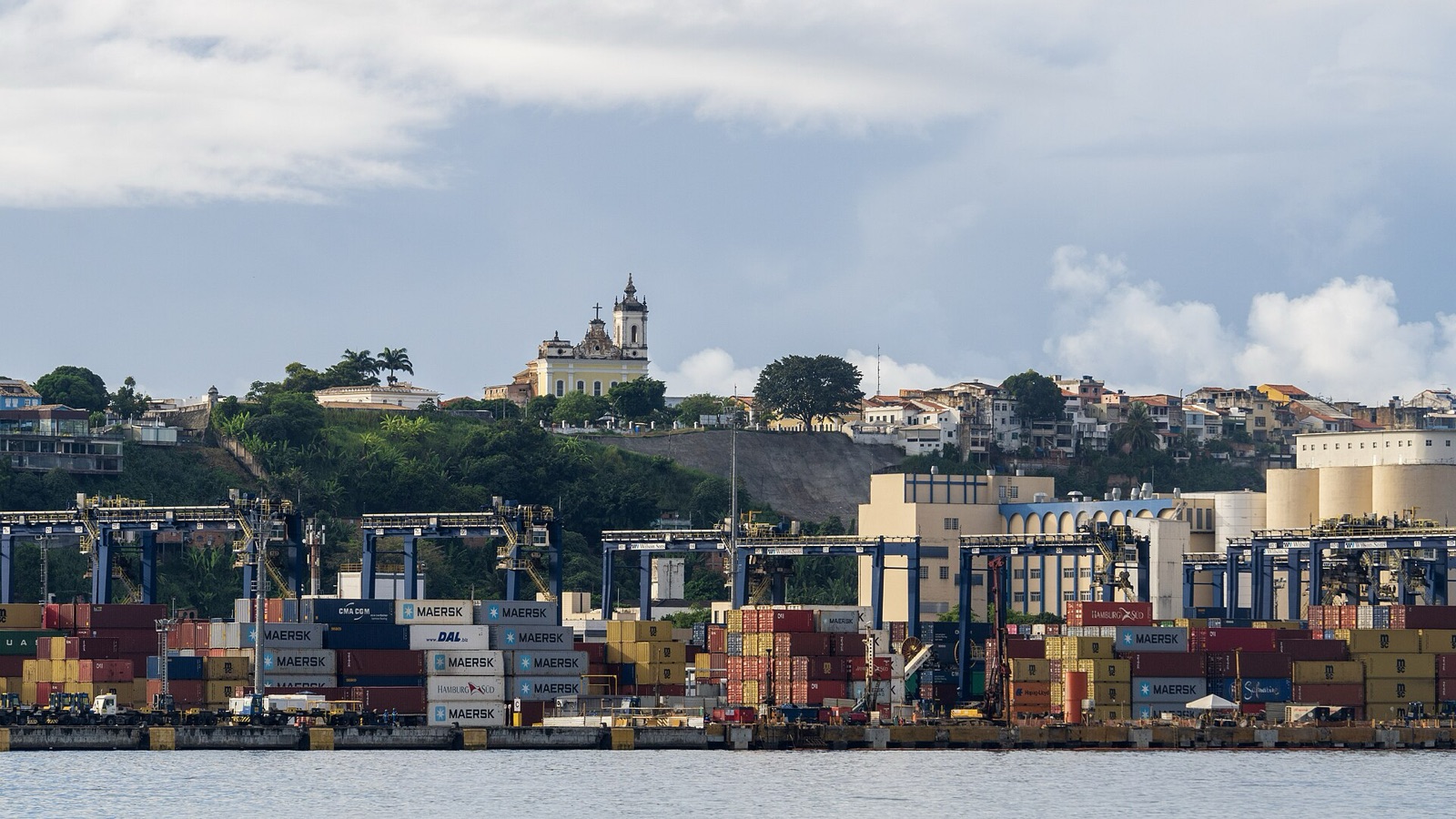
Photo: Container terminal, Port of Salvador, Brazil. Samory Pereira Santos, CC BY-SA 4.0, via Wikimedia Commons.
Ready to ship your freight?
