
On this page14
You ship to Bolivia by ocean to Arica or Iquique (Chile) and truck to inland customs, or by air to Santa Cruz (VVI) and La Paz (LPB): 15 to 25 days Miami to La Paz, clearance by the Aduana Nacional on SUMA, 0% to 40% duty and 13% IVA. Bolivia has no coastline, so every ocean shipment is two shipments: a sea leg to a port in Chile or Peru, and an overland leg across the Andes to La Paz, El Alto, Oruro, Cochabamba or Santa Cruz. Most Bolivian ocean cargo moves through Arica under the free transit rights of the 1904 Treaty, with Iquique and Antofagasta as other Chilean options and Ilo and Matarani in southern Peru as alternatives. That structure decides the bill of lading routing, the transit customs documents, the time a container spends inland (and the detention it accrues), and where Bolivian customs clears the goods. On the tax side, the 13% IVA works out higher on the import base, Bolivia is in a transition period as a new full member of Mercosur, and 2026 decrees have cut the tariff to 0% on selected goods such as consumer electronics.
Bolivia Shipping at a Glance: Transit Times and Options
Ocean freight from Miami to La Paz via Arica takes 15 to 25 days including the truck leg, air freight to Santa Cruz or La Paz 2 to 4 days, and ocean freight from China 35 to 55 days.
| Route & mode | Transit | Best for |
|---|---|---|
| Miami to Arica, ocean FCL, then truck to La Paz or El Alto | 15 to 25 days door to inland customs | full loads for the Altiplano |
| Miami to Iquique, ocean FCL, then truck to Oruro or Uyuni area | 15 to 25 days | mining and lithium projects in the southwest |
| Miami to Bolivia, ocean LCL via a Chilean port | 20 to 35 days | shipments under 12 CBM |
| Miami (MIA) to Santa Cruz (VVI) or La Paz (LPB), air | 2 to 4 days | urgent parts, electronics, pharma |
| China to Arica or Iquique, ocean FCL, then truck | 35 to 55 days | full containers from Asia |
| Europe to Arica, ocean FCL, then truck | 35 to 50 days | EU machinery |
These ranges include the inland leg, and the high end applies when border crossing queues, Altiplano weather or short truck supply slow it down. Confirm each leg with your forwarder, because the inland leg is where the step-by-step process differs from any coastal market.
How to Ship to Bolivia: Step by Step
Shipping to Bolivia follows eight steps, from HS classification to release at a Bolivian inland customs administration.
- Classify the goods and check permits. Assign the HS code under Bolivia's NANDINA-based tariff and check whether the product needs SENASAG or Ministry of Health authorization before clearance.
- Choose the gateway port for the consignee city. Use Arica for La Paz and El Alto, Iquique or Antofagasta for Oruro and the southwest, and Ilo or Matarani when the Peruvian routing is shorter.
- Choose the mode and Incoterm. Pick air under 2 CBM, LCL from 2 to 12 CBM and FCL above that, and fix the Incoterm in writing, because the tariff is assessed on the CIF value at the border.
- Book from Miami or origin with transit routing. The bill of lading shows the Chilean or Peruvian port of discharge and Bolivia as final destination, with the cargo declared in transit.
- Prepare the documents. Issue the commercial invoice, packing list, bill of lading or air waybill, insurance certificate, certificate of origin where a preference applies, and the power of attorney to the despachante de aduana.
- File the US export record. For US cargo, the exporter or forwarder files Electronic Export Information (EEI) in AES when any Schedule B line exceeds $2,500 or the goods need an export license.
- Truck under transit and declare in SUMA. The container leaves the port under a customs transit regime, crosses the border to an inland administration such as El Alto, Oruro or Santa Cruz, and the broker files the DIM in SUMA.
- Pay duties and taxes, then take delivery. The importer pays the tariff, IVA and any ICE, the Aduana Nacional releases the goods, and the empty container returns to port within its free days.
Steps 2 and 4 decide whether the cargo is treated as a Bolivian transit shipment, which starts with how US cargo is routed.
Shipping From the USA to Bolivia
Ship from the USA to Bolivia by ocean to a Chilean or Peruvian port and then by truck, or by air direct to Santa Cruz or La Paz. The standard ocean route runs from Miami (or another East Coast port) through the Panama Canal to Arica or Iquique in northern Chile, followed by truck transit to Bolivian inland customs. Miami is the practical consolidation point: Bolivian importers buy from several US suppliers, and Interworld Freight combines them into one container in Miami with one bill of lading, one transit document and one Bolivian import declaration. Our overview of shipping from Miami to Latin America covers the wider regional network.
The bill of lading must show the Chilean or Peruvian port of discharge and Bolivia as the final destination, with the cargo declared in transit, so that it is not treated as a Chilean or Peruvian import. Because the same carriers serve both markets, routing overlaps with container shipping to Chile on the sea leg, and with container shipping to Peru when Ilo or Matarani is the better gateway for southern Bolivia.
For smaller volumes, LCL shipping works, but each consolidation and deconsolidation point adds handling, so LCL to Bolivia takes longer than to a coastal market. Air freight from Miami to Viru Viru (VVI) in Santa Cruz or El Alto (LPB) is the fastest option and suits spare parts, electronics and pharmaceuticals. Asian cargo uses the same Pacific gateways.
Shipping From China and Asia to Bolivia
Cargo from China reaches Bolivia through the same Pacific ports in 35 to 55 days door to inland customs for a full container: ocean to Arica, Iquique or a Peruvian port, then overland. Some services call Arica directly; others transship in Callao, Panama or Manzanillo (Mexico), and direct transpacific services into Peru (Callao or Chancay) offer another option followed by truck through southern Peru. Santa Cruz in the eastern lowlands is much farther from the Pacific ports than La Paz, so compare the full door-to-door routing and transit for each consignee city.
Shipping From Europe to Bolivia
European machinery and consumables reach Bolivia through the same Pacific ports after transiting the Panama Canal, in 35 to 50 days including the inland leg. Plan European project cargo as you would Asian cargo: book the sea leg, the transit documentation and the truck capacity together, not one after the other. The choice of port behind that booking is the next decision.
Which Ports and Airports Handle Cargo in Bolivia?
Bolivia has no seaport of its own: its ocean cargo uses Chilean and Peruvian ports, and its international air cargo lands mainly at Santa Cruz (VVI) and El Alto (LPB). Ports used for Bolivian cargo:
- Arica (CLARI), Chile: the main port for Bolivian transit cargo, operating under the 1904 Treaty of Peace and Friendship, which grants Bolivia free transit through Chilean territory and ports. Bolivian cargo makes up a large share of the port's throughput, as our guide to shipping to Chile also notes.
- Iquique (CLIQQ), Chile: second Chilean option, next to the Iquique free trade zone (ZOFRI); convenient for Oruro and the southwest, including the Uyuni area.
- Ilo (PEILQ), Moquegua, Peru: Peruvian alternative for southern Bolivia and La Paz, described in our guide to shipping to Peru.
- Matarani (PEMRI), Arequipa, Peru: Peruvian port also used for Bolivian transit and mining inputs.
- Antofagasta (CLANF), Chile: a further Chilean port under the same transit framework, closer to the southwestern mining districts.
- Puerto Busch, Santa Cruz department, Bolivia: a river port on the Paraguay River, part of Bolivia's outlet to the Atlantic through the Paraguay-Paraná waterway, the same river system used for shipping to Paraguay.
The Administración de Servicios Portuarios Bolivia (ASP-B) is the Bolivian state entity that manages Bolivian cargo services at these ports; the ASP-B lists Arica, Antofagasta, Ilo, Matarani and Puerto Busch among its operations and offers online cargo tracking and fee calculators. Iquique handles Bolivian cargo through private terminals and the ZOFRI free zone rather than an ASP-B operation.
Airports in Bolivia:
- Viru Viru International (VVI), Santa Cruz de la Sierra: the main international cargo airport.
- El Alto International (LPB), La Paz: the high-altitude airport serving La Paz and El Alto.
- Jorge Wilstermann International (CBB), Cochabamba.
How Does Customs Clearance Work in Bolivia?
Imports into Bolivia clear through the Aduana Nacional de Bolivia (AN), which processes declarations in its web system SUMA (Sistema Único de Modernización Aduanera) with a licensed customs broker filing on the importer's behalf. SUMA replaced the earlier SIDUNEA (ASYCUDA) system administration by administration, with offices such as the Yacuiba border administration added in 2025; it uses electronic signature, digitized supporting documents and electronic notifications, and issues the import declaration (DIM, Declaración de Mercancías de Importación). The importer needs a tax ID (NIT) from the Servicio de Impuestos Nacionales (SIN), and goods are classified under Bolivia's NANDINA-based tariff schedule, the Andean Community nomenclature built on the HS code.
- Transit at the foreign port: the cargo is discharged in Arica, Iquique, Ilo or Matarani and leaves the port under a customs transit regime toward Bolivia.
- Border and inland customs: the truck crosses the border and delivers to a Bolivian customs administration (for example in El Alto, Oruro or Santa Cruz), where the cargo is stored pending clearance.
- Prior authorizations: regulated goods need their authorization before clearance (for example SENASAG for agricultural and food products, the Ministry of Health for pharmaceuticals).
- Declaration: the import is declared through a licensed customs broker (despachante de aduana), who files the DIM in SUMA. The broker is jointly liable with the importer for the dispatch.
- Payment, inspection and release: duties and taxes are paid, selected shipments are inspected, and the goods are released.
Delays at any step keep the container inland, so watch the free days in your carrier contract; see demurrage and detention explained for how these charges build up.
What Are the Import Duties and Taxes in Bolivia?
Bolivia charges an import tariff (Gravamen Arancelario, GA) of 0% to 40% on the CIF value plus 13% IVA, and ICE on selected goods. Tariff bands are 0%, 5%, 10%, 20%, 30%, 35% and 40%, with most goods between 0% and 20% and the 30% to 40% bands kept for products that compete with sensitive local production such as textiles and leather, according to the U.S. International Trade Administration's Bolivia Country Commercial Guide.
- Import tariff (GA): assessed on the CIF value at the border (CIF airport value for air cargo). Some staples, such as wheat, flour, rice, corn and vegetable oil, are at 0%. US goods pay the general rates, since Bolivia has no trade agreement with the United States, while Andean Community origin goods enter duty free with a certificate of origin.
- Temporary 0% tariffs: Decreto Supremo 5518 sets the GA at 0% from January 17 to December 31, 2026 for laptops, tablets, smartphones, printers, monitors, cameras, speakers and video game consoles, with IVA still payable at clearance, as the Aduana Nacional explains. Similar time-limited 0% decrees have covered other goods, so check for one before quoting.
- IVA (VAT): 13% statutory. Because it is charged on an accumulated base, the effective rate on import is about 14.94%. IVA paid at import is creditable against IVA on resale.
- ICE (specific consumption tax): on goods such as automobiles, perfumes, cosmetics, liquor, cigarettes and beer.
- Fees: storage, broker fees and other private charges add to the landed cost, which makes the effective cost considerably higher than the headline tariff.
Bolivia is a member of the Andean Community and became a full member of Mercosur in July 2024, after Law 1567 of July 4, 2024 ratified its accession protocol, as reported by Bolivia's Ministry of Foreign Affairs. That puts Bolivia in the same customs bloc that governs shipping to Brazil, with up to four years to adopt the Mercosur Common Nomenclature (NCM), the common external tariff and the Mercosur rules of origin. Check the current tariff for your HS code at the time of import, because the transition to the common external tariff is still open, and have the document set ready to support it.
What Documents Are Required to Ship to Bolivia?
Bolivian customs requires a commercial invoice, packing list, transport document, transit documentation and the broker's power of attorney, plus prior authorizations for regulated goods.
- Commercial invoice with value, Incoterm and full description
- Packing list with weights and dimensions
- Bill of lading (showing the Chilean or Peruvian port and Bolivia as final destination) or air waybill
- Transit documentation for the overland leg
- Certificate of origin where a preference applies
- Insurance certificate
- Prior authorizations for regulated goods (SENASAG, Ministry of Health and others)
- Power of attorney to the despachante de aduana
Restricted Goods and Import Permits in Bolivia
Bolivia prohibits used clothing and shoes (unless authorized), contaminated food, diseased plants and animals, radioactive waste, ozone-depleting substances, foreign lottery tickets and other hazardous goods, according to the ITA list of prohibited and restricted imports. Vehicle imports are barred for diesel engines, right-hand steering and models over the age limit set for each vehicle class, so check the current decree before buying any used vehicle for Bolivia.
Agricultural and food products must be registered with SENASAG (Servicio Nacional de Sanidad Agropecuaria e Inocuidad Alimentaria), which recognizes the United States as negligible risk for BSE, and pharmaceuticals need Ministry of Health and Sports registration. Arms, munitions and explosives are highly regulated. For heavy and out-of-gauge equipment, the overland leg across the Andes needs route surveys, permits and specialized trucks, and road conditions at altitude set the schedule.
LCL, FCL or Air Freight to Bolivia: Which to Choose?
For Bolivia, use air under 2 CBM or when urgent, LCL from 2 to 12 CBM, and FCL above 12 to 15 CBM.
- Under 2 CBM or urgent: air freight to VVI or LPB. On a landlocked lane, air wins at lower volumes than on coastal lanes because it removes the port and inland transit.
- 2 to 12 CBM: LCL through Miami to a Chilean port, accepting longer transit for the extra handling points.
- Above 12 to 15 CBM: FCL. A full container moves under one transit document from port to inland customs without deconsolidation, which reduces handling risk on a long trip.
- Heavy equipment: flat racks or breakbulk to Arica or Iquique, then specialized road transport, planned together.
Key Industries Shipping Freight to Bolivia
Bolivia's main imports are fuels (diesel and gasoline), machinery and equipment, vehicles and parts, chemicals, steel and consumer goods. Mining (tin, zinc, silver and gold on the Altiplano) and hydrocarbons drive demand for heavy equipment, reagents and spare parts, while agro-industry in Santa Cruz imports farm machinery, inputs and packaging.
Lithium is the emerging story. Bolivia holds about 23 million tons of identified lithium resources, among the largest in the world according to the USGS Mineral Commodity Summaries 2026, mostly in the Salar de Uyuni in Potosí, with additional resources in the Coipasa and Pastos Grandes salt flats. The state company Yacimientos de Litio Bolivianos (YLB), created by Law 928 of April 2017, leads development, and projects need evaporation, extraction and processing equipment delivered to remote sites at high altitude. Our follow-up guide covers how to ship lithium mining equipment to Bolivia through Arica, Iquique and the Peruvian ports.
Choosing a Freight Forwarder for Bolivia
Choose a forwarder for Bolivia that coordinates the sea leg, the transit regime and the inland truck as one move, because a Bolivian shipment succeeds or fails on that coordination. The forwarder's job is to route the bill of lading correctly for transit, pick the port that fits the consignee city, book truck capacity in time, and keep container free days under control while Bolivian customs clears the goods. Interworld Freight was founded in Miami in 1992 and runs ocean FCL and LCL, air freight and customs coordination from its Miami hub with warehousing, with coverage on every major trade lane, including the Pacific ports that serve Bolivia. Quote requests are answered within one business day.
Frequently Asked Questions
How do you ship a container to Bolivia if it has no seaport?
Containers are shipped to a port in Chile (Arica or Iquique are the main ones) or Peru (Ilo or Matarani), then moved by truck under a customs transit regime to Bolivian inland customs. The bill of lading must show Bolivia as the final destination.
Why is Arica the main port for Bolivian cargo?
The 1904 Treaty of Peace and Friendship between Bolivia and Chile grants Bolivia free transit through Chilean territory and ports in perpetuity. Arica is also the closest Chilean port to La Paz.
How long does shipping from Miami to Bolivia take?
Including the inland leg, ocean freight from Miami to La Paz or El Alto via Arica takes 15 to 25 days for a full container, and 20 to 35 days for LCL. Air freight to Santa Cruz or La Paz takes 2 to 4 days.
What taxes apply to imports into Bolivia?
Tariffs range from 0% to 40% by product, with most goods between 0% and 20%, and electronic devices are at 0% through December 31, 2026. IVA is 13% statutory, about 14.94% effective because of how the base is built, and ICE applies to specific goods such as vehicles and alcohol.
What customs system does Bolivia use?
The Aduana Nacional processes import declarations in SUMA, which replaced SIDUNEA. A licensed despachante de aduana files the declaration (DIM) on the importer's behalf.
How much does it cost to ship freight to Bolivia?
Cost depends on volume, the gateway port and the inland truck leg, which adds a significant share on top of the ocean freight. Interworld Freight has no published LCL rate for Bolivia, so request a quote that covers ocean freight to Arica or Iquique, port and transit charges and the truck to your city. Budget separately for the tariff, IVA, broker fees and storage at inland customs.
Does Mercosur membership change Bolivian tariffs?
Yes, over a transition: Bolivia became a full Mercosur member in July 2024 and has up to four years to adopt the common nomenclature, the common external tariff and the rules of origin. Confirm the tariff for your HS code before quoting a landed cost, because the transition is still open.
Can I import used vehicles into Bolivia?
Used vehicles face restrictions on engine type, steering position and age, with limits that vary by vehicle type. Confirm the current rules with your customs broker before purchase.
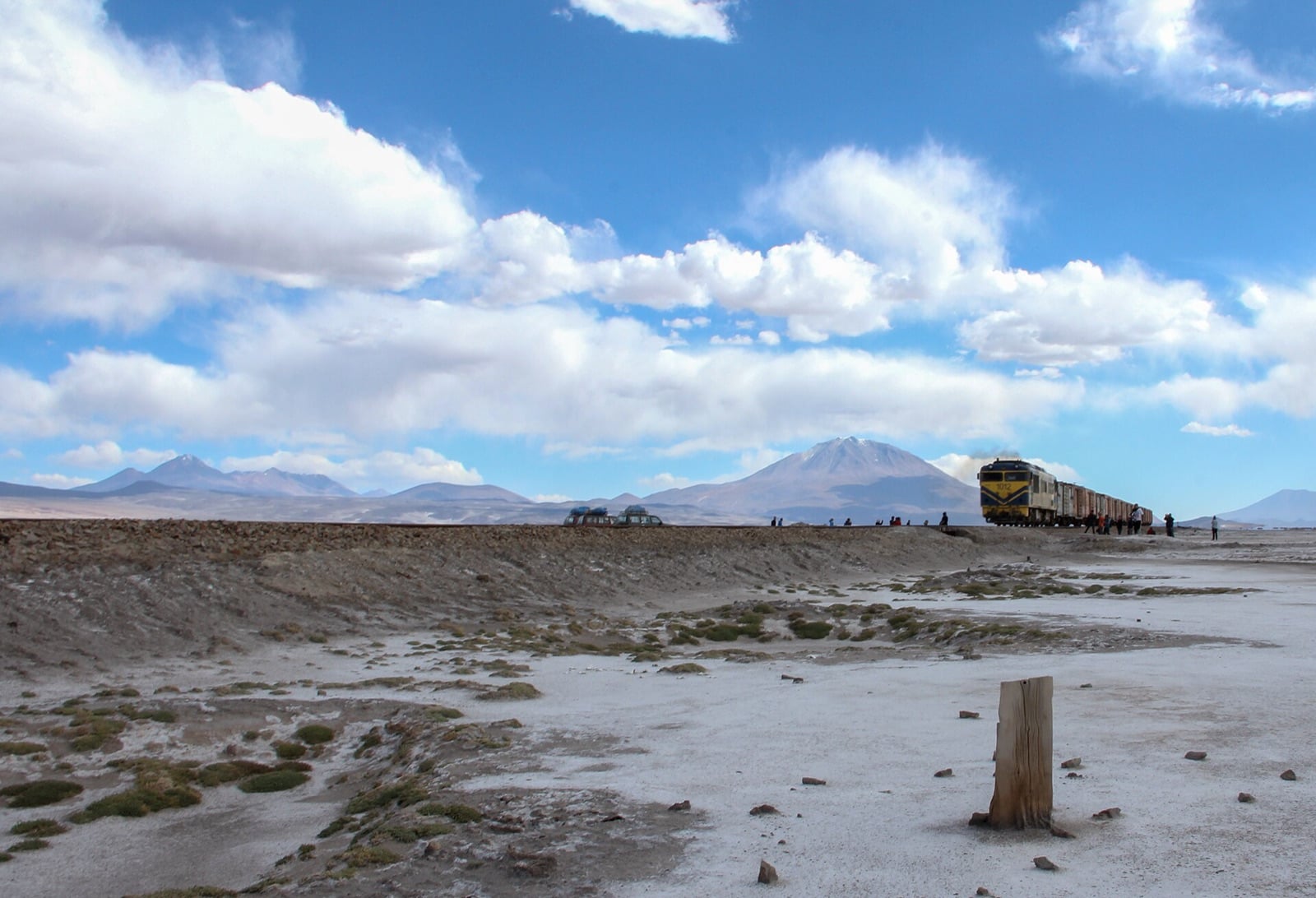
Photo: Freight rail on the Bolivian Altiplano. Bob Ramsak, CC BY 3.0, via Wikimedia Commons.
Ready to ship your freight?
