
On this page13
Ship to Nicaragua by ocean FCL or LCL into Corinto (or via Puerto Cortés, Honduras, plus trucking) or by air into Managua (MGA): 10 to 20 days by sea from Miami, 1 to 3 days by air, DGA clearance on SIDUNEA World, and 15% IVA plus duty.
Nicaragua is a Pacific-facing market with an Atlantic-facing supply chain. Its main container port, Corinto, sits on the Pacific coast, while most US and European cargo starts on the Atlantic side, so every Nicaragua shipment involves a routing decision: a Pacific service into Corinto, or an Atlantic port in a neighboring country followed by a truck leg across the border into Managua. CAFTA-DR gives US-origin industrial and consumer goods duty-free entry, yet clearance is where Nicaragua shipments lose time: the Dirección General de Servicios Aduaneros (DGA) assesses value and classification closely, a licensed broker is mandatory, and since April 2026 every import must carry a written forced labor declaration. Shippers who plan the routing and paperwork before the cargo moves get predictable results; shippers who do not pay for it in storage.
Nicaragua Shipping at a Glance: Transit Times and Options
Ocean freight from Miami reaches Nicaragua in 10 to 20 days (12 to 20 for FCL, 10 to 20 for consolidated LCL), air freight to Managua takes 1 to 3 days, and Asian cargo needs 30 to 45 days.
| Route & mode | Transit | Best for |
|---|---|---|
| Miami to Nicaragua, ocean LCL (consolidated) | 10-20 days, depending on routing and consolidation cut-off | mixed pallets, distributor restocks under 15 CBM |
| Miami / US East Coast to Nicaragua, ocean FCL | 7-15 days, via Corinto or an Atlantic port plus trucking | full loads, equipment, building materials |
| Miami to Managua (MGA), air freight | 1-3 days | spare parts, urgent, high-value cargo |
| China / Asia to Corinto, ocean FCL | 30-45 days, with one transshipment on most services | factory orders, machinery, consumer goods |
| Europe to Nicaragua, ocean FCL | 25-40 days, via a Caribbean or Central American hub | industrial inputs, food products, machinery |
Transit times are indicative and depend on carrier schedules, transshipment connections and border crossing times. Nicaragua is not part of the IWF published LCL rate table, so request a quote for current pricing. The ranges above only hold when the process behind them runs in the right order, which is the next point.
How to Ship to Nicaragua: Step by Step
Shipping to Nicaragua follows eight steps, from HS classification at origin to release in Corinto or Managua.
- Classify the goods and check permits. Assign the HS code under the Central American Tariff System (SAC) and confirm whether IPSA, MINSA, TELCOR or another agency must issue a permit through VUCEN before shipping.
- Confirm the importer's registration. The consignee needs a DGI tax number (RUC) registered with the DGA, and US exporters screen the buyer, consignee and bank against OFAC lists.
- Choose mode, routing and Incoterm. Decide between LCL, FCL or air, and between a Pacific service into Corinto or an Atlantic port such as Puerto Cortés with a truck leg into Nicaragua.
- Book from Miami or origin. Deliver to the Miami warehouse for consolidation or load a full container at origin before the carrier cut-off.
- Prepare the document set. Original commercial invoice with the declaration of invoice authenticity, packing list, bill of lading or air waybill, CAFTA-DR origin certification and the Law No. 1280 forced labor declaration.
- File the US export. Shipments over $2,500 per Schedule B line, or any licensed cargo, need EEI filed in AES before departure.
- Clear customs on SIDUNEA World. The licensed broker files the declaration with the DGA, and selectivity decides between direct release, document review or physical inspection.
- Pay duties and taxes, then deliver. DAI, 15% IVA and any ISC are paid electronically before release, and the cargo moves to the consignee by truck.
Shipping From the USA to Nicaragua
Miami is the gateway for US cargo heading to Nicaragua: suppliers across the Southeast and the Midwest deliver into Miami warehouses, cargo is consolidated or loaded into full containers, and it moves south on regular Central America services. Two routings dominate. The first is an ocean service to Corinto on the Pacific coast, the port operated by the Empresa Portuaria Nacional (EPN) and linked to Managua by highway. The second is an Atlantic routing into Puerto Cortés in Honduras, the same port that anchors shipping to Honduras, with the container trucked overland into Nicaragua under a customs transit regime. The faster option depends on the sailing schedule in a given week and the final destination inside the country.
For shippers who do not fill a container, LCL consolidation out of Miami is the default tool. You pay by the cubic meter, your pallets share a container with other cargo bound for Central America, and the box is deconsolidated at destination. If you are new to the mechanics, how LCL container shipping works explains the CFS cut-offs and why consolidation transit is longer than a direct FCL booking. Full loads move as container shipping to Nicaragua in 20ft or 40ft equipment, with 40ft high cubes the standard choice for light, bulky goods.
Air freight from Miami International (MIA) lands at Augusto C. Sandino International in Managua (MGA) in one to three days. It suits repair parts for agricultural and industrial equipment, pharmaceuticals with valid registrations, electronics and any shipment where a week of downtime costs more than the freight. The rule of thumb on this lane: if the cargo is under 300 kg and urgent, fly it; if it is over 2 CBM and can wait two weeks, consolidate it by sea. Cargo bought outside the US follows a different path into the same ports.
Shipping From China, Asia and Europe to Nicaragua
Asian cargo reaches Nicaragua on transpacific services that call the Pacific coast of Central America, with a transshipment at a regional hub before the final leg into Corinto on most rotations. Full containers take 30 to 45 days port to port, and LCL takes longer, because consolidated cargo waits for both the origin consolidation and the transshipment connection. An alternative that works well for mixed-origin buyers is routing Asian goods into Miami, combining them with US-sourced products in one consolidated shipment, and sending a single container south. That trades a few days of transit for one customs entry and one delivery.
European cargo arrives through Caribbean or Central American transshipment hubs on the Atlantic side, then continues by feeder or by truck into Nicaragua, in 25 to 40 days depending on the origin port and the hub. The same Miami consolidation logic applies when the importer is also buying in the US: one consolidated flow out of Miami is simpler to clear than two separate entries arriving weeks apart. Whichever origin you ship from, the cargo ends at one of a handful of Nicaraguan gateways.
Which Ports and Airports Handle Cargo in Nicaragua?
Corinto on the Pacific coast is Nicaragua's main container port, and Augusto C. Sandino International (MGA) in Managua is its main air cargo gateway.
- Port of Corinto (NICIO), Chinandega department, Pacific coast: Nicaragua's largest port and its main container gateway, handling containers, liquid and dry bulk and general cargo. Operated by the Empresa Portuaria Nacional (EPN) and linked to Managua by highway.
- Puerto Sandino (Pacific coast) and Puerto Cabezas (Caribbean coast): smaller ports in the EPN system, relevant for specific bulk and regional cargo rather than mainstream container imports.
- Atlantic gateways in neighboring countries: a share of Nicaraguan imports moves through Puerto Cortés (Honduras) and continues by truck under a customs transit regime.
- Augusto C. Sandino International Airport (MGA), Managua: the country's main air cargo gateway.
How Does Customs Clearance Work in Nicaragua?
Nicaraguan imports clear through the Dirección General de Servicios Aduaneros (DGA) via a licensed customs broker, who files on SIDUNEA World, according to the U.S. Commercial Service guide to Nicaraguan customs regulations. Nicaragua applies the Central American Uniform Customs Code (CAUCA) and its regulations, which require electronic transmission of customs information and electronic prepayment of duties and taxes; SIDUNEA World is the ASYCUDA World platform.
- Broker requirement: the licensed broker files the declaration on SIDUNEA World and responds to valuation and classification queries.
- Tax registration: the importer must register as a taxpayer with the Dirección General de Ingresos (DGI), obtain a tax identification number (RUC), register it with the DGA and stay current on its monthly tax obligations.
- Single window: permits and prior authorizations from regulatory agencies are processed through VUCEN, the foreign trade single window run by the Centro de Trámites de las Exportaciones (CETREX).
- Declaration and risk selection: the declaration is filed electronically, and a selectivity mechanism determines whether the shipment is released directly, reviewed on documents or physically inspected.
- Valuation and classification: the DGA scrutinizes declared values and tariff classifications. US commercial guidance reports that officials apply reference prices, so invoices must be complete and consistent with the packing list and payment records.
- Forced labor declaration: under Law No. 1280 (April 9, 2026) and DGA Circular CT/27/2026, foreign trade operators must attach a written statement that the imported goods were not produced, wholly or partially, with forced labor. It applies to imports and to goods admitted under free zone and temporary admission regimes.
- Payment and release: duty, IVA and any selective consumption tax are paid before the goods are released.
- Party screening: Nicaragua is not under a comprehensive US embargo, but the Treasury Department's Nicaragua-related sanctions program blocks designated persons and entities, so US exporters screen the buyer, consignee and bank before shipping.
A clean Nicaraguan entry starts before departure: the invoice, packing list, bill of lading and certificate of origin are reviewed together so the broker files once, not twice. What the broker files determines what the importer pays.
What Are the Import Duties and Taxes in Nicaragua?
US-origin consumer and industrial goods enter Nicaragua duty free under CAFTA-DR, but every import still pays 15% IVA unless the product is on an exempt list. Four layers build the landed cost:
- Import duty (DAI) under the Central American tariff: Nicaragua applies the Central American Tariff System (SAC) of the Central American Common Market, with about 95% of tariff lines harmonized at 15% or lower. Rates are set by HS code, and temporary decrees, most recently extended in June 2025, apply a reduced 5% rate to many basic foodstuffs and consumer goods.
- CAFTA-DR preferences: 100% of US consumer and industrial goods and more than half of US agricultural products enter duty free, according to the Nicaragua import tariffs chapter of the Country Commercial Guide. Tariff-rate quotas remain on white corn and on onions and shallots, and dairy tariffs were eliminated on January 1, 2025. Preference requires a valid origin certification.
- IVA at 15%: under Law No. 822 (Ley de Concertación Tributaria), IVA applies to imports at 15%, calculated on the customs value plus duties. Goods whose domestic sale is exempt under Article 127 are also exempt on import, and the Ministry of Finance publishes the exempt lists by tariff classification.
- Selective consumption tax (ISC): applies to non-essential goods such as alcohol, tobacco and sugary drinks, on the CIF value for imports.
For goods from outside CAFTA-DR, such as Chinese or European products, the DAI applies at the full Central American rate for the HS code, so classification is the single largest cost lever. The same CAFTA-DR rules govern shipping to El Salvador and the rest of the bloc, but each country sets its own VAT rate. Claiming any of these preferences depends on the document set.
What Documents Are Required to Ship to Nicaragua?
A Nicaraguan import needs an original commercial invoice with a declaration of invoice authenticity, a packing list, the transport document, the forced labor declaration and, to claim CAFTA-DR, a certificate of origin.
- Commercial invoice (original), with a declaration of invoice authenticity
- Packing list
- Bill of lading (ocean) or air waybill (air)
- Certificate of origin or CAFTA-DR origin certification when claiming preferential duty
- Importer's tax registration (DGI) details
- Forced labor declaration under Law No. 1280
- Permits from the competent Nicaraguan authority when the commodity requires them, listed in the Nicaragua import requirements and documentation guide
The commercial invoice requirements are where most Nicaraguan holds originate: value, Incoterm, HS description and origin must match across every document. Regulated products add a permit layer on top of this base set.
Restricted Goods and Import Permits in Nicaragua
Nicaragua restricts rather than bans most commercial goods: food, agricultural inputs, medicines, cosmetics, telecom equipment, firearms and pressurized gas need a permit or registration from the competent agency, processed through VUCEN, before the cargo ships.
- Agricultural and animal products: the Instituto de Protección y Sanidad Agropecuaria (IPSA) inspects agricultural products at entry points and registers animal feed, agrochemicals and seeds. Plan for phytosanitary or zoosanitary certificates from origin.
- Food, beverages, medicines and cosmetics: the Ministry of Health (MINSA) registers most processed foods and issues import permits, and its pharmaceutical office handles medicines, cosmetics and hygiene products. Sanitary registration must be in place before the goods ship.
- Telecommunications equipment: requires a permit from TELCOR, the telecommunications regulator.
- Firearms, ammunition and explosives: import permits are issued by the National Police firearms office; cylinders for liquefied or compressed gases need a permit from the Fire Department.
- Wood packaging: use ISPM 15 treated and marked pallets and crates, the international standard for wood packaging, to avoid problems at agricultural inspection.
LCL, FCL or Air Freight to Nicaragua: Which to Choose?
LCL is the right mode for Nicaragua shipments between 2 and 15 CBM, FCL wins above 15 CBM, and air suits urgent cargo under 300 kg.
- Under 2 CBM: air freight is competitive for urgent cargo, and LCL is the economical choice when the timeline allows.
- 2 to 15 CBM: LCL consolidation out of Miami. This is where most distributor restocks and mixed-supplier orders sit.
- 15 CBM and up: price a 20ft FCL. Once volume passes 15 to 18 CBM, a dedicated container costs less per unit than LCL and avoids deconsolidation handling at destination.
- Over 30 CBM or heavy machinery: a 40ft or 40ft high cube, or flat rack and open top equipment for out-of-gauge machinery.
Buyers comparing Central American markets will find the same thresholds in shipping to Costa Rica, Nicaragua's southern neighbor across the Peñas Blancas land border. The mix of cargo on this lane explains why those thresholds matter.
Key Industries Shipping Freight to Nicaragua
Agriculture and agroindustry drive the largest share of Nicaragua's freight. Coffee, beef, sugar, peanuts and dairy move out, and the inputs to produce them move in: tractors, implements, irrigation equipment, fertilizers, agrochemicals, seeds and packaging. Much of this inbound flow is seasonal and tied to planting cycles, so missed delivery windows carry a real cost for the buyer.
Construction materials, vehicles and parts, consumer goods for retail distribution, and textiles for the apparel free zones complete the picture. Free zone manufacturers import fabric and trims and export finished apparel, which keeps a steady flow of containers moving in both directions. The agricultural side has its own logistics rules on permits, equipment types and timing, which we cover in detail in our guide to shipping agricultural machinery and inputs to Nicaragua.
Choosing a Freight Forwarder for Nicaragua
On the Nicaragua lane, a forwarder earns its fee in three places: picking the right routing for each shipment, consolidating smaller orders into reliable departures, and getting the documents right before the DGA sees them. Interworld Freight has run freight out of Miami since 1992, with a Miami warehouse for receiving and consolidation, ocean FCL and LCL, air freight and customs coordination with licensed brokers at destination. For shippers working across the region, our overview of shipping from Miami to Latin America shows how the same hub feeds every Central American market. Urgent shipments move as air freight into Managua. Quotes are answered within one business day.
Frequently Asked Questions
How long does shipping to Nicaragua take?
Ocean freight from Miami takes 12 to 20 days for a full container and up to 20 days for consolidated LCL, depending on whether the cargo routes via Corinto or an Atlantic port with trucking. Air freight to Managua arrives in one to three days. From China, allow 30 to 45 days for a full container.
Which port should I use for Nicaragua?
Corinto on the Pacific coast is the main container port and the closest to Managua by highway. Some cargo from the US East Coast and Europe arrives through Puerto Cortés in Honduras and is trucked into Nicaragua, which is faster in weeks when the Atlantic schedule fits better.
Do US goods pay import duty in Nicaragua?
No: under CAFTA-DR, US-origin consumer and industrial goods enter duty free, as do more than half of US agricultural products, provided origin is properly certified. IVA at 15% (Law No. 822, the Tax Conciliation Law) still applies on the customs value plus duties unless the goods are on an exempt list.
How much does it cost to ship to Nicaragua?
The cost depends on volume, routing and season: LCL from Miami is priced per cubic meter, FCL per container, and air per chargeable kilogram. The landed cost then adds 15% IVA, any DAI for non-CAFTA-DR goods, broker fees and inland trucking. Request a quote with dimensions, weight and HS codes for a firm figure.
Is Nicaragua under US sanctions?
Nicaragua is not under a comprehensive US embargo. OFAC's Nicaragua-related sanctions block specific designated persons and entities, so commercial trade is possible, but every buyer, consignee and bank should be screened against the SDN List before shipping.
Do I need a customs broker in Nicaragua?
Yes. Importers must use a licensed customs broker, who files the declaration with the DGA on its electronic system and handles valuation and classification queries.
What is the forced labor declaration for Nicaraguan imports?
It is a written statement, mandatory since April 9, 2026 under Law No. 1280 and DGA Circular CT/27/2026, certifying that the imported goods were not produced with forced labor. Customs can request supporting supply chain information.
Should I ship LCL or FCL to Nicaragua?
LCL is the better choice for shipments between 2 and 15 CBM. Above 15 to 18 CBM, a 20ft container becomes more economical and reduces handling.
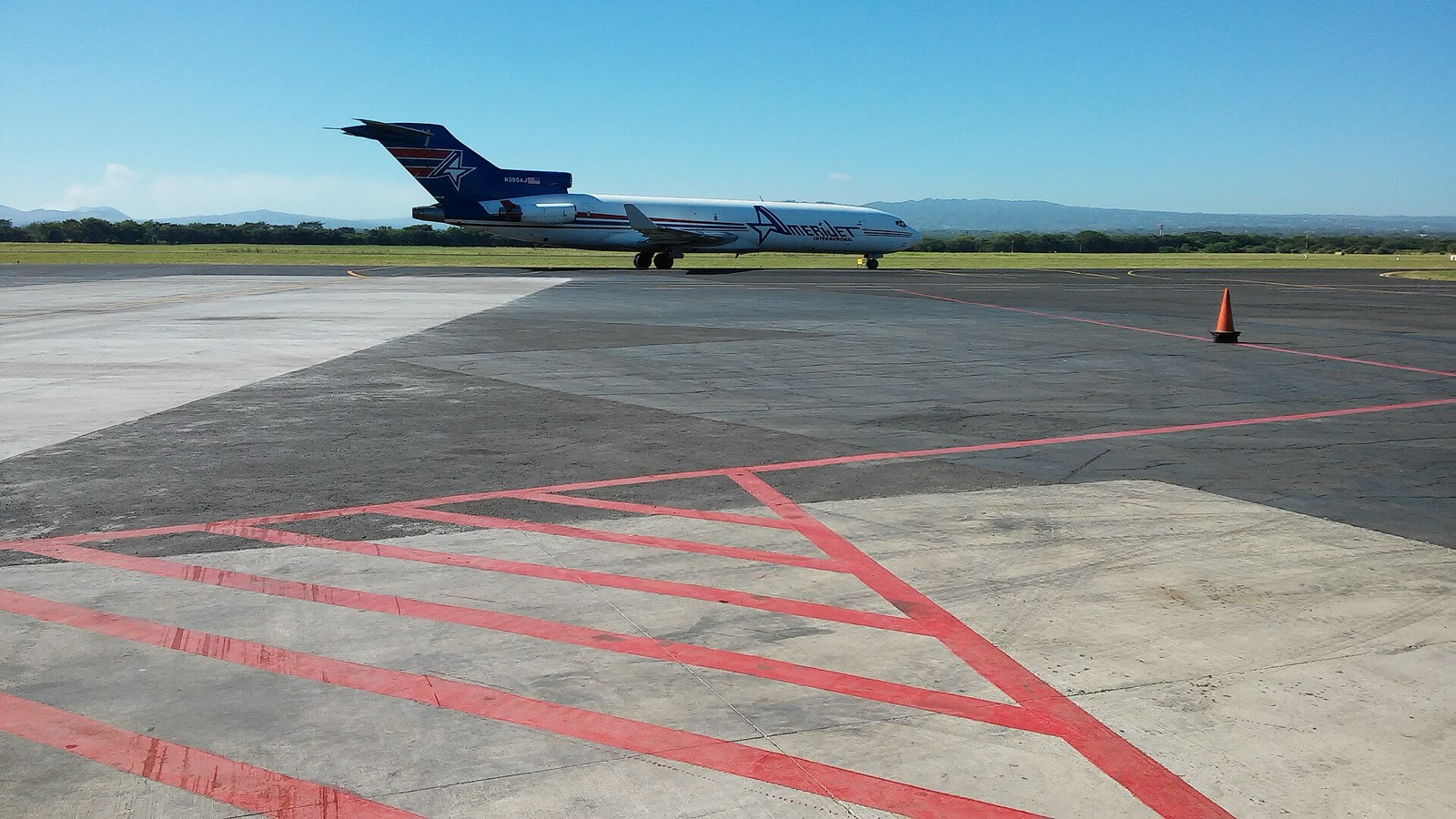
Photo: Cargo freighter at Managua airport, Nicaragua. Eveliojose10, CC BY-SA 4.0, via Wikimedia Commons.
Ready to ship your freight?
